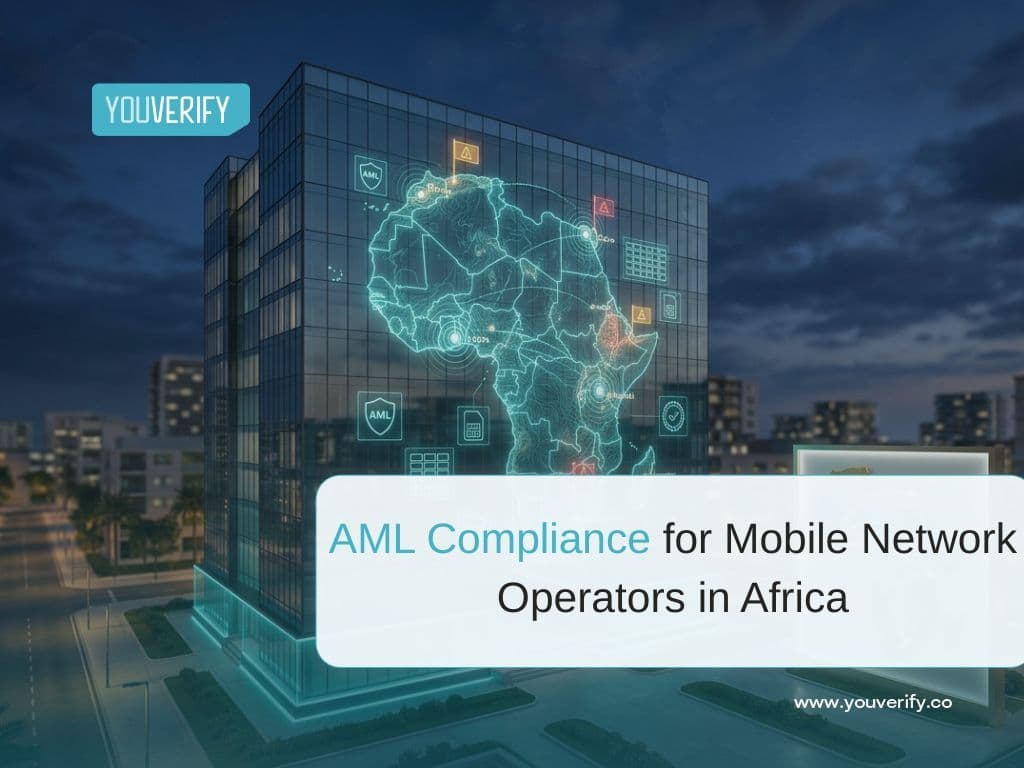
Mobile network operators (MNOs) providing mobile money services in Africa now face direct AML compliance obligations under evolving regional regulations. In Nigeria, Kenya, and the UEMOA region, regulators increasingly require MNOs to deploy automated AML systems, strengthen KYC/AML controls, and improve transaction monitoring capabilities.
In 2026, regulators now expect real-time monitoring, risk-based customer due diligence, suspicious transaction reporting (STR), and stronger operational controls across agent networks and digital wallets.
As mobile money adoption expands across Africa, regulators are tightening AML regulations to reduce money laundering, fraud, terrorism financing, and cross-border illicit flows.
Related read: AML Compliance for Neobanks and Digital Banks in Africa
Why AML Compliance Matters for Mobile Money Operators
Mobile money has transformed financial inclusion across Africa. Services such as M-Pesa, MTN MoMo, Airtel Money, and PSBs in Nigeria process millions of transactions daily.
However, this rapid growth also creates serious financial crime exposure.
The accessibility and speed of mobile wallets make them attractive for structuring, layering, mule account activity, and terrorist financing schemes. Historically lighter-touch onboarding processes have also increased AML/CFT compliance risks for operators.
As a result, regulators across Africa now require stronger KYC/AML frameworks, continuous monitoring, and automated AML systems capable of detecting suspicious activity in real time.
Nigeria: CBN AML Regulations for Mobile Money Operators
In Nigeria, MNOs operate mobile money services through Payment Service Banks (PSBs). These PSBs are regulated as Other Financial Institutions under the CBN framework and must comply fully with Nigerian AML laws.
The CBN’s March 2026 circular on automated AML baseline standards introduced stricter AML requirements for PSBs.
Under these AML regulations, operators must:
- Deploy automated transaction monitoring systems
- Detect suspicious activity in real time
- File STRs with the NFIU through GoAML
- Monitor agent cash-in and cash-out activity
- Submit implementation roadmaps to the CBN
- PSBs classified as OFIs must achieve full automated AML compliance by March 2028.
INTERESTING READ: Transaction Monitoring for Mobile Money Operators in Nigeria
Tiered KYC and AML Controls in Nigeria
The CBN’s tiered onboarding structure forms a key part of Nigerian KYC/AML controls.
Lower-tier wallets have reduced limits and simplified onboarding requirements, while higher-tier accounts require stronger identity verification, address verification, and enhanced due diligence.
This framework helps PSBs align AML compliance controls with customer risk levels.
Real-time limit monitoring is also critical because regulators expect operators to detect structuring attempts designed to avoid reporting thresholds.
BCEAO AML Regulations for Mobile Money Operators in UEMOA
The BCEAO regulates mobile money operators across eight UEMOA countries including Senegal, Côte d’Ivoire, Togo, Benin, and Mali.
Under updated BCEAO guidance issued in 2025, all Electronic Money Institutions (EMIs) must strengthen AML/CFT compliance programmes.
The updated framework requires operators to implement:
- -Risk-based CDD procedures
- Continuous transaction monitoring
- Beneficial ownership verification for business wallets
- Ongoing suspicious activity reporting to CENTIF
Cross-border mobile money transfers within the UEMOA interoperability framework are now a major focus area under BCEAO AML regulations.
Operators must monitor high-frequency wallet transfers, cross-border transaction spikes, and transaction behaviour inconsistent with a customer’s economic profile.
Related read: AML Compliance for Payment Service Providers in Africa
Kenya: CBK AML Compliance Requirements for Mobile Money Operators
In Kenya, mobile money operators fall under the oversight of the Central Bank of Kenya (CBK) and the Proceeds of Crime and Anti-Money Laundering Act (POCAMLA).
The CBK requires PSPs such as M-Pesa and Airtel Money to maintain strong AML compliance controls and implement automated AML systems.
Under CBK guidelines, operators must:
- Apply tiered KYC controls
- Conduct real-time transaction monitoring
- File suspicious activity reports with the FRC
- Monitor agent networks continuously
- Review high-risk wallet activity
Kenya’s mobile money ecosystem processes extremely high transaction volumes. This creates increased exposure to structuring, mule activity, Paybill abuse, and SIM swap-enabled fraud.
Key AML Compliance Requirements for African MNOs
Regardless of jurisdiction, mobile money operators across Africa are expected to maintain strong AML/CFT compliance programmes.
A compliant framework should include a documented enterprise-wide risk assessment tailored specifically to mobile money services. Operators must also apply customer risk rating methodologies that classify wallet users based on transaction behaviour, geography, onboarding level, and financial activity.
Effective AML systems should support:
- Real-time transaction monitoring
- Agent network monitoring
- Structuring detection
- Cross-border transaction analysis
- STR escalation workflows
- Automated audit trails
Strong staff training programmes are equally important because compliance teams, onboarding staff, and agent managers all play a role in maintaining AML compliance.
Mobile Money AML Typologies African Operators Must Detect
Mobile money creates unique money laundering risks that traditional banking controls are not always designed to detect. Some of the most common typologies include agent cash-out structuring, mule account activity, Paybill abuse, and cross-border layering.
SIM swap fraud combined with immediate wallet draining has also become a growing threat in East and West Africa. Modern AML systems increasingly rely on AI, behavioural monitoring, and relationship mapping to identify suspicious patterns linked to these typologies.
Read Also: Anti-Money Laundering Compliance Program Guide
Technology Requirements for Mobile Money AML Compliance
Manual monitoring is no longer sufficient for large-scale mobile money ecosystems. Therefore, modern AML systems for MNOs must support high-volume transaction processing, API-based integrations, configurable rules, and automated reporting workflows.
Real-time transaction monitoring is especially important because suspicious activity often happens within minutes across wallets, agents, and payment corridors.
Automated reporting tools also help operators meet local AML laws governing STR and CTR filing obligations.
How Youverify Supports AML Compliance for Mobile Money Operators in Africa
Youverify cowork provides an AI-powered platform that can help MNOs strengthen AML compliance, automate KYC/AML workflows, and improve transaction monitoring across multiple African jurisdictions.
With Youverify, operators can verify customer identities in real time, monitor transactions continuously, detect suspicious wallet activity, and automate regulatory reporting workflows. The platform also supports agent monitoring, sanctions screening, adverse media checks, and intelligent risk scoring to strengthen overall AML/CFT compliance.
Youverify’s scalable AML systems are designed to support high-volume mobile money ecosystems while reducing false positives and operational burden.
Book a free demo today and see how Youverify helps African MNOs automate AML compliance and transaction monitoring at scale.