KYB Compliance Nigeria: CAC Verification and AML Due Dilige… | YouVerify
Know Your Business (KYB)
KYB Compliance Nigeria: CAC Verification and AML Due Diligence Full Guide
ByTemitope Lawal
•5mins Read
Key Takeaways
KYB compliance Nigeria is mandatory for banks, fintechs, payment service providers, and B2B companies under the MLPPA 2022 and CBN regulations.
CAC verification confirms a business is legally registered but does not constitute full KYB due diligence on its own.
Full KYB requires UBO identification, PEP screening, sanctions checks, and adverse media review.
The CBN issued Circular BSD/DIR/PUB/LAB/019/002 on March 10, 2026, mandating automated AML solutions for all regulated institutions. Implementation roadmaps were due to the CBN by June 10, 2026.
Deposit Money Banks (DMBs) must achieve full automated AML compliance by September 10, 2027. Other Financial Institutions have until March 10, 2028.
Manual KYB processes no longer satisfy Nigeria's regulatory baseline.
Know Your Business (KYB) compliance in Nigeria is the process of verifying a business entity's legal registration, ownership structure, and AML risk profile before establishing a commercial or financial relationship. It is mandated by the Central Bank of Nigeria (CBN), the Nigerian Financial Intelligence Unit (NFIU), and the Money Laundering (Prohibition) Prevention Act 2022 (MLPPA) for all regulated financial institutions and B2B platforms operating in the country.
Checking a company's CAC registration number is just the beginning. Full KYB compliance in Nigeria requires Ultimate Beneficial Owner (UBO) identification, Politically Exposed Persons (PEP) screening, sanctions list checks, adverse media review, and ongoing transaction monitoring. As of March 2026, all of this must be performed using automated solutions that meet the CBN's newly issued Baseline Standards.
This guide walks compliance officers and MLROs through the complete KYB process for Nigerian businesses, including what the CAC verification covers, where it stops, and what AML due diligence steps must follow.
What Is KYB and Why Does It Matter for Nigerian Businesses?
Know Your Business (KYB) is a regulatory due diligence framework that requires organisations to verify the legal identity, ownership structure, and financial crime risk of any business entity they onboard or transact with. It is the business-to-business equivalent of Know Your Customer (KYC) for individuals.
For Nigerian compliance professionals, KYB is not optional. The Money Laundering (Prohibition) Prevention Act 2022 and the CBN's AML/CFT Regulations require all financial institutions, payment companies, and regulated entities to perform structured business verification before entering any commercial relationship. Failure to comply exposes institutions to administrative sanctions, financial penalties, licence revocations, and reputational damage.
Nigeria's financial system processed over $2 trillion in digital transactions in 2024, according to the NFIU's annual report. This volume creates significant exposure to shell companies, layering schemes, and beneficial ownership concealment. KYB compliance is the primary control mechanism that regulated institutions use to close these exposure gaps.
What are the Regulatory Bodies Governing KYB Compliance for Businesses in Nigeria?
The regulatory bodies governing KYB compliance in Nigeria are the CBN AML Baseline Standards, The Money Laundering (Prohibition) Prevention Act 2022, the NFIU and FATF.
Understanding the regulations that control KYB compliance in Nigeria is important for building a defensible compliance programme.
1. The CBN AML Baseline Standards 2026 (Circular BSD/DIR/PUB/LAB/019/002)
On March 10, 2026, the Central Bank of Nigeria issued Circular BSD/DIR/PUB/LAB/019/002, titled "Issuance of Baseline Standards for Automated Anti-Money Laundering Solution for Financial Institutions in Nigeria." This is the most significant AML regulatory development for Nigerian institutions since the MLPPA 2022.
The circular applies to all banks, fintechs, mobile money operators, International Money Transfer Operators (IMTOs), and payment service providers under CBN regulation. Key provisions directly relevant to KYB compliance include:
Mandatory automation: AML solutions must now cover end-to-end Customer Due Diligence (CDD), including full KYB workflows integrated with BVN and NIN databases.
Real-time screening: Sanctions, PEP, and adverse media checks must be performed in real time or near real time, not periodically.
KYB-AML integration: The CBN has explicitly stated that "AML Solutions without effective linkage to CDD/KYC/KYB information and customer risk assessments will not be regarded as compliant."
Audit trails: Every KYB decision must generate a tamper-proof, timestamped audit trail accessible to CBN examiners.
The implementation deadlines are:
Implementation roadmaps submitted to the CBN: June 10, 2026
Deposit Money Banks (DMBs) full compliance: September 10, 2027
Other Financial Institutions full compliance: March 10, 2028
2. The Money Laundering (Prohibition) Prevention Act 2022
The MLPPA 2022 replaced Nigeria's prior AML legislation and broadened the scope of compliance obligations. For KYB purposes, the Act requires:
Customer Due Diligence on all business entities at onboarding.
Enhanced Due Diligence (EDD) for high-risk business relationships, including Politically Exposed Persons and entities from high-risk jurisdictions.
Continuous monitoring of business relationships throughout their lifecycle.
Suspicious Transaction Reports (STRs) filed with the NFIU where red flags are identified.
3. NFIU Guidelines and Nigeria's FATF Alignment
The Nigerian Financial Intelligence Unit operates under the MLPPA 2022 and enforces AML/CFT obligations across all reporting entities. The NFIU requires regulated institutions to file Suspicious Transaction Reports and Currency Transaction Reports and to maintain transaction records for a minimum of five years.
Nigeria is a member of the Inter-Governmental Action Group against Money Laundering in West Africa (GIABA), the FATF-style regional body for West Africa. Nigeria's alignment with FATF Recommendations 10 and 16 means that KYB requirements for cross-border business relationships are increasingly stringent, particularly for entities from jurisdictions on the FATF grey or black list.
CAC Verification and KYB in Nigeria: How to Get Your Business Verified in Nigeria with CAC
What Does CAC Verification Confirms?
The Corporate Affairs Commission (CAC) is the body responsible for business registration in Nigeria under the Companies and Allied Matters Act 2020 (CAMA 2020). Every legally operating business entity in Nigeria must be registered with the CAC.
Checking a business's CAC registration number confirms the following:
The business exists as a legally registered entity.
Its registered name, address, type of entity, and date of incorporation.
Its current status, whether Active, Dissolved, or Struck Off.
Its registration number and entity type prefix.
CAC registration number prefixes and what they mean:
Prefix
Entity Type
RC
Private Company Limited by Shares
BN
Business Name (sole proprietor or partnership)
IT
Incorporated Trustees (NGO, religious body, association)
LP
Limited Partnership
LLP
Limited Liability Partnership
Compliance officers and KYB analysts can perform a basic CAC status search through the CAC Public Search Portal or through an automated API that queries the CAC registry in real time.
No, KYB Verification is not the same as CAC Verification.
This is a distinction that many compliance teams miss: a confirmed CAC registration does not constitute KYB compliance.
CAC verification tells you a business is registered. It does not tell you:
Who ultimately controls the business (UBO identification).
Whether any director, shareholder, or beneficial owner appears on a sanctions list or PEP database.
Whether the business has been associated with fraud, money laundering, or adverse media coverage.
Whether the business's address is real and operational.
Whether the business's actual activity matches its registered purpose.
Running a CAC check and treating it as KYB is a significant compliance gap, and one that CBN examiners are trained to identify. Full KYB compliance in Nigeria requires the steps described in the next section.
KYB/ AML Due Diligence for Nigerian Businesses: A Step-by-Step Process
AML due diligence for businesses separates robust KYB compliance from a surface-level registration check. The following process reflects the requirements of the CBN Baseline Standards 2026 and the MLPPA 2022.
Step 1: Collect and Verify Core Business Information/ Documents
Begin by collecting and cross-verifying the business's foundational registration data against authoritative sources.
Below are the documents required for KYB compliance for businesses in Nigeria:
CAC Certificate of Incorporation (for private companies) or CAC Certificate of Registration (for business names).
CAC Status Report confirming the entity is Active and in good standing.
Memorandum and Articles of Association (MEMART).
Tax Identification Number (TIN) issued by the Federal Inland Revenue Service (FIRS).
Form CAC 7 (list of directors and shareholders) for companies incorporated before 2021, or equivalent CAC filings for entities registered under CAMA 2020.
Business address proof (utility bill or tenancy agreement, dated within 90 days).
Valid ID and BVN/NIN: For directors and Ultimate Beneficial Owners (UBOs).
Proof of Address: Recent utility bill or lease agreement.
Board Resolution: Authorizing the business relationship.
Verify the business name, registration number, and TIN against CAC records and FIRS databases. If there are inconsistencies, request clarification before proceeding.
Step 2: Identify and Verify Ultimate Beneficial Owners (UBOs)
A beneficial owner is any individual who directly or indirectly owns or controls 25% or more of the business's shares or voting rights, or who otherwise exercises effective control over the entity. The MLPPA 2022 requires institutions to identify and verify all such individuals.
UBO identification is the most operationally demanding part of KYB compliance in Nigeria, and it is where regulated institutions face the most regulatory scrutiny.
What are Documents Required for Verifying Ultimate Beneficial Owners?
Valid government-issued photo ID (National ID Card, International Passport, or Driver's Licence).
Bank Verification Number (BVN) to confirm identity against the Central Bank's biometric database.
National Identity Number (NIN) for additional corroboration.
Proof of address.
The 2026 CBN Baseline Standards specifically flag the risk of shell companies concealing their beneficial owners. Institutions are required to look through complex ownership structures, including multi-tier holdings, to identify the natural persons who ultimately benefit.
A practical challenge for Nigerian compliance teams: Many small and medium-sized businesses in Nigeria, particularly those operating in non-urban markets, have incomplete or outdated CAC filings. Family-run businesses may not have formally filed changes in ownership or directorship. In these cases, obtaining a corporate organisational chart and audited financial statements can supplement the verification process.
Step 3: PEP Screening, Sanctions Checks, and Adverse Media Review
Once you have identified the business and its UBOs, the next step is to screen all entities against the following:
Nigeria-specific sanctions: Lists maintained by the CBN, EFCC, and NFIU.
International sanctions: OFAC (US Treasury), UN Security Council, EU Consolidated List, and UK HMT lists.
PEP databases: Any director, shareholder, or UBO who holds or has held a prominent public function must be identified as a Politically Exposed Person and subjected to Enhanced Due Diligence (EDD).
Adverse media: Searches for negative news coverage, fraud allegations, court actions, or regulatory sanctions involving the business or its principals.
The CBN's 2026 Baseline Standards require these checks to be performed in real time at onboarding and continuously throughout the business relationship. Periodic batch screening is no longer sufficient for regulated Nigerian institutions.
Not all business relationships carry the same risk. Nigeria's AML/CFT framework is explicitly risk-based, meaning that the depth of due diligence should match the risk profile of the business being verified.
Risk Tier
Business Profile
Due Diligence Level
Low
Small registered BN entity, domestic operations, known sector
Standard CDD: CAC check, TIN, director ID, basic AML screening
Institutions must document their risk rationale for each tier assignment. The CBN requires this documentation to be reviewable during examinations.
Step 5: Ongoing Monitoring and Periodic Reassessment
KYB compliance is not a one-time event. Regulatory requirements in Nigeria, as in all FATF-aligned jurisdictions, mandate continuous monitoring of business relationships.
Ongoing monitoring requirements include:
Real-time transaction monitoring for unusual patterns, large cash movements, or payments to high-risk counterparts.
Periodic KYB refresh: updating records when ownership changes, when new directors are appointed, or when the CBN review cycle triggers a reassessment.
Alert management: investigating and documenting any suspicious activity, and filing STRs with the NFIU where warranted.
Sanctions re-screening at defined intervals or when new list updates are published.
The CBN's 2026 Baseline Standards require institutions to maintain a consolidated customer risk view that links KYB data, transaction history, and AML screening outcomes in a single, auditable record.
KYB Document Checklist for Nigerian Businesses (2026)
Use this checklist as a starting point for structuring your KYB intake process. Adjust requirements based on the entity type and risk tier.
For All Business Entities:
For Directors and Key Controllers:
For Ultimate Beneficial Owners (UBOs):
For High-Risk Entities:
How Youverify Automates KYB and AML Due Diligence for Nigerian Businesses
Manual KYB processes cannot scale to meet the volume and speed demands of modern Nigerian financial institutions. They are also no longer sufficient to satisfy the CBN's 2026 Baseline Standards, which explicitly require automated, real-time verification workflows.
A compliant automated KYB solution for Nigeria needs to:
Query the CAC registry in real time using the business's RC or BN number.
Verify director and UBO identities against BVN and NIN databases.
Screen all identified persons against international and Nigeria-specific sanctions lists, PEP databases, and adverse media sources.
Generate a consolidated risk profile linking all verification outputs.
Produce a tamper-proof, timestamped audit trail for each verification decision.
Support ongoing monitoring and automated re-screening when watchlist updates occur.
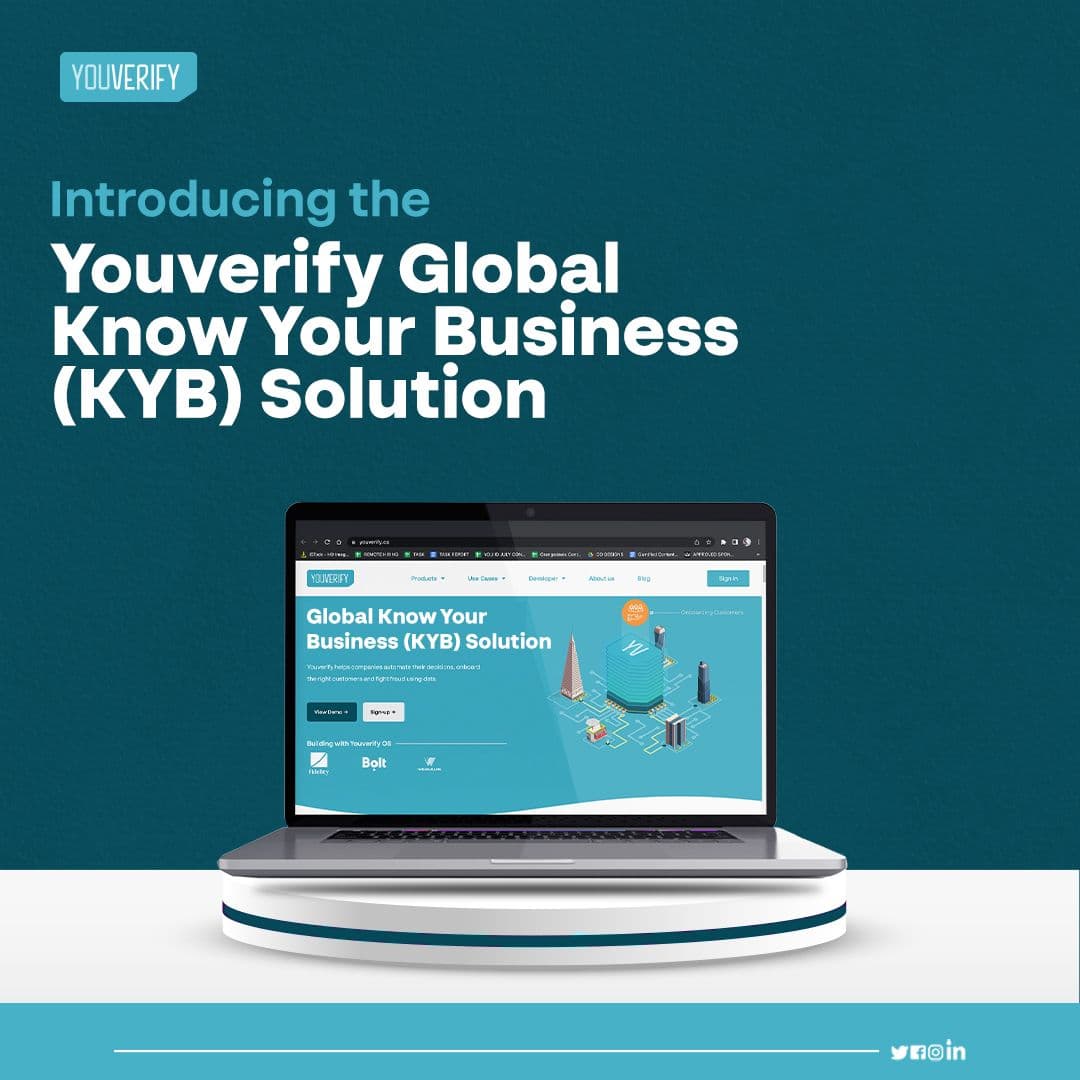
Youverify's KYB solution does all of this within a single platform. Through direct integration with the CAC registry, Nigerian BVN/NIN databases, and over 1,100 global sanctions and PEP watchlists, Youverify enables compliance teams to verify a Nigerian business entity, identify its beneficial owners, and complete AML screening in minutes, not days. The platform is built to the specifications of the CBN's 2026 Baseline Standards, including real-time monitoring, role-based audit trails, and maker-checker workflows.
For regulated Nigerian institutions preparing for the CBN's September 2027 or March 2028 full compliance deadlines, Youverify provides the automated infrastructure needed to meet the standard without disrupting the customer onboarding experience.
KYB compliance in Nigeria has moved well beyond a CAC search. Regulated institutions now operate in a landscape where the CBN expects automated, integrated, and real-time business verification as a minimum standard. The March 2026 Baseline Standards have formalised what best-in-class compliance teams were already building: a single connected system that links entity verification, UBO identification, sanctions screening, and transaction monitoring in one auditable workflow.
For compliance officers and MLROs preparing for the CBN's 2027 and 2028 deadlines, the priority is not whether to automate KYB. The CBN has settled that question. The priority now is choosing the right solution that meets all twelve categories of the baseline standards without creating friction in your onboarding pipeline.
Temitope Lawal has spent five years writing for fintech companies and financial institutions across Nigeria and international markets, with a research focus on AML compliance, fraud prevention, and financial crime regulation. Her work covers regulatory developments from the FCA, NCA and FATF, and is informed by ongoing engagement with primary compliance sources and industry research.