AML Compliance for African Development Finance Institutions
ByVictoria okere
•5mins Read
Key Takeaways
1. The African Development Bank runs its own dedicated AML/CFT strategy and a 2024–2026 action plan on illicit financial flows, and it actively funds capacity-building with regional bodies like GIABA and ESAAMLG.
2. FATF Recommendation 16 and the FATF's ongoing grey-list monitoring directly shape which counterparties and jurisdictions require enhanced due diligence in DFI project finance.
3. Correspondent banking access, not retail deposit flight, is the practical constraint that AML failures put at risk for African DFIs, because it determines whether cross-border settlement is possible at all.
Introduction
AML compliance for African development finance institutions (DFIs) means something different than it does for a retail bank. A DFI disburses into infrastructure, agriculture, and SME finance across multiple sovereign jurisdictions at once, and it answers to donor covenants as well as national regulators.
That combination is why a generic bank AML program, transplanted onto a DFI, tends to miss the risks that actually matter: project-finance layering, commodity trade finance typologies, and the correspondent banking relationships a DFI depends on to move money across borders at all.
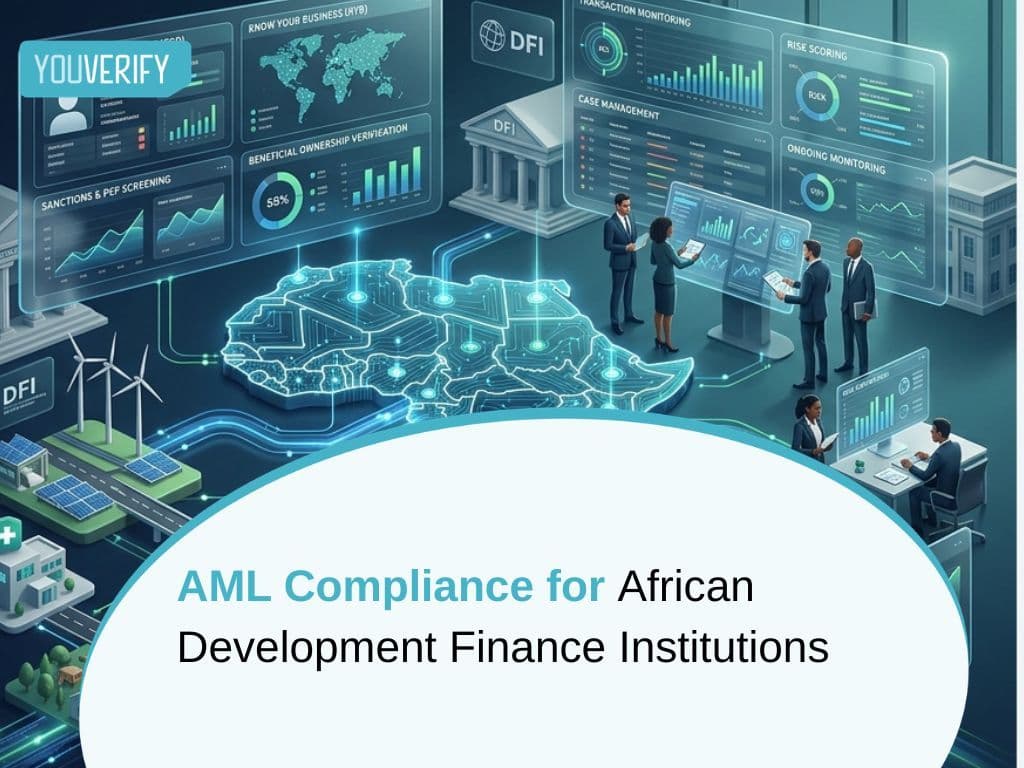
Addressing these risks requires more than policy documentation. DFIs increasingly rely on integrated compliance technology to verify counterparties, identify beneficial owners, monitor transactions, and continuously assess customer risk across multiple jurisdictions.
What Counts as a Development Finance Institution in Africa
Development finance institutions mobilize long-term capital for economic development rather than take retail deposits. In Africa this spans three tiers.
1. Multilateral institutions, chiefly the African Development Bank (AfDB), headquartered in Abidjan.
2. Regional institutions such as the ECOWAS Fund and other regional development banks operating across several national regulatory regimes at once.
3. National institutions such as Nigeria's Bank of Industry, operating under a single central bank and FIU while still meeting the AML covenants of international co-financiers.
Snippet-ready answer: A development finance institution channels long-term capital into infrastructure, agriculture, and enterprise finance rather than taking retail deposits. In Africa, DFIs range from multilateral bodies like the AfDB down to national institutions, and all of them carry AML obligations that combine national law with donor and co-financier covenants.
The AfDB's Own AML Framework
The AfDB does not treat AML as an add-on. It operates under its Group Strategy for the Prevention of Money Laundering and Terrorist Financing in Africa, and in 2025 it launched a Bank Group Action Plan for Anti-Money Laundering and Combatting the Financing of Terrorism covering 2024–2026, alongside its Bank Group Policy on the Prevention of Illicit Financial Flows. That policy document is candid about the stakes: it estimates that Africa has lost roughly one trillion US dollars over the past 50 years to illicit financial flows, a sum comparable to all the Overseas Development Assistance the continent has received over the same period.
The AfDB backs this with direct capacity-building funding to regional AML bodies. It financed a roughly $5.2 million project with the Eastern and Southern Africa Anti-Money Laundering Group (ESAAMLG) to strengthen AML/CFT regimes in Burundi, Eritrea, Madagascar, Mozambique, and South Sudan, and separately backed a $5 million capacity-development project with GIABA, the West African body, for member states in transition.
Institutions working alongside the AfDB should ensure their compliance technology supports risk-based customer due diligence, beneficial ownership verification, sanctions screening, and ongoing monitoring throughout the project lifecycle.
Why This Matters for Co-Financing Institutions
Any African bank or DFI co-financing a project alongside the AfDB, or alongside bilateral development finance institutions, effectively inherits an expectation of AML programme maturity board-approved policy, documented risk assessment, and functioning suspicious-transaction reporting because the AfDB's own framework assumes its partners meet a comparable standard.
GIABA, FATF, and the Grey List: What Actually Changes Risk Ratings
West African DFIs sit inside GIABA's supervisory reach. GIABA is the FATF-Style Regional Body responsible for strengthening member states' capacity to prevent and control money laundering, terrorist financing, and proliferation financing across the region, and it has been completing mutual evaluations of ECOWAS member states as part of that mandate. (Sources differ on GIABA's exact member count; some put it at 15 ECOWAS states plus observers, others at 16 or 17, depending on how associate members are counted.
The FATF grey list is the other live input. As of the FATF's 19 June 2026 statement, jurisdictions under increased monitoring included Bosnia and Herzegovina and Iraq (newly added), while Algeria and Namibia were removed, bringing the list to 22 jurisdictions. Angola has been on that list since October 2024 while it works through an agreed action plan with FATF and ESAAMLG. This list changes three times a year, so any DFI risk assessment that cites a specific country roster needs a review date attached to it, and you should check the FATF's current list directly before relying on it.
Snippet-ready answer: FATF's grey list formally "jurisdictions under increased monitoring" flags countries with agreed strategic deficiencies in their AML/CFT regimes. For a DFI, exposure to a grey-listed jurisdiction is a trigger for enhanced due diligence and senior-management sign-off, not an automatic bar on lending, since FATF does not require blanket enhanced measures for every grey-listed country.
Correspondent Banking: The Practical Constraint
DFIs depend on correspondent banking relationships to clear USD, EUR, and GBP payments internationally. Global reporting on correspondent banking has documented a broad decline in active correspondent relationships in emerging markets over the past decade, driven by international banks reassessing risk appetite for certain corridors the IMF and World Bank's joint work on correspondent banking withdrawal documents this dynamic in detail, though the specific percentage decline varies by region and study, so you should verify any single figure against the source before quoting it in a client-facing document.
A Real-World Scenario
A national DFI is financing an SME on-lending program through three intermediary banks. One intermediary's compliance file shows generic KYC checks but no beneficial ownership verification on the ultimate borrowers, several of which are shell companies registered days before receiving the DFI's first disbursement. Left unaddressed, that gap does not just create money laundering exposure; it is precisely the kind of finding that triggers a correspondent bank's own periodic review and can lead to a relationship being narrowed or withdrawn, regardless of whether any actual laundering occurred.
Situations like this demonstrate why KYB alone is insufficient. Institutions also need Ultimate Beneficial Owner (UBO) verification, continuous monitoring, and adverse media screening to identify ownership changes or emerging risks after project funding begins.
Building a DFI-Grade AML Programme: The Sequence
Table 1 sets out where FATF's core requirements land differently for a DFI than for a retail bank.
FATF Area
Retail Bank Application
DFI Application
Recommendation 10 (ongoing due diligence)
Per-customer transaction review
Per-project and per-disbursement review across the loan lifecycle
Recommendation 16 (payment transparency)
Wire transfer screening
Disbursement and repayment message screening across co-financiers
Recommendation 24 (beneficial ownership)
Corporate account opening
Layered SPV and joint-venture structures in project finance
Suspicious transaction reporting
Single national FIU
Potentially several FIUs across the jurisdictions a project touches
A practical build sequence follows.
1. Conduct a documented institutional risk assessment covering geographic exposure, sector risk, and delivery channel (direct lending versus on-lending through intermediaries) and update it at least annually.
2. Collect full KYB documentation on corporate borrowers, including beneficial ownership declarations, before first disbursement, following KYC best practices for AML compliance rather than treating it as a one-off form.
3. Screen every counterparty borrower, guarantee beneficiary, and contractor against sanctions lists before and throughout the relationship, not only at onboarding.
4. Set transaction monitoring rules specific to disbursement and repayment patterns, flagging payments to third parties not named in the project agreement.
5. Confirm, in writing, which national FIU has reporting authority for each jurisdiction a project touches, before a suspicious transaction arises.
6. Deliver typology-specific training on construction sector invoice fraud, commodity trade finance red flags, and PEP exposure in sovereign lending rather than generic AML training.
How Technology Strengthens DFI AML Programs
Modern DFI compliance programs rely on technology to manage increasingly complex customer, project, and jurisdictional risks.
Rather than maintaining separate systems for customer onboarding, sanctions screening, transaction monitoring, investigations, and reporting, many institutions are moving toward unified compliance platforms that centralize these activities within a single workflow.
This enables compliance teams to:
verify businesses and beneficial owners
perform sanctions and PEP screening
continuously monitor counterparties
investigate alerts
document regulatory evidence
manage multi-jurisdiction compliance
Conclusion
AML compliance for African development finance institutions is a precondition for correspondent banking access and co-financing eligibility, not a back-office formality. The AfDB's own strategy, action plan, and funding of GIABA and ESAAMLG capacity-building show that the continent's largest DFI treats this as a core operational risk. Institutions that build project-finance-specific AML programs covering beneficial ownership, grey-list exposure, and multi-jurisdiction reporting will be better positioned to keep the correspondent relationships their mandate depends on.
Building that capability increasingly depends on combining customer due diligence, beneficial ownership verification, sanctions screening, transaction monitoring, and ongoing monitoring within a unified compliance program that supports multi-jurisdictional lending throughout the project lifecycle.
Learn how Youverify helps development finance institutions strengthen AML compliance through KYB, UBO verification, sanctions screening, continuous monitoring, transaction monitoring, and integrated case management built for multi-jurisdiction financial institutions.
Victoria Okere is a compliance writer at Youverify specializing in AML/CFT regulations across Nigeria, South Africa, and Kenya, covering CBN, FICA, POCAMLA, and FATF frameworks.