CBN Agent Banking Guidelines: KYC, Monitoring and Fines
ByTemitope Lawal
•5mins Read
Key Takeaways
The Guidelines for the Operations of Agent Banking in Nigeria replaced the 2013 agent banking guidelines and the 2015 super agent framework.
They apply to deposit money banks, other financial institutions, payment service providers, super agents and licensed agents.
Agents must now work with one principal only, and may belong to only one super-agent network, enforceable from 1 April 2026.
Agent transaction limits are capped, and payment terminals must be geo-fenced or tagged from 1 April 2026.
Principals file monthly returns covering transaction volumes, fraud cases, complaints, active agents and training, and keep audit trails and settlement records for at least five years.
Fines are explicit: from ₦2 million for missing approvals to ₦20 million plus ₦500,000 a day for unapproved ownership changes.
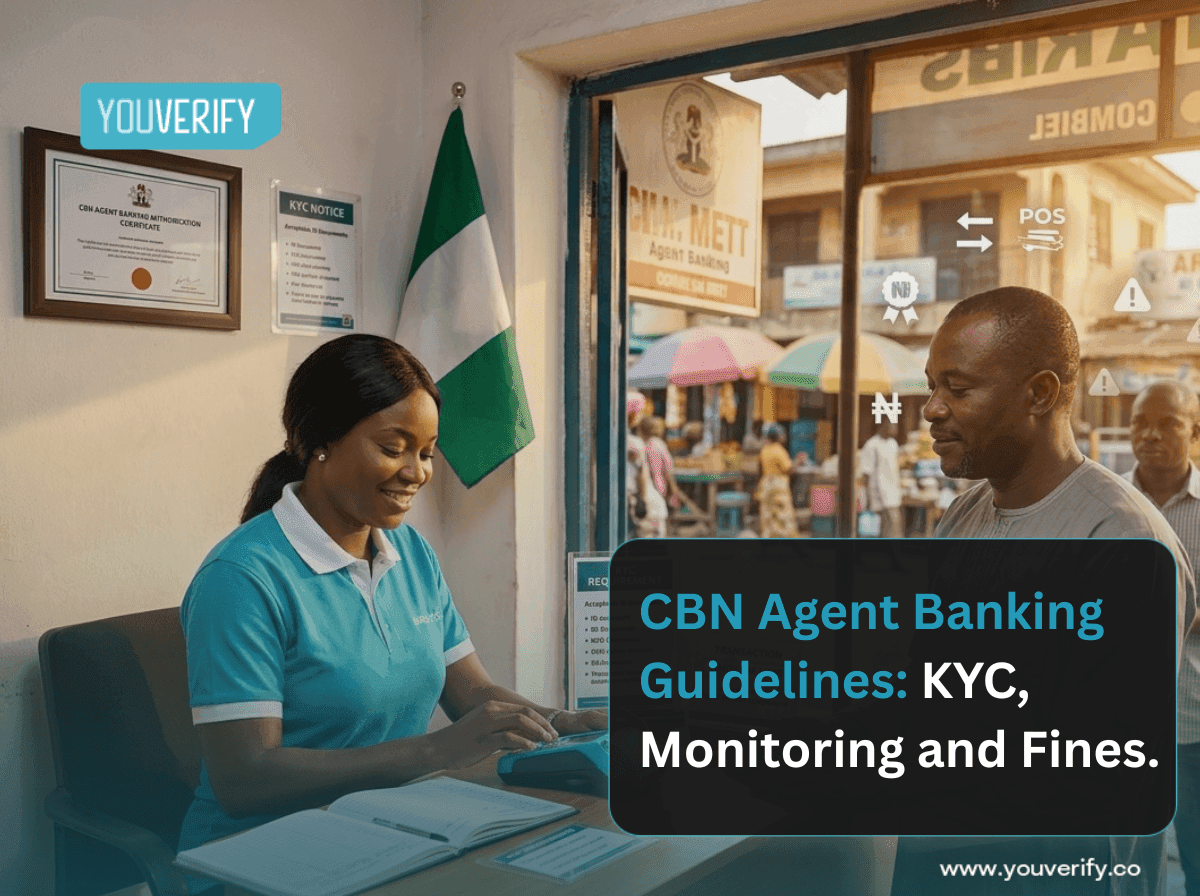
The CBN agent banking guidelines set four obligations for principals: due diligence and training on every agent, customer verification at the agent point, monitoring of agent activity for fraud and money laundering, and monthly reporting to the Central Bank of Nigeria (CBN). Issued on 6 October 2025, the Guidelines for the Operations of Agent Banking in Nigeria took immediate effect, with agent location, exclusivity and terminal geo-fencing enforceable from 1 April 2026.
The change that matters most is the shift from discretionary sanctions to named ones. Where the old framework left penalties open, the 2025 guidelines attach specific fines and daily penalties to specific failures, and hold principals accountable for what their agents do.
What Are the CBN Agent Banking Guidelines?
The CBN agent banking guidelines are theGuidelines for the Operations of Agent Banking in Nigeria, issued on 6 October 2025 to set minimum standards for agent banking relationships. They consolidate and replace two earlier instruments: the 2013 Guidelines for the Regulation of Agent Banking and Agent Banking Relationships, and the 2015 Regulatory Framework for Licensing Super Agents.
Agent banking lets a third party deliver financial services on behalf of a licensed institution. That institution, the principal, carries the regulatory risk. A customer who is defrauded at a kiosk is still the principal's customer, and an agent used to layer criminal funds is still the principal's exposure.
Provision
Status
Most of the guidelines, including KYC, monitoring, reporting and sanctions
In force since 6 October 2025
Agent location rules
Enforceable from 1 April 2026
Agent exclusivity
Enforceable from 1 April 2026
Geo-fencing or tagging of payment terminals
Enforceable from 1 April 2026
Who Do the Agent Banking Guidelines Apply To?
The agent banking guidelines apply to five groups: deposit money banks, other financial institutions such as microfinance banks, payment service providers, super agents, and the licensed agents themselves. Responsibility does not stop at the agreement, because the principal answers for the conduct of every agent in its network.
Exclusivity reshapes that network. An agent must now be tied to a single principal and may belong to only one super-agent network. For a bank or fintech, this means auditing the existing base, renegotiating agreements, and building a check that stops an agent from being onboarded while active elsewhere.
What KYC Checks Must Principals Run on Agents and Customers?
Principals must run three layers of KYC under the agent banking guidelines: due diligence on the agent as a business, verification of every customer served at the agent point, and mandatory anti-money laundering (AML) and know your customer (KYC) training before an agent is onboarded and periodically afterwards.
1. Agent Due Diligence: Verify the Business, Not Just the Person
Confirm the agent's registration with the Corporate Affairs Commission, identify directors and beneficial owners, and screen them against sanctions and politically exposed person lists. Keep the evidence on file. An agent network assembled from unverified businesses is a due diligence failure waiting to appear in an examination.
2. Exclusivity Screening: Check the Agent Is Not Already Tied Elsewhere
Before onboarding, confirm the agent is not operating for another principal or super-agent network. Build this into the onboarding check rather than the contract alone, since a contractual promise does not detect a breach.
3. Customer Verification: BVN, NIN and Tiered Limits at the Agent Point
Customers served at an agent location still need verification against the Bank Verification Number (BVN) and National Identification Number (NIN) databases, with tiered limits applied. Agent-assisted onboarding raises the risk of coached or coerced verification, so liveness checks and device signals matter more here than at a branch.
4. Agent Training: KYC and AML Before Onboarding, Then Regularly
Training on KYC, AML and countering the financing of terrorism (CFT), consumer protection and financial literacy is mandatory before an agent starts and on a continuing basis. Record attendance and dates. Training records are part of the monthly return to the CBN.
What Transaction Limits Apply to Agent Banking?
Agent banking transaction limits cap deposits and withdrawals at ₦100,000 daily and ₦500,000 weekly per customer, with bill payments capped at ₦100,000. Limits are a control, not a ceiling to be worked around, and the pattern of customers sitting just below them is itself a monitoring signal.
Transaction type
Daily limit
Weekly limit
Deposits and withdrawals
₦100,000
₦500,000
Bill payments
₦100,000
₦100,000
Structuring is the risk these limits create. A customer who cannot move ₦600,000 in one transaction can move it across six agents in a week, and each transaction looks compliant on its own. Detecting that requires monitoring across the network rather than at the terminal.
How Should Principals Monitor Agent Networks for Fraud and Money Laundering?
Principals should monitor agent networks in four ways: aggregating activity at agent level rather than transaction level, enforcing device and location controls, watching behavioural patterns across the network, and routing flags into a case workflow with owners and deadlines.
1. Agent-Level Aggregation: Watch the Agent, Not Only the Transaction
Most agent banking blind spots come from rules calibrated to single transactions. Each transaction clears the threshold, so nothing fires, while the agent's daily volume drifts far above what its registered business profile would predict. Score the agent as an entity, with its own risk profile and expected volume band.
2. Device and Location Controls: Geo-Fencing From 1 April 2026
Payment terminals must be geo-fenced or tagged. A terminal operating outside its registered location is both a guideline breach and a strong fraud signal, since roaming terminals are common in card-skimming and cash-out schemes. Alert on the movement, not just the transaction.
3. Behavioural Signals: The Patterns That Precede Losses
Track repeated transactions just below limits, unusual cash-in and cash-out ratios, activity concentrated in the small hours, many customers sharing one device, and sudden volume spikes after a quiet period. These are network-level signals that a terminal-level rule will never see.
4. Case Handling: Turn Flags Into Cases With Owners
An alert on an agent needs a decision path: who investigates, what evidence is gathered, whether the agent is suspended, and when the matter becomes a suspicious transaction report to the Nigerian Financial Intelligence Unit (NFIU). Keep the record of each decision, because the monthly return asks for fraud cases and the CBN can inspect systems and premises.
What Must Principals Report, and How Long Must Records Be Kept?
Principals must file monthly returns to the CBN covering transaction volumes, fraud cases, complaints, active agents and training completed, and retain audit trails and settlement records for at least five years. Reports drawn from different systems each month tend to disagree with each other, which is the sort of inconsistency an examiner notices first.
Build the return from one source. If your fraud cases live in a spreadsheet, complaints in a support tool and agent status in another system, reconciliation becomes a monthly project instead of a report.
What Are the Fines Under the CBN Agent Banking Guidelines?
Fines under the CBN agent banking guidelines are explicit and, in several cases, accrue daily. The 2025 guidelines replaced discretionary penalties with named amounts for named failures, alongside powers to blacklist agents, terminate agreements and revoke licences.
Breach
Penalty
Change of ownership, acquisition or merger without CBN approval
Not less than ₦20,000,000, plus ₦500,000 for each day the default continues
Operating without a valid super agent licence
Minimum of ₦10,000,000, plus a daily penalty for continued operation
Engaging in non-permissible agent banking activities
From ₦5,000,000, plus ₦100,000 daily, and possible forfeiture of estimated profits
Failure to obtain CBN approval for specified activities
₦2,000,000 on the financial institution and on each responsible director
Late rendition of returns
Penalties set according to the severity of the default
Beyond money, the CBN can direct remedial action, require termination of agent agreements, blacklist agents and super agents, and inspect systems and premises directly. Agents can also be held personally liable for misconduct. For a wider view of financial crime penalties, see our guide to AML regulations in Nigeria.
How Do the Agent Banking Guidelines Connect to the CBN Baseline Standards?
The agent banking guidelines and the CBN Baseline Standards for Automated AML Solutions ask for the same underlying capability: verified identity feeding live monitoring, alerts becoming managed cases, and an audit trail behind every decision. Institutions running an agent network face both, and the Baseline Standards deadlines of 10 September 2027 for banks and 10 March 2028 for other institutions apply regardless of how the network is structured.
Read together, they point to one build. Agent and customer identity data belongs in the same profile your monitoring reads. Terminal location and device signals belong beside transaction data. Fraud cases feed both the monthly return and your NFIU reporting. Verification requirements are set out in the CBN KYC and AML requirements for 2026.
How Do Principals Get Agent Banking Compliance Right?
Principals get agent banking compliance right in six ways: auditing the agent base against exclusivity, tightening onboarding due diligence, moving monitoring to agent level, enforcing terminal location controls, building the monthly return from one source, and keeping training records current.
1. Network Audit: Find the Agents Tied to Someone Else
Map every active agent against the exclusivity rule and decide which relationships end, which are renegotiated and which need escalation. Do this before enforcement rather than after a finding.
2. Onboarding: Make Agent Due Diligence a Gate, Not a Form
Verify registration, directors and beneficial owners, screen against sanctions and PEP lists, and block onboarding when checks fail. Keep the evidence attached to the agent record.
3. Monitoring: Give Every Agent a Risk Profile and an Expected Volume
Set a baseline for each agent, then alert on deviation. This is the control that catches the drift between "the agent passed onboarding" and "the agent is now moving unexplained volume".
4. Terminal Controls: Alert When a Device Leaves Its Location
Register each terminal's location, monitor against it, and treat movement as an event requiring explanation. Keep the alert history for examination.
5. Reporting: Generate the Monthly Return From One System
Pull transaction volumes, fraud cases, complaints, agent counts and training records from a single record rather than reconciling four sources under deadline.
6. Training Records: Log Completion, Not Just Delivery
Record who was trained, on what, and when, with refreshers scheduled. Untrained agents are both a reporting gap and the most common source of customer harm.
Meeting the CBN Agent Banking Guidelines With Youverify
Meeting the CBN agent banking guidelines means verifying every agent and customer, watching the network rather than the terminal, and producing evidence on demand. Youverify gives Nigerian banks, microfinance banks, mobile money operators and super agents those three capabilities in one platform.
Customer Onboarding runs document, anti-deepfake liveness and government-source checks in one journey, scored to a risk tier, which covers both the agent as a business and the customers onboarded at agent locations. Fraud Insights scores device and browser fingerprint, IP spoofing, emulators and remote tools, velocity and behaviour inside the same session, so a terminal behaving out of pattern surfaces early.
Transaction Monitoring applies rules and models on live flows, with typologies tuned to multi-currency, mobile money and cross-border corridors, which is where agent-level aggregation and structuring across a network get caught. When a flag becomes a case, Case Management holds the queues, SLAs, the entity graph, evidence and a decision trail you can hand to an examiner, and that same record feeds your monthly return.
Your agent agreements, suspensions and commercial decisions stay with your team. Youverify supplies the checks and the evidence behind them. Speak to our fraud and compliance team about monitoring your agent network before the next examination.