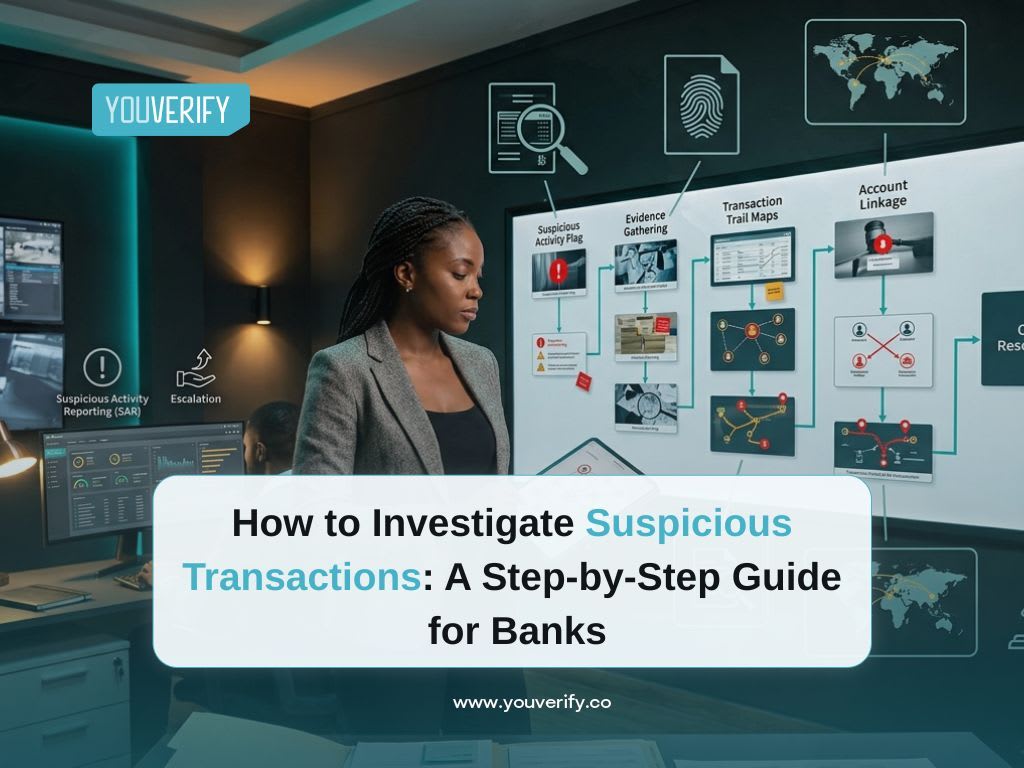
How to Investigate Suspicious Transactions: A Step-by-Step Guide for Banks (2026/2027)
ByFavour Praise
•5mins Read
Key Takeaways
Not every unusual transaction is suspicious, but every suspicious transaction should follow a structured AML investigation process that includes customer review, transaction analysis, evidence gathering, and risk assessment.
Effective transaction monitoring, KYC, and customer due diligence help banks detect suspicious activity early, enabling compliance teams to distinguish legitimate behaviour from potential financial crime.
A well-documented Suspicious Transaction Report (STR) is essential when reasonable grounds for suspicion remain, supporting regulatory compliance and financial crime investigations.
AI-powered transaction monitoring strengthens AML investigations by reducing false positives, prioritising high-risk alerts, and helping compliance teams investigate suspicious transactions faster and more accurately.
Every suspicious transaction tells a story, but not every unusual transaction is financial crime. The challenge for compliance teams is knowing when unusual activity becomes suspicious enough to investigate, document, and report to the appropriate authorities.
Financial institutions are required to identify, investigate, and report suspicious transactions as part of their Anti-Money Laundering (AML) obligations. A structured AML investigation process helps compliance teams separate genuine customer behaviour from potential fraud while meeting regulatory reporting requirements. This guide explains how banks can investigate suspicious transactions, when to file a Suspicious Transaction Report (STR), and how AI-powered transaction monitoring strengthens the investigation process.
Note that: Investigating suspicious transactions involves reviewing customer information, analysing transaction patterns, gathering supporting evidence, assessing financial crime risk, and determining whether a Suspicious Transaction Report (STR) should be filed with the relevant Financial Intelligence Unit (FIU).
What Are Suspicious Transactions?
Suspicious transactions are financial activities that appear inconsistent with a customer's known profile, business activities, or expected transaction behaviour and may indicate money laundering, fraud, terrorist financing, or another financial crime.
Suspicion does not require proof that a crime has occurred. Instead, it is based on reasonable grounds to believe a transaction or pattern of activity warrants further investigation. According to the Financial Action Task Force (FATF), financial institutions are expected to examine unusual transactions and report suspicious transactions when there are reasonable grounds for suspicion.
Unusual Transaction vs Suspicious Transaction
Although these terms are often used interchangeably, they are not the same.
Unusual Transaction
Suspicious Transaction
Differs from a customer's normal behaviour
Suggests possible fraud or money laundering
May have a legitimate explanation
Requires investigation and possible reporting
Can often be resolved through customer clarification
May result in a Suspicious Transaction Report (STR)
Does not always indicate criminal activity
Requires escalation if suspicion remains
Understanding this distinction helps your compliance team avoid unnecessary investigations while ensuring genuine risks are identified and reported appropriately.
As it has been established that certain transaction patterns consistently require closer review during an AML investigation. When these activities cannot be reasonably explained by a customer's profile or expected behaviour, they may warrant further investigation and, where appropriate, the filing of a Suspicious Transaction Report. See this illustration below.
Suspicious Activity
Why It Raises Concern
Large cash deposits with no clear business purpose
May indicate placement of illicit funds
Multiple small transactions below reporting thresholds
Possible structuring or "smurfing" to avoid detection
Sudden international transfers to high-risk jurisdictions
Potential money laundering or sanctions risk
Dormant accounts becoming unexpectedly active
May indicate account takeover or mule account activity
Rapid movement of funds through multiple accounts
Possible layering to conceal the source of funds
Transactions inconsistent with a customer's occupation or business
A single indicator may not confirm financial crime. However, when several red flags appear together, compliance teams should investigate the transaction and assess the customer's overall risk profile before deciding on the next course of action.
How Do Banks Identify Suspicious Activity?
Banks identify suspicious activity by combining AI or machine learning technology, customer due diligence (CDD), and human expertise.
So, instead of reviewing every transaction manually, they rely on transaction monitoring systems that continuously analyse customer behaviour, payment patterns, and risk indicators in real time.
Links to previously identified suspicious accounts
When unusual patterns exceed predefined risk thresholds, alerts are automatically generated for compliance teams to investigate.
Modern AI-powered transaction monitoring solutions go a step further by using behavioural analytics and machine learning to identify suspicious activity that traditional rules-based systems may miss. This helps investigators focus on high-risk cases while reducing false positives.
Step-by-Step Suspicious Transaction Investigation Process
Investigating suspicious transactions requires more than reviewing a single payment or account activity. Compliance teams need to understand the transaction in context, assess customer behaviour, gather supporting evidence, and determine whether there are reasonable grounds to suspect financial crime.
Following a structured AML investigation process helps banks investigate suspicious transactions consistently, reduce false positives, and meet regulatory reporting obligations.
Step 1: Detect and Flag the Suspicious Transaction
Every investigation begins when a transaction is flagged for further review. Banks typically identify suspicious transactions through transaction monitoring systems that analyse customer behaviour against predefined rules, risk thresholds, and historical activity. Alerts may also come from customer complaints, employee observations, or requests from law enforcement agencies.
At this stage, investigators are not trying to prove financial crime. Their goal is simply to determine whether the transaction warrants a closer review.
Step 2: Review the Customer's Profile
The next step is to understand the customer behind a transaction that has been flagged.
Compliance teams review the customer's KYC records, CDD information, occupation or business activity, source of funds, previous transaction history, and existing risk rating. They also check whether the customer has been involved in previous alerts or investigations.
Looking at the customer's overall profile helps determine whether the transaction fits their normal behaviour or represents a genuine change in risk.
Step 3: Analyse the Transaction History
A single transaction rarely tells the full story.
Hence, investigators should also examine the customer's transaction history to identify patterns that may indicate money laundering or other financial crimes. This includes reviewing transaction frequency, payment values, beneficiaries, geographic locations, channels used, and the movement of funds between related accounts.
The objective is to determine whether the flagged transaction is an isolated event or part of a broader pattern of suspicious activity.
Step 4: Gather Supporting Evidence
Before any reporting decision is made, investigators should collect evidence that supports their findings.
This may include identity verification records, account opening information, customer communications, payment instructions, invoices, device information, and transaction receipts. Having complete documentation makes it easier to justify investigation outcomes and supports the preparation of a Suspicious Transaction Report if one becomes necessary.
Step 5: Escalate the Case for Internal Review
If concerns remain after the initial investigation, the case should be escalated to the appropriate compliance authority within the organisation.
Depending on the institution's governance structure, this may involve the Compliance Manager, Financial Crime team, or Money Laundering Reporting Officer (MLRO). Internal escalation helps ensure reporting decisions are reviewed consistently and supported by sufficient evidence.
Step 6: Decide Whether to File a Suspicious Transaction Report
After reviewing all available information, investigators decide whether there are reasonable grounds to suspect financial crime.
If the activity can be explained, the alert may be closed with proper documentation. However, if suspicion remains, the institution should prepare and submit a Suspicious Transaction Report (STR) to the relevant Financial Intelligence Unit (FIU) in accordance with applicable regulations.
A good STR should clearly explain why the transaction is considered suspicious, identify the parties involved, summarise the supporting evidence, and describe the suspected criminal activity.
Step 7: Continue Monitoring the Customer and Strengthen AML/CFT/CPF Risk Assessment
Submitting a Suspicious Transaction Report (STR) does not conclude the investigation. The customer's risk profile should be updated, and future transactions should continue to be monitored for suspicious activity.
Financial institutions should maintain effective AML/CFT/CPF risk assessment procedures that continuously assess customer behaviour, transaction patterns, and emerging risks. Continuous transaction monitoring enables compliance teams to detect new threats early, strengthen ongoing customer due diligence, and improve long-term AML compliance.
AML Investigation Process Summary
Step
Objective
1. Detect
Identify suspicious transactions through alerts or transaction monitoring.
2. Review
Assess the customer's KYC records, risk profile, and due diligence information.
3. Analyse
Review transaction history, customer behaviour, and related account activity.
4. Gather Evidence
Collect supporting documentation to validate investigation findings.
5. Escalate
Refer the case to compliance or AML investigation teams for review.
6. Report
Submit a Suspicious Transaction Report (STR) where suspicion remains.
7. Monitor
Continue monitoring the customer for emerging risks and suspicious activity.
What Should Be the First Step When a Transaction Seems Suspicious?
The first step when a transaction appears suspicious is to review the customer's profile, transaction history, and risk rating to determine whether the activity is unusual or genuinely indicative of financial crime.
This approach helps investigators distinguish legitimate changes in customer behaviour from genuine financial crime risks while reducing unnecessary escalations.
How to Track and Flag Suspicious Transactions
Detecting suspicious transactions begins long before an investigator reviews an alert. Financial institutions need systems that continuously monitor customer activity and identify behaviours that fall outside expected patterns.
Modern transaction monitoring platforms use predefined rules and behavioural analytics to flag transactions that may require investigation. Rather than relying on manual reviews alone, these systems continuously assess customer activity and generate alerts when unusual patterns are detected.
Some common suspicious transaction examples that may trigger an alert include:
Sudden increases in transaction value or frequency.
Transactions involving high-risk countries or sanctioned entities.
Rapid movement of funds across multiple accounts.
Transactions that are inconsistent with the customer's profile or expected business activity.
Structuring transactions to avoid reporting thresholds.
How to Report Suspicious Activity
Once an investigation confirms there are reasonable grounds for suspicion, the institution should prepare and submit a Suspicious Transaction Report (STR)to the appropriate Financial Intelligence Unit (FIU) in accordance with applicable regulations.
A Suspicious Transaction Report should be clear, factual, and supported by evidence. Investigators should avoid assumptions and instead explain why the transaction appears suspicious based on the information gathered during the investigation.
A typical STR should include:
Customer identification details.
Transaction dates and values.
A clear description of the suspicious activity.
Supporting evidence and investigation findings.
The suspected financial crime or predicate offence, where applicable.
According to the Nigerian Financial Intelligence Unit(NFIU) Guidelines for Reporting Suspicious Transactions in Financial Institutions, reporting entities are expected to maintain adequate customer records, document investigation findings, and submit Suspicious Transaction Reports promptly once suspicion has been established.
Some common mistakes compliance officers and teams make weaken investigations or delay regulatory reporting. Be conversant with suspicious transaction examples and cases.
Some of the most common to avoid are:
Closing alerts before gathering sufficient evidence.
Relying on a single transaction instead of reviewing the customer's overall behaviour.
Poor documentation of investigation findings.
Failing to update customer risk ratings after an investigation.
Delaying the submission of Suspicious Transaction Reports.
Following a structured AML investigation process helps improve consistency, strengthen regulatory compliance, and reduce the risk of missed financial crime indicators.
Investigate Suspicious Transactions Faster with Youverify
Investigating suspicious transactions becomes increasingly difficult when customer records, transaction history, sanctions screening, and case management are spread across multiple systems.
With Youverify Cowork, compliance teams can investigate suspicious transactions from a single intelligent workspace. The platform brings together transaction monitoring alerts, KYC records of entities, customer risk profiles, compliance health, sanctions screening results, and investigation history into one dashboard, providing a complete 360-degree view of every customer.
Powered by Vyra, Youverify's AI Compliance Copilot, investigators can analyse suspicious activity, review supporting evidence, and prepare Suspicious Transaction Reports (STRs) in seconds. This helps compliance teams investigate faster, make better-informed decisions, and strengthen AML compliance without increasing operational complexity.
Favour Praise is a compliance researcher and writer at Youverify, where she creates educational content on KYC, AML, fraud prevention, identity verification, and regulatory technology. She focuses on helping financial institutions and regulated businesses understand complex compliance topics through practical, research-backed insights.
FAQs
Frequently Asked Questions
A suspicious transaction is any financial activity that appears inconsistent with a customer's known profile or behaviour and may indicate money laundering, fraud, terrorist financing, or another financial crime. These transactions should be reviewed as part of an AML investigation process.
Banks identify suspicious activity using transaction monitoring systems, customer due diligence, behavioural analytics, sanctions screening, and AI-powered risk scoring. These tools help detect suspicious transactions that require further investigation.
The first step is to review the transaction alongside the customer's KYC information, historical activity, and risk profile. This helps determine whether the activity is unusual or whether there are reasonable grounds for further investigation.
Reporting suspicious transactions involves documenting investigation findings, gathering supporting evidence, preparing a Suspicious Transaction Report (STR), and submitting it to the appropriate Financial Intelligence Unit (FIU) in accordance with applicable AML regulations.
After an STR is submitted, the Financial Intelligence Unit reviews the report and may request additional information or share intelligence with law enforcement agencies where appropriate. Financial institutions should continue monitoring the customer's activity while maintaining confidentiality throughout the process.