KYC in Online Casinos (iGaming Compliance Guide 2027)
ByVictoria okere
•5mins Read
Key Takeaways
1. Casino KYC is a continuous obligation that runs from registration through ongoing transaction monitoring, not a one-time check at sign-up.
2. Regulators across Nigeria, South Africa, and Kenya now treat gambling operators as accountable institutions with the same due diligence duties as banks.
3. "No KYC" casinos are not a loophole; they operate outside licensed, regulated markets, and players and operators both carry the risk.
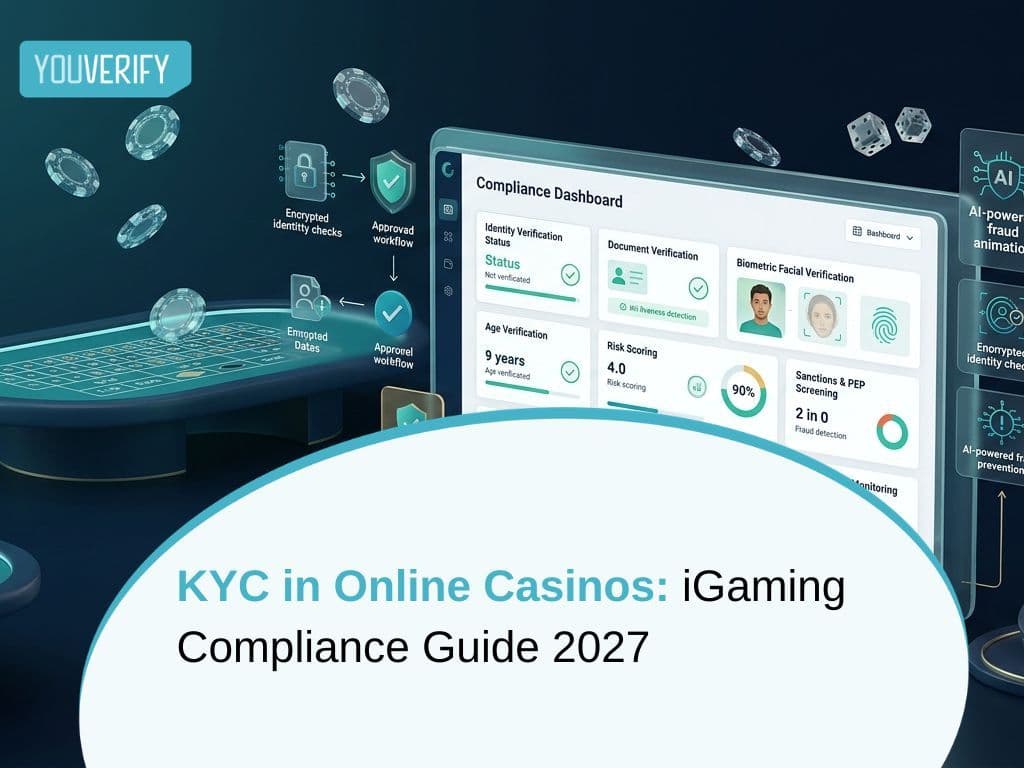
KYC in online casinos is the process of verifying a player's identity, age, and source of funds before and during their use of a gambling platform. It is a legal obligation under nearly every gaming licence in Africa and abroad, not an optional layer of friction.
Online gambling in Africa is expanding faster than almost any other region, and regulators are moving just as quickly to close the compliance gaps that growth exposes. For compliance officers at banks, fintechs, and gaming operators, understanding exactly how KYC works and where the specific regulatory obligations sit is now a board-level concern rather than a back-office task.
What Is KYC in Online Casinos?
Know Your Customer (KYC) is the set of checks a gambling operator runs to confirm a player's real identity, legal age, and the legitimacy of their funds before granting full access to deposits, bets, and withdrawals. It exists to prevent fraud, underage gambling, and money laundering, and it is a condition of nearly every gaming licence rather than a customer-experience choice operators can opt out of.
How the Casino KYC Verification Process Works
1. Registration and Identity Verification
The player submits basic details and a government-issued ID, which the operator checks against issuing databases through a customer verification solution. Non-documentary checks, verifying against a national ID database or mobile network data, are increasingly used in markets where formal documents are harder to produce.
2. Age and Source of Funds Checks
The operator confirms the player meets the legal gambling age and, for higher-value accounts, requests evidence of where deposited funds originate. The Financial Action Task Force's guidance on the risk-based approach for casinos, FATF's RBA guidance, sets the international baseline for when enhanced checks apply.
3. Screening and Ongoing Monitoring
Every player is screened against sanctions, politically exposed persons, and adverse media lists, then monitored continuously through compliance management and transaction monitoring tools. Suspicious patterns trigger a report to the relevant financial intelligence unit rather than a quiet account closure.
Regulatory Requirements Shaping iGaming KYC in 2027
In Nigeria, gambling operators are classified as Designated Non-Financial Businesses and Professions under the Money Laundering (Prevention and Prohibition) Act, requiring registration and reporting through SCUML and the NFIU.
Real-World Scenario: When a KYC Gap Becomes a Regulatory Finding
A licensed operator waives source-of-funds checks below a fixed deposit threshold to keep onboarding fast. A player deposits repeatedly just under that threshold over several weeks, then requests a large withdrawal. Because the account was never escalated for enhanced due diligence, the pattern only surfaces during a routine regulatory audit, by which point the operator has no documented rationale for the account's risk rating, only a difficult conversation with its regulator.
Comparing KYC Approaches for iGaming Operators
Approach
Onboarding Speed
Regulatory Defensibility
Document-only, one-time check
Fast
Weak: no ongoing risk signal
Document plus periodic manual review
Moderate
Moderate: gaps between reviews
Continuous automated monitoring plus tiered due diligence
Fast
Strong: audit-ready trail per account
Choosing a Compliance Partner
An effective KYC partner for African iGaming combines multi-jurisdiction coverage, non-documentary verification options, and monitoring that continues well after onboarding. Youverify's KYT transaction monitoring solution and broader AML compliance tools are built around exactly this continuous, jurisdiction-aware model.
Conclusion
KYC in online casinos is no longer a checkbox; it is the difference between an operator with a defensible compliance record and one that finds its gaps during a regulator's audit instead of its own. Getting the source-of-funds, screening, and ongoing monitoring layers right, in a way that reflects the specific rules of the African markets an operator serves, is what keeps a gaming licence intact.
If your KYC program still relies on one-time checks and manual reviews, it is carrying more regulatory risk than your team may realize. Book a free demo today to see how continuous, multi-jurisdiction KYC and transaction monitoring can close those gaps before a regulator finds them.
About the Author
Victoria Okere is a compliance writer at Youverify specializing in AML/CFT regulations across Nigeria, South Africa, and Kenya, covering CBN, FICA, POCAMLA, and FATF frameworks.