The CBN's March 2026 Circular BSD/DIR/PUB/LAB/019/002 makes automated KYC verification and AML a legal minimum, not a best practice.
Real-time BVN and NIN verification via NIBSS and NIMC is mandatory, batch processing no longer complies with KYC verification in Nigeria.
Nigerian banks need a provider that covers KYC, AML, fraud detection, and regulatory reporting in one platform.
Global providers like Sumsub, Trulioo, and ComplyAdvantage lack direct NIBSS/NIMC integrations needed for proper online KYC verification in Nigeria.
Youverify is the only kyc verification provider built specifically for the Nigerian and African bank environment that offers a unified FRAML (Fraud + AML) platform with Vyra AI.
A KYC verification provider for Nigerian banks is a technology platform that automates identity verification, customer due diligence, transaction monitoring, and regulatory reporting to meet Central Bank of Nigeria (CBN) compliance requirements. In 2026, choosing the wrong online KYC verification in Nigeria provider does not just create operational friction, it creates direct enforcement exposure. The CBN fined 29 Nigerian banks a combined N15 billion for KYC and AML failures in 2024, and the 2026 enforcement cycle is expected to be significantly more aggressive.
This guide compares the leading KYC verification providers available to Nigerian commercial banks in 2026, explains exactly what CBN now requires technically, and identifies what separates a genuinely compliant solution from one that looks compliant on paper. This will also guide compliant officers and KYC aml analysts on how to choose the best KYC verification provider that complies with CBN KYC requirements.
Why Nigerian Banks Need a CBN-Aligned KYC Verification Provider Now
TheCBN issued Circular BSD/DIR/PUB/LAB/019/002 on 10 March 2026, establishing Baseline Standards for Automated AML Solutions. This circular is not a roadmap for future compliance. It is an enforcement document that is already active.
Under this circular, all Nigerian banks, fintechs, and payment service providers were required to submit a formal automated AML implementation roadmap to the CBN by 10 June 2026. Institutions without automated KYC Verification systems face sanctions for technical non-compliance with the automation mandate itself, even when no underlying AML violation has occurred.
The financial consequences of inadequate KYC are already visible. Access Bank received a N35 million fine from the CBN in May 2026 for AML/CFT/CPF compliance lapses. Zenith Bank was fined N15.42 billion in 2025 covering money laundering failures, cybersecurity breaches, and FX violations. These are not warnings. They are enforcement actions affecting Nigeria's largest commercial banks.
A KYC provider for Nigerian banks must therefore be evaluated not just on feature completeness but on regulatory alignment, specifically to CBN, NFIU, and FATF standards applicable to Nigerian financial institutions.
What CBN Now Requires from a KYC Verification Provider
Before comparing providers, every compliance team needs a clear picture of what the CBN technically requires. These are minimum standards, not aspirational targets.
1. The Three-Tier KYC Framework
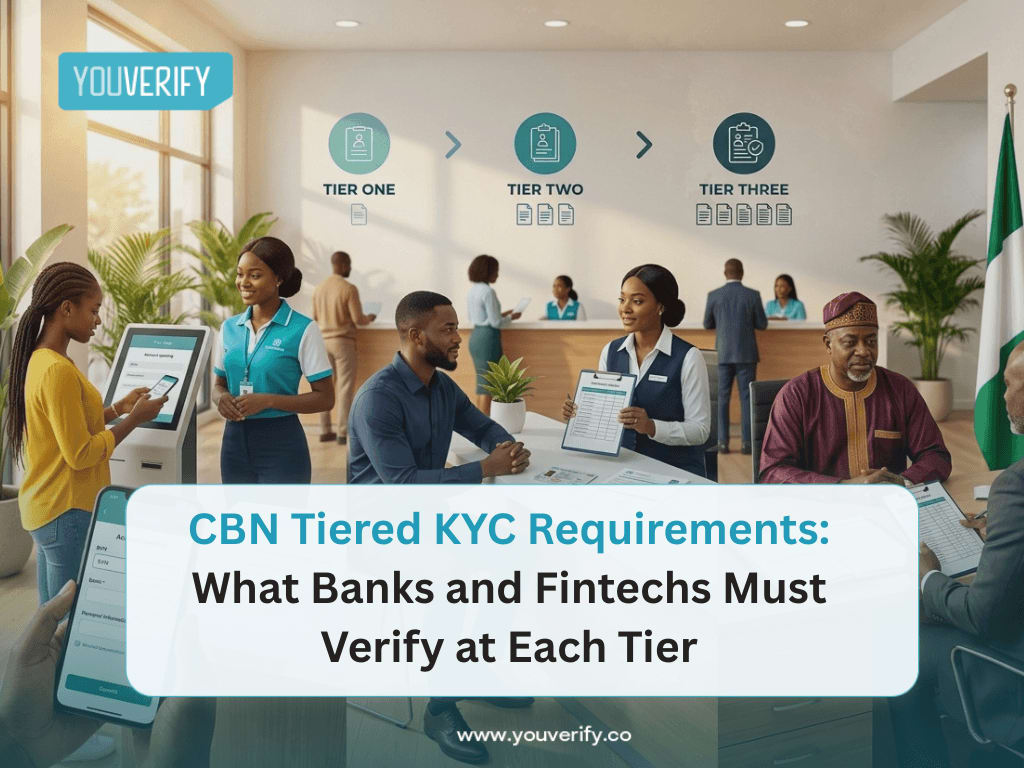
The three-tier KYC verification in Nigeria is mandatory for all customer accounts at Nigerian banks. Tier 1 requires BVN or NIN linkage with a N30,000 daily transaction limit. Tier 2 requires a verified government-issued ID plus address verification with a N500,000 daily limit. Tier 3 requires full beneficial ownership verification with no transaction limits.
Your KYC verification provider must support automated verification workflows for all three tiers without manual intervention at each stage.
2. Automated Real-Time BVN and NIN Verification
Automated KYC verification via real-time BVN lookups through NIBSS and NIN lookups through NIMC is the minimum standard under 2026 baseline requirements. Self-declaration alone no longer satisfies any tier. Any KYC verification provider for Nigerian banks that relies on batch processing or manual document uploads does not meet the 2026 CBN standard.
3. AI-Powered Transaction Monitoring
Static, threshold-only transaction monitoring rules no longer meet the CBN's 2026 technical standard. The baseline standards require AI-powered monitoring capable of detecting behavioral anomalies and complex patterns -- not just flagging transfers above a set amount.
4. NFIU Reporting Within 24 Hours
Suspicious transactions, large cash transactions, and international transfers must all be reported to the Nigerian Financial Intelligence Unit (NFIU) within 24 hours of detection. Missing this window is itself a regulatory violation under the CBN/AML/CFT/CPF Regulations 2022.
Your provider must generate STRs, CTRs, and FTRs in NFIU-approved formats automatically. Manual report preparation at the volume Nigerian commercial banks handle is not operationally viable.
5. Five-Year Record Retention
All KYC records must be retained for a minimum of five years after a customer relationship ends, stored securely and retrievable on demand during CBN or NFIU examinations.
Global KYC Providers vs Nigerian-Built KYC Solutions: The Critical Difference
What Global KYC Verification Providers Offer
1. Sumsub is a well-regarded KYC and fraud prevention platform popular with digital-first businesses and crypto exchanges globally. It offers document verification, biometric checks, liveness detection, and AML watchlist screening. It is strong for international fintech onboarding.
Limitation for Nigerian banks: Sumsub does not have a direct integration with NIBSS for real-time BVN lookups or NIMC for NIN verification. BVN and NIN checks through Sumsub require a third-party connector, creating an additional integration layer and a potential data gap in the audit trail.
2. Trulioo covers identity verification across 195 countries with access to 450+ data sources. It is strong for global enterprises that need to onboard customers across multiple jurisdictions simultaneously.
Limitation for Nigerian banks: Trulioo's strength is breadth, not depth. For Nigeria-specific requirements -- BVN linkage, NIN verification, NFIU-format reporting, CBN circular alignment -- Trulioo requires significant custom configuration and lacks the out-of-the-box regulatory alignment that a commercial bank under CBN supervision needs.
3. ComplyAdvantage excels at AML screening and sanctions data, offering one of the largest proprietary databases of adverse media, sanctions, and PEP records globally.
Limitation for Nigerian banks: ComplyAdvantage is primarily a screening data provider, not a full-stack KYC platform. It does not handle BVN/NIN verification, customer onboarding workflows, or NFIU reporting. Nigerian banks using ComplyAdvantage still need additional vendors to cover the full KYC lifecycle.
The KYC Verification Provider Nigerian Banks Actually Need
A genuinely compliant automated KYC verification provider for Nigerian banks needs three things that global providers typically do not offer out of the box:
1. Direct NIBSS and NIMC integration for real-time BVN and NIN lookups returning results in seconds, not minutes.
2. NFIU-formatted regulatory reporting generated automatically within the 24-hour filing window.
3. Deep familiarity with CBN circulars, the three-tier KYC framework, and the specific risk profile of the Nigerian banking environment, including local PEP lists, Nigerian sanctions databases, and the fraud typologies prevalent in the market.
Youverify: The KYC and FRAML Platform Built for Nigerian Banks
Youverify is not simply an automated KYC verification provider. The company has evolved into a full-cycle FRAML (Fraud + AML) platform, giving Nigerian commercial banks a unified, 360-degree view of every customer from first onboarding through ongoing relationship monitoring.
This distinction matters because the CBN's 2026 requirements cannot be met by a KYC-only solution. BVN and NIN verification at onboarding is the starting point, not the end state. Real-time transaction monitoring, automated EDD, PEP and sanctions screening, NFIU reporting, and continuous customer risk scoring are all now mandatory. Managing five or six separate vendors to cover all of this creates data gaps, audit inconsistencies, and compliance risk that no Nigerian commercial bank can afford.
Youverify covers all of it in one intelligent platform including:
1. Automated Identity Verification and Customer Onboarding
Youverify connects directly to NIBSS for real-time BVN lookups and NIMC for NIN verification, returning results in seconds. Liveness detection, document verification, and biometric matching run within the same onboarding workflow, eliminating the manual steps that create delays and compliance gaps.
For a commercial bank onboarding hundreds or thousands of customers per day, automating this process does not just reduce cost, it eliminates the human error that creates regulatory exposure. This makes Youverify an automated KYC verification provider.
2. Automated Customer Due Diligence Across All Three CBN Tiers
Youverify's AI-powered decision engine executes full-scale AML and KYC checks across all three CBN tiers automatically. EDD is triggered without human intervention for PEPs, customers from high-risk jurisdictions, and complex beneficial ownership structures. Transaction monitoring applies behavioral analytics, not just static rules, to detect suspicious patterns before they become enforcement problems.
3. Vyra AI, Your Compliance Copilot
Vyra is Youverify's AI compliance copilot, working alongside your compliance team in a single intelligent workspace. Instead of analysts manually reviewing dozens of flagged alerts daily and deciding which warrant escalation, Vyra analyses the complete customer risk profile, transaction history, behavioral signals, identity verification status, AML watchlist hits, and surfaces what genuinely requires human attention.
For Nigerian bank compliance teams that are under-resourced relative to the regulatory demands placed on them, Vyra AI is not a premium add-on. It is how a team of five handles the workload that used to require fifty.
360-Degree Customer Risk Profile
Youverify's actionable analytics and custom dashboards give compliance officers a complete picture of every customer in one view, identity verification status, transaction risk scores, EDD outcomes, sanctions screening history, and real-time alerts. No switching between platforms. No reconciling data from multiple vendors. No gaps in the audit trail.
When a CBN examiner arrives, your team pulls a complete, timestamped compliance record for any customer account in minutes, not days.
4. Automated NFIU Reporting
Youverify generates STRs, CTRs, and FTRs in CBN and NFIU-approved formats automatically. When a suspicious transaction is detected, the reporting workflow initiates immediately, keeping your bank within the 24-hour filing window without manual preparation or compliance team overtime.
Youverify currently serves Standard Chartered Nigeria, Sterling Bank, Fidelity Bank, Bolt, and Leadway Assurance among others, production-scale deployments under real CBN regulatory scrutiny.
KYC Verification Provider Comparison for Nigerian Banks
Criteria
Youverify
Sumsub
Trulioo
ComplyAdvantage
Real-time NIBSS BVN integration
Yes, direct
No -- third party connector needed
No
No
Real-time NIMC NIN integration
Yes, direct
No
No
No
CBN three-tier KYC support
Yes, out of the box
Partial, requires configuration
Partial
No
NFIU-formatted STR/CTR/FTR reporting
Yes, automated
No
No
No
AI-powered transaction monitoring
Yes, Vyra AI
Yes
Limited
Yes
PEP and sanctions screening
Yes
Yes
Yes
Yes, strongest
Liveness detection and biometrics
Yes
Yes
Yes
No
360-degree FRAML view
Yes
Partial
No
No
Built specifically for African markets
Yes
No
No
No
CBN circular alignment
Yes
Requires customization
Requires customization
Requires customization
How to Choose the Right KYC Verification Provider: A Checklist for Nigerian Banks
Before signing any vendor contract, your compliance team should verify these specific capabilities:
1. Does the provider have a live, maintained direct integration with NIBSS for BVN and NIMC for NIN?
Ask for a demonstration with real response time data. Batch processing does not meet the 2026 standard.
2. Can the platform generate NFIU-formatted STRs, CTRs, and FTRs automatically within the 24-hour filing window?
Ask to see a sample report and the triggering workflow.
3. Does transaction monitoring use AI and behavioral analytics or only static threshold rules?
Ask for the specific monitoring logic and how false positive rates are measured and managed.
4. Does the platform maintain a complete timestamped audit trail of every compliance action, retrievable on demand for CBN examiners?
5. Can the platform support all three CBN KYC tiers within a single workflow, or does it require separate vendor relationships for different verification types?
6. What is the provider's implementation timeline and dedicated support model for Nigerian commercial bank clients specifically?
Conclusion
The right KYC verification provider for Nigerian banks in 2026 is not a global platform adapted for Nigeria. It is a platform built for the Nigerian compliance environment from the ground up, with direct NIBSS and NIMC integrations, CBN circular alignment, NFIU-ready reporting, and the fraud detection depth that a 360-degree FRAML view provides.
Youverify is that platform. Proven with Nigerian commercial banks, aligned to CBN requirements, and equipped with Vyra AI to make your compliance team more effective regardless of its size.
Nigerian banks are operating under the most demanding compliance environment in the sector's history. The CBN's 2026 Baseline Standards have raised the technical bar permanently, automated BVN and NIN verification, AI-powered transaction monitoring, and NFIU-formatted reporting within 24 hours are no longer aspirational targets. They are minimum requirements with enforcement consequences.
A KYC verification provider gives banks the technology to verify customer identities, conduct due diligence, monitor transactions, and meet regulatory reporting requirements automatically. For Nigerian banks specifically, this means real-time BVN and NIN verification, liveness detection, document checks, AML screening, PEP monitoring, and automated NFIU report generation, all within a single integrated platform rather than multiple disconnected tools.
Yes. The CBN mandates a three-tier KYC framework for all customer accounts, requires automated BVN and NIN verification as the minimum standard, and under the March 2026 Circular BSD/DIR/PUB/LAB/019/002, requires AI-powered transaction monitoring and NFIU reporting within 24 hours of detecting suspicious activity. Manual KYC processes are no longer compliant.
The CBN requires: automated three-tier KYC onboarding (Tier 1 BVN/NIN, Tier 2 government ID plus address, Tier 3 beneficial ownership), real-time BVN and NIN lookups via NIBSS and NIMC, AI-powered transaction monitoring, sanctions and PEP screening, NFIU-formatted STR and CTR filing within 24 hours, and five-year record retention accessible on demand. All institutions must have submitted an automated AML implementation roadmap by June 2026.
The CBN can levy significant financial penalties. In 2024, 29 banks were collectively fined N15 billion. Access Bank received a N35 million fine in May 2026. Zenith Bank was fined N15.42 billion in 2025 for money laundering failures. Beyond the fine, enforcement actions increase regulatory scrutiny, damage correspondent banking relationships, and create lasting reputational risk with enterprise clients. Under the 2026 automation mandate, a bank can be sanctioned for technical non-compliance even without an underlying AML violation.
Global providers like Sumsub, Trulioo, and ComplyAdvantage offer strong general-purpose KYC and AML capabilities but lack the Nigerian-specific integrations that 2026 CBN standards require -- specifically direct connections to NIBSS for BVN verification and NIMC for NIN lookups, and automated NFIU-format reporting. Nigerian banks using these providers need to build custom integrations or add additional vendors to close these gaps, which creates compliance risk and audit trail fragmentation.
The CBN three-tier KYC framework classifies customer accounts by risk level and verification depth. Tier 1 accounts require BVN or NIN linkage and carry a N30,000 daily transaction limit. Tier 2 requires a verified government-issued ID and address verification, with a N500,000 daily limit. Tier 3 requires full beneficial ownership disclosure and documentation, with no transaction limits. All tiers must now be supported through automated verification workflows under the 2026 Baseline Standards.
Vyra is Youverify's AI compliance copilot that works alongside your team in a single intelligent workspace. It analyses each customer's complete risk profile, including transaction history, identity verification status, AML screening results, and behavioral signals, and prioritises the alerts that genuinely require human review. For under-resourced Nigerian bank compliance teams, Vyra AI significantly reduces manual workload while improving detection accuracy and maintaining complete audit trails for CBN examinations.