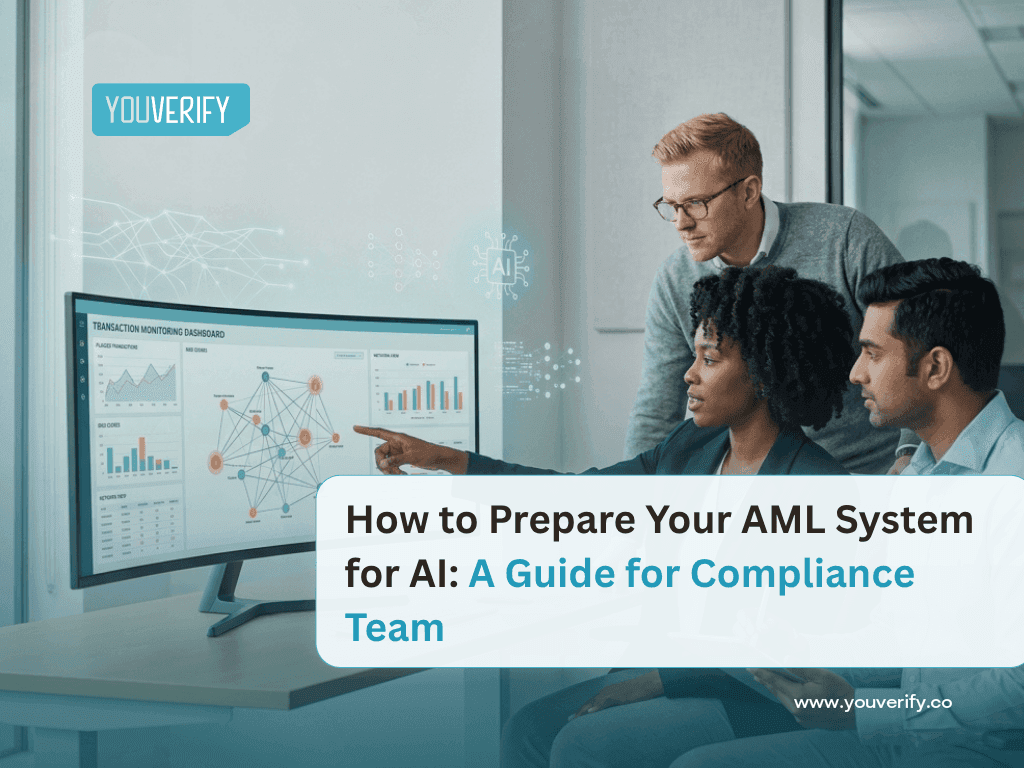
Preparing your AML system for AI means getting your data, your rules and your governance in order before you introduce a model that learns. It involves cleaning and standardising customer data, documenting how your current rules work and what they catch, setting measurable thresholds, and deciding who is accountable when the model gets something wrong.
Here is the part vendors do not lead with. Most of that work is not about AI at all.
Think of it like hiring a brilliant new analyst. If your records are inconsistent, your procedures live in someone's head, and nobody can explain why an alert was closed last March, that analyst will not save you. They will make confident decisions based on bad information, and they will make a lot of them very quickly.
AI behaves the same way. It amplifies whatever you already have.
What Does "AI-Ready" Actually Mean for an AML System?
An AI-ready AML system is one where a model can be introduced, tested, explained and challenged without anybody guessing.
In practice that means five things are true before you start:
- 1. Your customer and transaction data is complete, consistent and correctly formatted.
- 2. You know how your current rules perform, in numbers, not impressions.
- 3. You can explain why any given alert was raised or closed.
- 4. Somebody is accountable for the system's decisions by name.
- 5. You have a routine for checking the model still works after it goes live.
Notice that only the last one mentions a model. The other four are things you should arguably have anyway. AI simply makes their absence impossible to hide.
Why This Is Now a Requirement, Not a Nice-to-Have
For Nigerian institutions, the calendar has already started.
On 10 March 2026 the Central Bank of Nigeria issued Baseline Standards for Automated AML Solutions. They apply to banks, mobile money operators, payment service providers and other financial institutions under CBN supervision. Implementation roadmaps were due within three months of issuance. Deposit money banks have 18 months from issuance to full deployment. Other financial institutions have 24.
The standards require an automated AML solution to support seven core functions: customer identification and verification, risk assessment and profiling, sanctions and watchlist screening, transaction monitoring, case management, regulatory reporting, and audit logging.
But the parts that matter most for AI readiness are the technical conditions attached:
- 1. Machine learning models must be explainable, and must be validated annually.
- 2. You must define thresholds for false positives and false negatives.
- 3. Monitoring must be dynamic and risk-based, adjusting customer profiles in real time rather than applying static rules.
- 4. Audit trails must be complete and tamper-proof.
- 5. The whole thing must comply with the Nigeria Data Protection Act.
Read that list again as a shopping list of prerequisites rather than features. Every item assumes you already know what your data looks like, how your rules behave and who signs off on changes.
The CBN has said it will enforce this through off-site surveillance, on-site examinations and thematic reviews, with administrative sanctions and remedial directives available for non-compliance.
Step 1: Fix Your Data Before You Touch a Model
This is the least glamorous step and by far the most important.
Machine learning finds patterns in data. If your data is inconsistent, it will find patterns in the inconsistency. A model trained on records where the same customer appears three times under slightly different spellings will learn that those are three different people, and it will be very confident about it.
Work through four questions.
1. Is it complete? How many customer records are missing a date of birth, a nationality, or an identification number? Those gaps do not just weaken screening. They actively teach a model that missing fields are normal.
2 . Is it consistent? One system stores dates as DD/MM/YYYY, another as MM/DD/YYYY. Names are entered surname-first in some records and first-name-first in others. Phone numbers appear with and without country codes. Every inconsistency is noise a model will try to interpret as signal.
3. Is it current? A customer onboarded in 2019 whose details have never been refreshed is stale data presented as fact.
4. Is it connected? If your onboarding system, your transaction system and your case management system each hold a version of the customer and they disagree, decide now which one is authoritative.
The uncomfortable truth is that this cleanup usually takes longer than the AI implementation. Budget for it accordingly, and start it before you begin vendor conversations, not after.
Step 2: Measure What Your Current Rules Actually Catch
You cannot tell whether a new system is better if you never measured the old one.
Before any model goes near production, record how your existing rule-based monitoring performs. At minimum:
How many alerts do you generate per month?
What proportion are closed as false positives?
How long does an analyst spend on an average alert?
How many alerts became suspicious transaction reports?
Which specific rules generate the most alerts, and which have never produced a genuine hit?
That last question is uncomfortable and worth asking anyway. Most institutions have at least one rule that has fired thousands of times and never once caught anything, quietly consuming analyst hours.
These numbers become your baseline. Without them, "the AI reduced false positives" is a claim you cannot substantiate to an examiner, a board or yourself.
For more on the underlying problem, see our guide to false positives in AML.
Step 3: Decide What "Explainable" Means in Your Organisation
Explainability is where most AI compliance projects quietly fail.
The requirement sounds abstract until you picture the moment it bites: an examiner points at a closed alert from eight months ago and asks why the system scored that customer as low risk. "The model decided" is not an answer. Neither is a confidence score with no reasoning attached.
So decide, in advance and in writing, what an acceptable explanation looks like. A workable standard is that for any decision the system makes, you can state which factors drove it, in what direction, in language a non-technical person understands.
This has a practical consequence for vendor selection. Some model types are inherently easier to explain than others. A system that produces a risk score plus the three factors that most influenced it is defensible. A black box that produces only a number is not, regardless of how accurate it is.
Ask vendors to show you an actual explanation output for a real decision. Not a slide about explainability. The output.
Step 4: Set Your False Positive and False Negative Thresholds
The CBN standards require defined thresholds. Most institutions have never written one down.
A false positive is a legitimate customer flagged as suspicious. A false negative is a genuinely suspicious one the system let through. Every system trades one against the other. Tighten it and you catch more real cases but bury your analysts. Loosen it and the queue is manageable but things get through.
There is no correct setting. There is only a setting you chose deliberately and can defend.
Three things make it defensible. Decide what alert volume your team can genuinely review properly, because a threshold that produces more alerts than you can handle is not a control. Decide what level of missed detection your risk appetite tolerates, and get that agreed at senior management level rather than in the IT department. And write down who approved the number and when it was last reviewed.
Treat the threshold as a risk decision with a named owner. If an examiner asks why it sits where it does, "the vendor's default" is not an answer.
Step 5: Build the Validation Routine Before You Go Live
Annual validation is a CBN requirement. It is also the thing that stops a model degrading quietly.
Models drift. Customer behaviour changes, fraud typologies evolve, and a model trained on last year's patterns gradually becomes a model that describes a world that no longer exists. The dangerous part is that it keeps producing confident output the whole time.
Design the validation before deployment, not after your first examination. It should cover three questions. Does the model still catch known cases, tested against a set of confirmed suspicious activity? Have its outputs shifted over time, comparing alert volumes and score distributions month over month? And is it treating comparable customers consistently, or has it developed a bias toward flagging particular customer segments for reasons nobody intended?
Whoever validates should not be whoever built or runs the model. That independence is the point.
And set one alert almost nobody thinks of: an alert for the absence of alerts. A model that suddenly stops flagging anything looks identical to a model that is switched off.
Step 6: Decide Who Owns the Model
Every AI system needs a name attached to it.
Not a team, not a vendor, a person. Someone who is accountable for the model's decisions, who approves changes to it, who receives the validation results and who answers the examiner's question.
In practice this usually sits with the MLRO or head of compliance, with technical support from data or engineering. What matters is that it is not ambiguous, and that the owner has genuine authority to switch the model off if it misbehaves.
Two related decisions belong in the same conversation. What is the human override process, meaning who can overrule a model decision and what do they record when they do? And what happens if the vendor changes the model, since a supplier updating their algorithm is a change to your control environment and should not arrive as a surprise.
Our comparison of rule-based versus machine learning AML monitoring goes deeper on what supervisors expect from each approach.
Your AI Readiness Checklist
Work through this before signing anything. Every "no" is a gap to close first.
- 1. Can you state what percentage of your customer records are missing key identifying fields?
- 2. Have you standardised name, date and identifier formats across systems?
- 3. Do you know which system holds the authoritative customer record?
- 4. Have you recorded your current alert volume, false positive rate and time per alert?
- 5. Can you name a rule that has never produced a genuine hit?
- 6. Have you written down what counts as an acceptable explanation for a decision?
- 7. Have you set false positive and false negative thresholds, with a named approver?
- 8. Do you have a validation plan covering drift, accuracy and consistency?
- 9. Is validation independent of the people who run the system?
- 10. Is there one named person accountable for the model?
- 11.Do you have a documented human override process?
- 12. Does your data handling comply with the Nigeria Data Protection Act?
Most institutions can answer fewer than half of these on the first pass. That is normal, and it is exactly why the CBN gave 18 to 24 months rather than 18 to 24 weeks.
How Youverify Helps You Prepare Your AML System for AI
Most of what this guide describes is preparation no vendor can do for you. Nobody else cleans your data or decides your risk appetite.
What technology should do is make the requirements achievable rather than theoretical. That means models that produce an explanation alongside every score, not just a number. Thresholds you can configure, document and change, rather than a fixed black box. Complete audit logging by default, so the evidence exists without anyone remembering to capture it. And screening that covers the lists your own regulator names, including domestic Nigerian lists.
Youverify's AML compliance platform is built for institutions operating under CBN supervision, with the seven core functions the Baseline Standards require.
If you want a view on how ready your current setup is, book a demo with our compliance experts and we will walk through the checklist above with you.