Terrorism Financing Rules for Nigerian Banks | YouVerify
Anti-Money Laundering (AML)
What are Terrorism and Proliferation Financing Rules for Nigerian Banks
ByTemitope Lawal
•5mins Read
Key Takeaways
1. The Terrorism (Prevention and Prohibition) Act 2022, signed on 12 May 2022, is the legal basis for targeted financial sanctions in Nigeria.
2. The Nigeria Sanctions Committee (NIGSAC), chaired by the Attorney-General of the Federation, implements United Nations Security Council Resolutions and maintains the Nigeria Sanctions List.
3. Institutions must screen against both the UN Consolidated List and the Nigeria Sanctions List, not one or the other.
4. On a confirmed match: freeze without delay and without prior notice, report to the NIGSAC Secretariat, and file an STR with the NFIU.
5. Attempted transactions must be reported too, not only completed ones.
Banks and other financial institutions must file quarterly TFS returns to the CBN's Financial Policy and Regulation Department within 10 days of each quarter end.
6. In April 2026 the Federal Government designated 48 individuals and 12 entities, and the CBN made terrorism financing a supervisory priority on 8 September 2026.
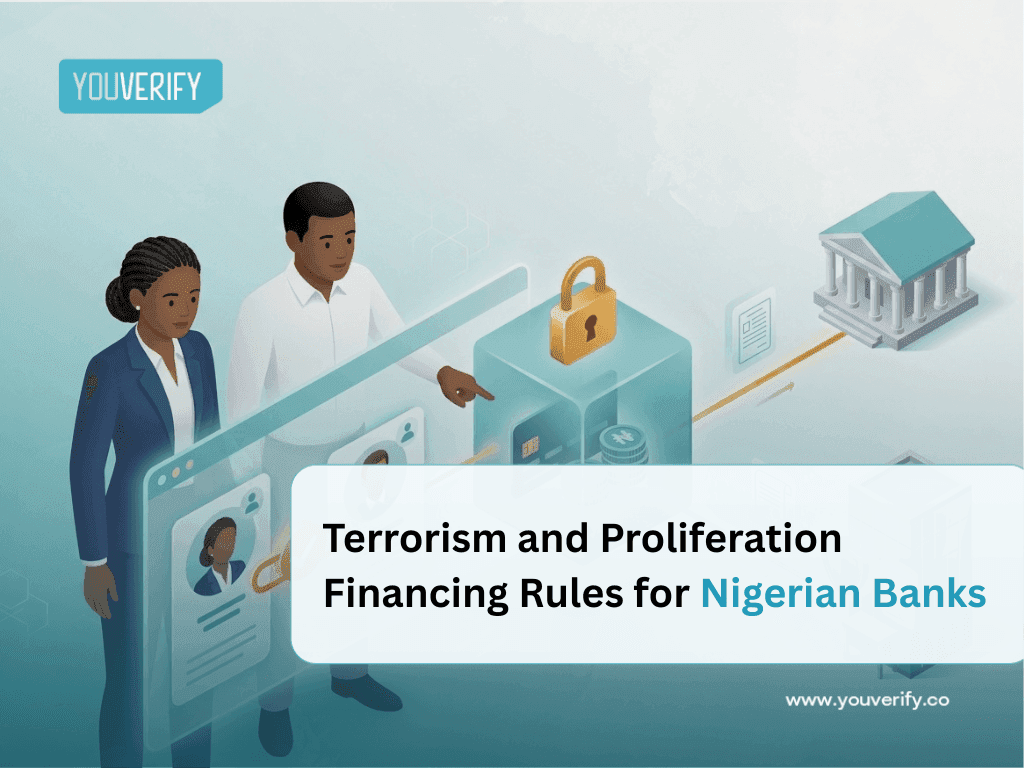
Nigeria's terrorism financing and proliferation financing rules require banks to do three things on a confirmed sanctions match: freeze the funds immediately and without prior notice, report the freeze to the Nigeria Sanctions Committee, and file a suspicious transaction report with the Nigerian Financial Intelligence Unit (NFIU). Those duties come from section 54 of the Terrorism (Prevention and Prohibition) Act 2022 and apply to every financial institution and designated non-financial business.
Unlike money laundering controls, targeted financial sanctions (TFS) leave no room for judgement about timing. There is no review window, no internal approval cycle and no customer conversation before the freeze. That difference is what most control gaps come down to.
What Are the Terrorism and Proliferation Financing Rules in Nigeria?
Nigeria's terrorism financing and proliferation financing rules sit in five instruments: the Terrorism (Prevention and Prohibition) Act 2022, the Regulation for the Implementation of Targeted Financial Sanctions 2022, the CBN AML/CFT/CPF Regulations 2022, the CBN Guidelines on Targeted Financial Sanctions Related to Terrorism and Terrorism Financing 2022, and the CBN Guidelines on Targeted Financial Sanctions Relating to Proliferation Financing 2022.
Instrument
What it does
Terrorism (Prevention and Prohibition) Act 2022
Creates the legal framework for targeted financial sanctions, establishes the Nigeria Sanctions Committee under section 10, and sets institution duties under section 54
Regulation for the Implementation of Targeted Financial Sanctions 2022
Issued by the Attorney-General on the same day as the Act; sets out how designations are communicated and acted on
CBN AML/CFT/CPF Regulations 2022
Requires financial institutions to implement targeted financial sanctions for both terrorism financing and proliferation financing
Sector guidance on screening, freezing and reporting
CBN Guidelines on TFS Relating to Proliferation Financing 2022
Sector guidance on weapons of mass destruction financing, including risk assessment, screening, monitoring and quarterly returns
Section 54 also obliges sector regulators to guide the institutions they supervise and to impose administrative sanctions on those that fail. That is why the CBN issued its own guidelines rather than leaving banks to read the Act alone, and why it wrote to all banks, payment service banks and other financial institutions in April 2025 restating these obligations.
Who Designates and Enforces Sanctions in Nigeria?
Four bodies matter: the Nigeria Sanctions Committee designates and maintains the Nigeria Sanctions List, the NFIU receives suspicious transaction reports, the CBN supervises financial institutions and receives quarterly returns, and sector regulators such as the Securities and Exchange Commission cover their own markets.
NIGSAC is chaired by the Attorney-General of the Federation and is empowered to enforce the United Nations Security Council Resolutions listed in Schedule 1 of the Act. Its Secretariat communicates designations and updates directly to financial institutions, and publication of a list on the Nigeria Sanctions Committee website is treated as sufficient notice of circulation.
That last point carries operational weight. Notice does not depend on an email reaching your compliance inbox. Once a designation is published, the clock has started, which is why list monitoring has to be a monitored process rather than a person's habit.
What Must a Bank Do When It Finds a Confirmed Match?
Section 54 of the Terrorism (Prevention and Prohibition) Act 2022 requires four actions on a confirmed match: freeze the assets immediately without prior notice, report the freeze to the NIGSAC Secretariat, file a suspicious transaction report with the NFIU, and report attempted transactions as well as completed ones.
1. Freezing: Immediate, and Without Telling the Customer
Identify and freeze all funds, assets and other economic resources owned or controlled by the designated person or entity, without delay and without prior notice. Freezing covers more than account balances: debts and trade debts, insurance and reinsurance interests, and interests in a sole trader or partnership can all fall within scope.
2. Reporting to NIGSAC: Tell the Secretariat What You Froze
Report the freeze, and any other action taken in compliance with the designation, to the Secretariat of the Nigeria Sanctions Committee. Include enough detail to identify the accounts, the values and the timing of each step.
3. Filing With the NFIU: An STR on Top of the Freeze Report
File a suspicious transaction report with the NFIU immediately, so the financial activity of the designated person or entity can be analysed. The freeze report and the STR are separate obligations, and doing one does not discharge the other.
4. Attempted Transactions: Report What Did Not Complete
Attempted transactions must be reported. A blocked transfer that never settled is exactly the intelligence the authorities want, and institutions that report only completed activity leave a gap that shows up in examination.
How Often Must Banks Screen, and Against Which Lists?
Screening must run against both the UN Consolidated List and the Nigeria Sanctions List, at onboarding, before transactions, on an ongoing basis for existing customers, and whenever a list is updated. A confirmed match against either list triggers the freezing duty.
Two failures recur in screening reviews. The first is list coverage: institutions screen the UN list and treat the national list as secondary, or vice versa. The second is matching logic, where records are loaded on legal name alone and miss alias forms, transliterations and non-Latin script variants.
Rescreening the existing book matters as much as screening new customers. A designation published today applies to relationships opened years ago, so the only way to comply is to run the new list across the whole customer base, not just the day's new traffic. Our daily sanctions monitor tracks list changes across authorities so compliance teams see each change on the day it lands.
What Is Proliferation Financing, and How Does It Differ From Terrorism Financing?
Proliferation financing is the provision of funds or financial services for the development, acquisition, export or trans-shipment of weapons of mass destruction and their delivery systems. Terrorism financing funds violence against people. Proliferation financing funds weapons programmes, chiefly through the United Nations regimes covering North Korea and Iran.
Detection differs as a result. Terrorism financing often shows behavioural signals such as small structured transfers to high-risk corridors. Proliferation financing usually shows up in counterparties, trade documentation and goods: dual-use items, front companies, shipping and freight-forwarding intermediaries, and trade routes that make no commercial sense for the stated business.
The CBN's guidelines on targeted financial sanctions relating to proliferation financing require institutions to assess proliferation risk, screen, monitor transactions and keep records accessible. They also carry a reporting duty that terrorism financing does not: quarterly returns on TFS actions to the Director of the Financial Policy and Regulation Department, within 10 days after each quarter ends.
What Sanctions Reports Are Due, and When?
Nigerian banks file three sanctions-related reports: an immediate freeze report to NIGSAC, an immediate STR to the NFIU, and quarterly TFS returns to the CBN. The quarterly return is the one most often missed, because nothing triggers it when there is no activity to report.
Report
Goes to
Deadline
Freeze report and actions taken, including attempted transactions
Secretariat, Nigeria Sanctions Committee
Immediately on freezing
Suspicious transaction report
NFIU, via goAML
Immediately; written report within 24 hours under the MLPPA 2022
Quarterly TFS returns on actions taken
Director, Financial Policy and Regulation Department, CBN
Within 10 days after each quarter end
Treat the quarterly return as a standing calendar item with a named owner, including quarters with nothing to report. Silence is not the same as a nil return.
Why Is Terrorism Financing a Supervisory Priority Right Now?
Three developments put terrorism financing at the top of the supervisory agenda: the Federal Government designated 48 individuals and 12 entities in April 2026, the CBN named terrorism financing a current supervisory priority on 8 September 2026, and Nigeria's removal from the FATF grey list in October 2025 raised the burden of proving its reforms hold.
The April 2026 designations tested institutions directly. Banks and designated non-financial businesses were directed to identify and block all associated transactions, and the Securities and Exchange Commission issued a parallel instruction to capital market operators. Any institution whose screening missed a name on that list, or whose freeze took days rather than hours, produced an examination finding it will have to explain.
The supervisory priority announced in September 2026 covers risk management, transaction monitoring, sanctions implementation and suspicious transaction reporting. Those are the same capabilities the AML regulations in Nigeriarequire through the CBN Baseline Standards, with deadlines of 10 September 2027 for banks and 10 March 2028 for other institutions.
How Do Banks Build Sanctions Controls That Hold Up?
Banks build defensible targeted financial sanctions controls in six ways: confirming list coverage, fixing matching logic, writing a freeze runbook that works outside office hours, keeping evidence of every decision, training the people who act, and filing quarterly returns from a single source.
1. List Coverage: Load Both the UN and Nigerian Lists
Confirm which lists your system holds, how often each refreshes, and how quickly a NIGSAC publication reaches production. Document the refresh cycle, because the gap between publication and loading is where liability sits.
2. Matching Logic: Test Aliases, Transliterations and Script Forms
Run known designated names through screening in their alias and non-Latin script forms. Alias coverage is the single most common failure found in screening reviews, and it is cheap to test before an examiner does it for you.
3. Freeze Runbook: Decide Now Who Can Act at 2am
Write down who confirms a match, who executes the freeze, who authorises it out of hours, and how the customer-facing teams are briefed without tipping anyone off. A freeze duty with no out-of-hours path is a policy, not a control.
4. Evidence: Keep the Record of Matches You Cleared
Log confirmed matches and dismissed ones, with the reasoning and the person who decided. Discounted alerts are reviewed as closely as frozen accounts, because that is where under-screening shows.
5. Training and Governance: Brief the Board and the Front Line
Run targeted financial sanctions training for the board, senior management and operational staff, and record it. Sanctions duties fall on people who may never have seen a designation before.
6. Quarterly Returns: One Owner, One Source, Nil Returns Included
Generate the CBN quarterly return from the same case records that hold your freezes and reports, so the numbers reconcile. Put the 10-day deadline in the compliance calendar with a named owner.
Meeting Nigeria's Terrorism Financing Rules With Youverify
Nigeria's terrorism financing and proliferation financing rules demand screening that catches alias forms, freezes that happen within minutes of a designation, and a record clean enough to hand to an examiner. Youverify supports all three for Nigerian banks, fintechs and payment providers.
Customer Onboardingruns document, anti-deepfake liveness and government-source checks in one journey, scored to a risk tier, so sanctions and politically exposed person screening happens against a verified identity rather than a typed name. Transaction Monitoring applies rules and models on live flows, with typologies tuned to multi-currency, mobile money and cross-border corridors, which is where terrorism financing patterns and proliferation-linked trade flows surface.
When a match is confirmed, Case Management holds the queues, SLAs, the entity graph, evidence and a decision trail you can hand to an examiner, covering both the freeze report and the alerts you cleared. Regulatory Reporting drafts STRs, CTRs and periodic returns from the case file, formatted per regulator, filed with the evidence attached, which is what the NFIU filing and the CBN quarterly return both need.
The freeze decision stays with your compliance team, as the Act requires. Youverify makes sure the match is found, the clock starts on time, and the evidence is there afterwards. Ask our team for a sanctions screening review and see what your current setup would have caught in April 2026.