
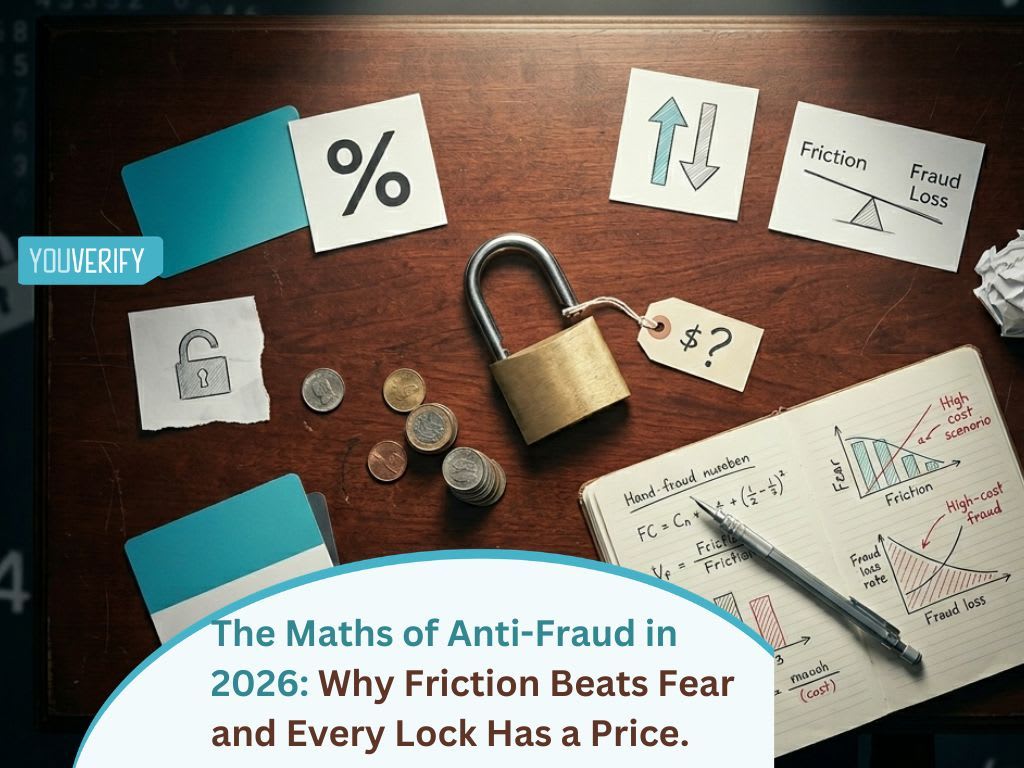
Maths of Anti-Fraud in 2026: Why Friction Beats Fear and Every Lock Has a Price
Key Takeaways
Fraud is an arithmetic problem. The attacker's cost has collapsed, a $1,000 toolkit can cause $2.5 million in monthly losses. Africa is one of the fastest-growing attack surfaces in the world, with deepfake fraud up 393% year-on-year. Meanwhile, defenders are still paying in months and tens of thousands to certify tools that attackers have already moved past.
The problem is not just the technology. It is the human. People will always choose less friction over more security, every time, in every market.
Your defences were never meant to be unbreakable. They were meant to make your customers' wallets not worth the effort. Right now, we are losing that bet.
What needs to change: stop procuring for the badge, start procuring for the decay curve. Treat anti-fraud like a subscription, not a one-time purchase. And make fraud expensive for institutions, so institutions make it expensive for fraudsters.
Anti-fraud is an arithmetic problem. Two ideas almost no one selling it will tell you out loud, both backed by numbers.
Friction will always beat fear in the user.
And our defences have never been about being unbreakable. They have been about being expensive to fraudsters.
By 2026, both ideas are working against us. Group-IB documented 8,065 deepfake bypass attempts against one financial institution’s liveness checks in just eight months of 2025. That is what the maths looks like when it goes wrong.
Let me start with the part that still bothers me.
In 2023 we pulled our own facial liveness service off the shelf at Youverify. Not because it had failed certification. Not because of uptime. We pulled it because customers were quietly telling us that the same trick used to bypass other vendors, global and local, also worked on us. Their words, not ours.
We rebuilt the engine specifically against deepfake and injection attacks. The new version held. We then spent tens of thousands of US dollars taking it through CEN/TS 18099 testing and FIDO certification.
By the time the certification process began, the attackers had already moved past the version we had submitted.
That is not a lab anecdote. That is the entire anti-fraud industry, in one season of one company. The defender pays in tens of thousands, in months, in certification cycles. The attacker pays in dollars, in minutes, in downloads, and in the relentless velocity of generative AI. That is the arithmetic.
Friction will always beat Fear
People do not use bad passwords because they do not understand fraud. They use bad passwords because the password they can remember is the only one they will actually use. Product designers learned this years ago. It is why Face ID, Touch ID and passkeys exist. Every step-up authentication flow is, deep down, an apology.
The security-enhancing friction framework from NSPW 2020 shows that strong-password rules and fear-appeal warnings can raise stated intent in the short term, but still lose to friction in the steady state. Fear is a short-lived emotion. Friction is a constant tax. Across a year, friction wins.
Before you decide whether I am right, try a quick test on yourself.
Five Questions you are the only Person reading
One. Your bank app gives you two ways to send $100 to a new beneficiary. Flow A is three taps and the money is gone. Flow B inserts a screen that says, “about 1 in 200 transfers this size to a new beneficiary turns out to be a scam, are you sure”, followed by a few more steps. Which do you actually use day to day. Which do you say in a survey you would prefer.
Two. When was the last time you read a security warning on a banking app, all the way through, before tapping “Continue”.
Three. You set up Touch ID once. It fails because the sensor is dusty. How many failures before you stop trying and just use the passcode.
Four. Your password manager pings you, “five of your passwords are reused”. You promise to fix them this weekend. It has been how many weekends.
Five. You forgot the PIN to one of your bank cards last month. Between three bank accounts, a few USSD services and two SIM PINs, you are juggling at least six PINs in your head. Be honest. How many of them are actually different from each other.
If you answered “less friction” on most, you are not unusual. You are the entire market. The fraud designer knows you will say that. Their entire business is built on it.
SIM PIN and PUK have existed since the 1990s. SMS OTP is older than most of the engineers building around it. People still get cleaned out using both, not because the cryptography is the only problem, but because the human in the loop will trade a small friction for a large risk every time you let them.
We built systems that let them.
The Lock is just a Price
This is the second idea, and it is the one practitioners forget under pressure.
Physical security has always been honest about it. A burglary-rated commercial safe is graded TL-15 or TL-30 by Underwriters Laboratories, where the number is the net minutes of attack time the door is supposed to survive against two skilled testers with a specific kit of tools. A lock is sold by how long a competent picker needs to defeat it. A banknote is judged by what it costs to counterfeit relative to its face value.
None of these defences are absolute. They are bets that the cost of cracking them is more than the prize, plus a margin.
Anti-fraud, KYC, liveness, AML and payments security are the same shape. Every defence carries a price for the institution and a price for the criminal. The job is to make the attacker’s cost, in effort, in tools, in the risk of getting caught, expensive enough that your customer’s wallet stops being worth it.
You are not building a wall. You are setting a price.
The Price of the Attack collapsed in our Generation
Look at the inputs. This is the maths the title promised.
A convincing voice clone no longer needs a lab. Microsoft’s VALL-E paper, published in early 2023, was the public demonstration. The 2024 New Hampshire robocall faking the voice of a sitting US president to suppress votes was the operational version. A New Orleans magician made it in roughly twenty minutes, for a $150 Venmo fee.
That is not the cost of a sophisticated state actor.
That is the cost of one gig.
A face swap good enough to defeat many face checks can now run on free or low-cost tooling. iProov’s 2024 Threat Intelligence Report found a 704% rise in face-swap attacks between H1 and H2 2023, with 120 face-swap tools in active use and thirty-one new threat groups selling them. Its later reporting was harder to read with a straight face. Native virtual-camera attacks were up 2,665% in 2024. iOS-specific injection attacks were up 1,151% in the second half of the year alone. Group-IB then documented those 8,065 attempts against one bank’s KYC flow between January and August 2025.
MIT Technology Review’s April 2026 investigation found 22 public Telegram channels openly selling virtual-camera injectors, deepfake generators and Android hooking frameworks for as little as $30 a kit, advertised against named banks.
Twenty dollars more than a takeaway pizza buys tooling designed to challenge a regulated financial institution.
Sumsub’s 2024 Identity Fraud Report lands the cost asymmetry in one line. A fraudster group with $1,000 in tooling can inflict $2.5 million in monthly losses on a target.
Read that as an economic statement, not a technical one.
The attacker’s cost has collapsed.
Africa is becoming one of the highest-ROI attack surfaces
That is not a comfortable line to write. It is what the numbers suggest.
The same Sumsub report puts Africa’s year-on-year deepfake fraud growth at 393%, with the Middle East at 643%. The two largest regional jumps in the world. Nigeria recorded the highest identity fraud rate on the continent. Country-level reporting since has been sharper still: Zambia saw a 967% surge in deepfake attempts in a single reporting cycle, with comparable jumps across DRC, Malawi, Tanzania and South Africa.
The retail picture is Banxso.
The South African trading platform took in a reported R280m from over 380 retail investors who clicked through social-media adverts using deepfake videos of Elon Musk, Johann Rupert and the UFC champion Dricus du Plessis. It then sponsored Bafana Bafana and du Plessis directly to project legitimacy.
The Western Cape High Court liquidated it. The Financial Sector Conduct Authority imposed a record R2bn penalty. It also debarred several key persons for 30 years, while one received a 10-year debarment.
Customers had already lost their savings.
This is not a freak event. It is what happens when the attacker’s prize grows faster than the defender’s cost base. It is the predictable outcome of a region where digital value is increasing, customer onboarding is moving online, fraud tooling is getting cheaper, and many institutions are still forced to buy the cheapest lock that meets the procurement checklist.
The Threat cycle is moving faster than the Certification cycle
I want to defend the standards, because procurement teams are starting to dismiss them, and that is not the right lesson
ISO/IEC 30107-3 is a serious piece of work. It is the international yardstick for presentation attack detection, somebody holding a printed photo, a mask or a video up to a camera. CEN/TS 18099 is a newer yardstick for injection attack detection, and FIDO certification has become an important signal for biometric liveness assurance, which is what actually matters in 2026 because injection attacks bypass the camera entirely.
Presentation attacks try to fool the camera.
Injection attacks try to bypass the camera.
That distinction is everything.
Certifications under these standards can run into tens of thousands of US dollars and take months. The standards are not the problem. The cycle time is.
A certification cycle measured in months, against an attacker community shipping updates in days, will always lag. The right way to read a liveness certificate is the way you read a safe rating. It tells you the door survived a specific set of tools for a specific number of minutes, on a specific test bench, at a specific time.
It does not promise the door is unbreakable today.
It certainly does not promise it will hold next year.
What the lock-buyer and the lock-seller should do
For financial institutions and telcos, stop procuring only for the badge. Start procuring for the decay curve.
Ask your vendor, in writing, for their median time-to-defence against a new attack class. That means the time between a new attack method being observed and the vendor shipping a tested defence against it.
Treat anti-fraud like an antivirus subscription, not a one-time purchase. If a vendor cannot tell you when their model was last retrained against face-swap and injection samples, you do not have a relationship.
You have a bill.
For vendors, including the ones I compete with, stop selling a state of certification as a state of safety. Be honest about the decay curve. Publish your refresh cycle. Show how often you test against new attack samples. Show what changed after the last bypass pattern. Show buyers that the defence is alive.
The market will reward it once it learns to ask.
For regulators, lift the floor for behaviour, not for badges. Mandate continuous testing programmes against current attack tooling, not a single annual certificate filed in a drawer.
Nigeria’s CBN Baseline Standards for Automated AML/CFT/CPF Solutions are already moving in this direction by requiring stronger governance, testing and defensibility around automated compliance systems. The harder question is how consistently those standards will be enforced.
The Philippines has moved faster than many markets on this specific issue, shifting liability pressure toward institutions that cling to weak controls under Circular 1213.
African regulators should seriously consider the same direction.
Make fraud expensive for institutions, and institutions will make it expensive for fraudsters. Today, individual victims of fraud, the ones who are not large corporates, are too often left to hold the bag. Many of those losses never get reported.
Nobody here is being lazy
I do not think the fintechs running outdated liveness, knowingly or not, are stupid. They are running on margins of nothing, and the unit economics tell the story.
M-Pesa, the largest mobile-money platform on the continent, runs at roughly USD 30 of revenue per active customer a year based on Safaricom’s FY24 results. PalmPay’s public numbers point in the same direction. Using reported 2023 revenue of roughly $64m and public user-base figures as a rough proxy, revenue per registered user appears to sit in the low single digits. That is not a perfect ARPU measure because registered users are not the same as active users. But it illustrates the pressure.
US and UK retail-bank customers sit somewhere between several hundred and well over a thousand dollars of revenue per year. McKinsey puts the gap most directly: reaching profitability per acquired customer is roughly four times harder in Africa than Latin America, and thirteen times harder than in the European Union, at comparable investment levels.
Now layer on identity controls.
In market-observed volume pricing, biometric liveness and face match can run from cents to a few dollars per session, while stacked electronic ID, address verification and full document checks increase the cost further.
At a US bank customer worth $1,000 a year, a $1 liveness session is rounding error.
At a low-ARPU African wallet, it can be a real economic decision.
That is the arithmetic quietly driving many cheap procurement decisions on the continent. It is also how one of the fastest-growing digital-finance regions in the world ends up with some of the most underpriced locks on its doors.
The maths of anti-fraud was never about unbreakable.
It was about being expensive to fraudsters.
We are losing that bet.
The job, for the next two years, is to balance the arithmetic again.
Related Articles

Fraud Detection Using Machine Learning - How Does it Work?
What is Bank Fraud with Examples