
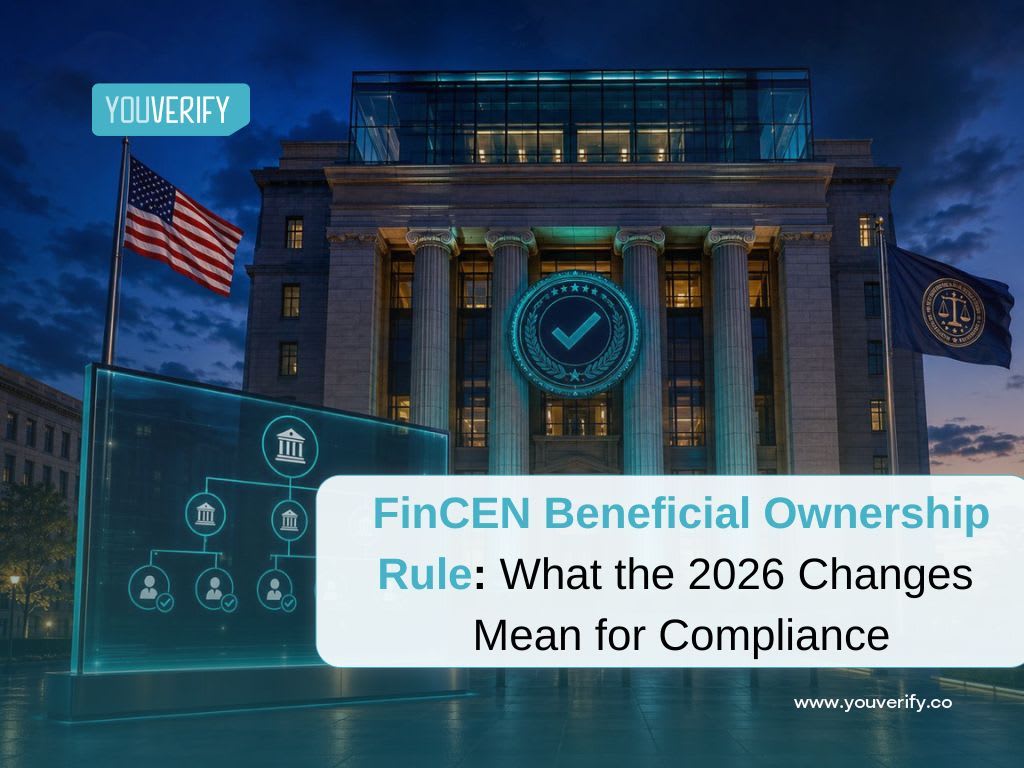
FinCEN Beneficial Ownership Rule: What the 2026 Changes Mean for Compliance
Key Takeaways
The FinCEN beneficial ownership rule permanently exempts U.S. companies and U.S. persons from federal BOI reporting requirements.
Beneficial ownership reporting obligations still apply to certain foreign reporting companies.
FinCEN plans to delete previously filed BOI information belonging to now-exempt U.S. persons.
The change affects FinCEN BOI reporting, but beneficial ownership risk remains relevant to KYB, AML and fraud controls.
The FinCEN beneficial ownership rule changed significantly in August 2026. U.S. companies and U.S. persons are no longer required to submit beneficial ownership information to FinCEN under the Corporate Transparency Act.
This ends a major federal beneficial ownership reporting requirement, but it does not make beneficial ownership information irrelevant to compliance teams. Financial institutions and other regulated businesses may still need to understand who ultimately owns or controls the entities they work with as part of their wider KYB and financial crime risk processes.
The August 2026 FinCEN beneficial ownership rule permanently removed mandatory BOI reporting for U.S. companies and U.S. persons. Certain foreign reporting companies can still have beneficial ownership reporting obligations, making the current scope of FinCEN BOI reporting narrower rather than entirely eliminated.
What changed under the FinCEN beneficial ownership rule?
The FinCEN beneficial ownership rule was finalized on August 11, 2026, permanently ending BOI reporting requirements for U.S. companies and U.S. persons. The rule was published on August 14, 2026. The changes to beneficial ownership reporting mean:
Before the 2026 final rule | Under the current rule |
U.S. companies had broader BOI reporting obligations | U.S. companies are exempt from FinCEN BOI reporting |
U.S. persons could be reported as beneficial owners | U.S. persons are generally exempt from the current reporting requirements |
Some FinCEN ID information required updates | Exempt U.S. persons are no longer required to update or correct information in the same way |
Foreign reporting companies had BOI obligations | Certain foreign reporting companies remain subject to beneficial ownership reporting |
The FinCEN beneficial ownership rule also provides for the deletion of previously reported BOI information belonging to U.S. persons who are now exempt.
The Corporate Transparency Act itself, however, has not been repealed. The change concerns the scope of the BOI reporting requirements administered by FinCEN.
Who still has to report beneficial ownership information?
The current FinCEN beneficial ownership rule does not remove every BOI obligation.
Certain foreign entities formed under foreign law and registered to do business in the United States can still qualify as reporting companies. Under the current beneficial ownership reporting framework, those companies may be required to report their foreign beneficial owners to FinCEN.
This is why compliance teams should avoid relying on articles written before the 2026 rule change. The scope of FinCEN BOI reporting has changed, and the reporting requirements now depend on the company's status and the nationality of the beneficial owners involved.
For the latest interpretation of the FinCEN beneficial ownership rule, businesses should consult FinCEN's current guidance and official announcements.
What does the FinCEN beneficial ownership rule mean for compliance teams?
The end of mandatory beneficial ownership reporting for millions of U.S. companies should not be interpreted as the end of beneficial ownership compliance.
A reporting obligation and a risk control serve different purposes. The Corporate Transparency Act created a reporting framework for beneficial ownership information, while banks, fintechs and other regulated businesses may need ownership information to assess the entities they onboard or monitor.
For example, a company can be legally registered and still present financial crime risks through:
Complex or layered ownership
Sanctions exposure involving owners or controllers
Fraud linked to undisclosed control relationships
Shell companies designed to obscure who ultimately benefits from the business
This makes beneficial ownership compliance an important consideration beyond any specific FinCEN BOI reporting deadline.
The reporting rule changed, but beneficial ownership risk remains
The FinCEN beneficial ownership rule changed a federal reporting requirement. It did not remove the need for businesses to understand who owns or controls higher-risk customers and counterparties.
For banks and fintechs, this is where KYB processes remain important. KYB compliance for financial institutions can go beyond basic company registration checks to assess ownership structures and the people behind a business.
Similarly, business identity verification helps establish whether a company is legitimate, while KYB checks can support a broader understanding of the entity, its ownership and its associated risk.
The FinCEN beneficial ownership rule changes the federal beneficial ownership reporting requirement. It does not eliminate the financial crime risks associated with opaque ownership structures.
For that reason, the right response to the 2026 change may be to reassess beneficial ownership compliance controls rather than simply removing ownership verification from an institution's risk framework.
Conclusion
The FinCEN beneficial ownership rule permanently ended mandatory FinCEN BOI reporting for U.S. companies and U.S. persons. Certain foreign reporting companies can still be subject to beneficial ownership reporting obligations under the current framework.
For affected businesses, the rule removes a major federal filing requirement under the Corporate Transparency Act. For compliance teams, however, the more important question remains: who ultimately owns and controls the businesses you are onboarding, monitoring or working with?
The end of one beneficial ownership reporting mandate does not automatically end the risks created by opaque corporate structures. Effective beneficial ownership compliance can still play an important role in KYB, fraud prevention and financial crime risk management.
For a deeper look at the importance of ownership information, read
Related Reads: Why KYB Verification Is Important for AML Compliance and What Documents Are Required for KYB Verification?
Related Articles
What are the Benefits of Compliance Automation Workflow?
How Compliance Solutions Streamline Operations and Improve Efficiency