

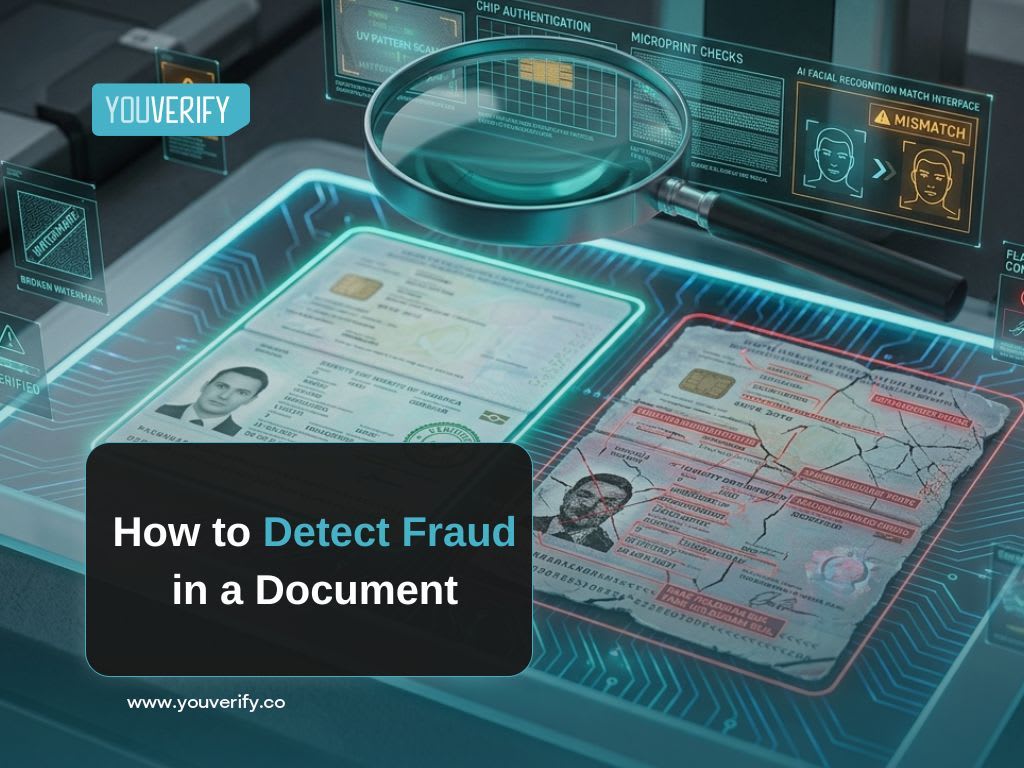
How to Detect Fraud in a Document
Key Takeaways
- Document fraud includes fake, altered, stolen, expired, and synthetic identity documents that criminals use to bypass KYC and commit financial fraud.
- Effective document fraud detection combines OCR, document validation, biometric verification, and AI to identify forged or manipulated identity documents with greater accuracy.
- AI-powered document fraud detection analyses document authenticity, image manipulation, and identity consistency in real time, enabling faster onboarding while reducing fraud risk.
- Integrated document verification platforms like Youverify automate identity verification, helping businesses strengthen compliance, reduce manual reviews, and prevent fraudulent onboarding.
In Know Your Customer (KYC) processes, customers are typically required to submit government-issued identity documents to prove they are who they claim to be. Verifying these documents is a critical step in preventing identity fraud, meeting regulatory requirements, and protecting businesses from financial crime.
However, fraudsters often attempt to bypass KYC checks by submitting fake, altered, stolen, or manipulated documents. This type of application fraud allows criminals to gain access to financial services, open accounts, or obtain benefits they are not entitled to.
Manual document reviews only are no longer efficient, and that is why businesses increasingly rely on AI-powered document fraud detection to identify these forged documents and verify identities at the phase of onboarding.
What Is Document Fraud?
Document fraud is the creation, alteration, or use of fake, forged, or manipulated documents to misrepresent a person's identity or information. In simple terms, it involves using documents that are either not genuine or do not belong to the individual using them.
Common types of document fraud include:
1. Fake documents: Completely forged identity documents designed to imitate genuine government-issued IDs.
2. Altered documents: Legitimate documents that have been modified by changing names, photographs, dates, addresses, or identification numbers.
3. Stolen or borrowed documents: Genuine documents presented by someone other than the rightful owner.
4. Expired or invalid documents: IDs that are no longer valid but are presented as active identification.
5. Synthetic identities: Identities created by combining genuine personal information with fabricated details to create a new identity.
Understanding document fraud is essential because a single successful fraudulent onboarding can expose organisations to financial losses, regulatory penalties, compliance failures, and reputational damage.
READ MORE: What is Document Fraud?
How to Detect Document Fraud
Detecting document fraud requires more than visual inspection. Modern document fraud detection combines automation, artificial intelligence, biometric verification, and document validation to identify suspicious documents at scale.
1. OCR and Data Extraction
Optical Character Recognition (OCR) extracts information from identity documents and converts it into structured digital data for analysis.
OCR helps identify:
- Inconsistent names, dates, document numbers, or spelling
- Incorrect document layouts and formatting
- Missing government seals or security markings
- Signs of digital editing or tampering
OCR is the foundation of most document fraud detection systems. However, OCR alone cannot confirm whether a document is authentic, making additional verification layers essential.
2. Visual and Security Feature Checks
Modern document fraud detection software examines built-in security features to determine whether a document has been forged or manipulated.
These checks include:
- Missing or poorly replicated security features
- Blurred photographs or poor image quality
- Evidence of photo replacement, cropping, or digital alteration
- Unnatural lighting, shadows, or image inconsistencies
Visual checks quickly identify obvious signs of document fraud but are most effective when combined with AI-powered analysis.
3. Data Validation and Consistency Checks
After OCR extracts document information, the data is validated against trusted data sources, country-specific document standards, and expected document formats.
Advanced document fraud detection systems also compare information across multiple submitted documents to identify inconsistencies that may indicate fraud.
4. Biometric Identity Matching
Biometric verification compares the photograph on the submitted document with a live selfie or video captured during onboarding.
This confirms that the document belongs to the individual presenting it and helps prevent identity theft, impersonation, and stolen document fraud.
Biometric matching has become a core component of online document fraud detection for remote customer onboarding.
5. AI-Powered Document Fraud Detection
Fraudsters constantly develop new methods to manipulate identity documents, making static verification rules increasingly ineffective.
AI-powered document fraud detection analyses thousands of document characteristics simultaneously, learning patterns that are often impossible to detect through manual review.
By combining machine learning, behavioural analysis, OCR, and biometric verification, AI continuously improves fraud detection accuracy while reducing false positives.
ALSO READ ON: ID Document Fraud Detection
How does AI Detect Document Fraud?
AI-powered document fraud detection combines multiple verification technologies and uses machine learning models trained on millions of real and fraudulent documents to detect fraud in real time.
A modern document fraud detection system can:
- Detect fake, forged, and altered identity documents.
- Identify image manipulation and synthetic identity fraud.
- Validate document authenticity and country-specific formats.
- Extract and verify document information using OCR.
- Match identity documents with biometric data.
- Scale fraud detection across thousands of verifications with minimal manual intervention.
Detect Document Fraud Faster with Youverify
With Youverify's AI-powered document fraud detection, businesses can verify identity documents in real time using OCR, AI, biometric verification, and document validation from a single platform. Instead of relying on manual reviews, Youverify automatically detects fake or altered documents, validates customer information, and confirms that the document belongs to the person presenting it.
Whether you're onboarding customers remotely or verifying documents at scale, Youverify helps you detect fraud faster, reduce manual reviews, strengthen KYC compliance, and deliver a seamless onboarding experience.
Ready to see it in action? Book a free demo now or speak with our experts.
Frequently Asked Questions
Related Articles

Fraud Detection Using Machine Learning - How Does it Work?

What is Bank Fraud with Examples