What Are The KYC Requirements For Banks In Nigeria
ByFavour Praise
•5mins Read
Key Takeaways
KYC requirements for banks in Nigeria cover customer identification, identity verification, due diligence, beneficial ownership, risk assessment, recordkeeping, and ongoing monitoring.
KYC in banking relies on tools such as BVN and NIN to support customer identity verification and help banks validate information during onboarding.
A strong KYC process uses a risk-based approach, with enhanced due diligence and closer monitoring for customers or activities presenting higher financial crime risks.
Effective KYC compliance requires continuous customer reviews, updated information, automated verification, and integrated controls to manage fraud and AML risks.
If a customer walks into a Nigerian bank to open an account, the bank needs to know who the customer is, verify their personal information provided, understand the customer's risk, and keep their records updated throughout the period the account exists.
These are the basics of KYC requirements for banks in Nigeria. The KYC requirements cover customer identity verification, beneficial ownership, customer due diligence, recordkeeping, and ongoing monitoring.
For Nigerian banks, KYC in banking should not be a one-time exercise. It starts when a customer opens an account and continues as the bank's relationship with that customer develops.
KYC Requirements in Nigeria: What Banks Need to Know
The KYC requirements for banks in Nigeria form part of the country's AML/CFT framework. This framework includes the Money Laundering (Prevention and Prohibition) Act 2022 and the Central Bank of Nigeria's AML/CFT/CPF Regulations.
The Nigerian Financial Intelligence Unit's laws and regulations (NFIU) includes the Money Laundering (Prevention and Prohibition) Act 2022 among Nigeria's key financial crime legislation. The CBN also has specific AML/CFT/CPF regulations for financial institutions.
That is to say that these rules provide the foundation for KYC compliance and strict financial crime controls for banks and other financial institutions.
Understanding source of funds or wealth where required
Monitoring customer activity
Keeping customer information and records up to date
The level of due diligence can vary according to the customer's risk profile. Higher-risk customers may require enhanced customer due diligence (EDD) and closer monitoring.
This means KYC in banking goes beyond collecting an ID card. A bank needs to understand who the customer is, what they intend to use the account for, and whether their activity is consistent with their profile.
What Documents Are Required for KYC in Nigerian Banks?
The documents required can differ depending on whether the customer is an individual or a corporate customer, as well as the account type and risk level.
Here is a practical overview of common information and documents banks may request as part of their KYC requirements:
Individuals
Corporate Customers
Full name, address and date of birth
Certificate of Incorporation or registration documents from CAC
BVN (Bank Verification Number)
Tax Identification Number (TIN)
NIN or other valid government-issued ID
Registered business address
Valid ID such as NIN, passport or driver's licence
Board resolution and authorised signatories, where applicable
Recent utility bill or acceptable proof of address
Ownership structure and beneficial ownership information
Phone number and email address
Details of directors and persons authorised to act for the business
Source of funds or income, where required
Nature and purpose of the business relationship
Other information required based on the customer's risk profile
Source of funds or wealth, where required
The CBN's BVN information identifies documents such as a driver's licence, international passport, National Identity Card and Permanent Voter's Card among identification documents used in Nigeria's banking system.
For new individual accounts and wallets, CBN guidance also requires electronic retrieval of available BVN or NIN-related information where applicable.
However, submitting these documents does not automatically complete the KYC process. The bank must verify the information and carry out appropriate due diligence based on the customer's risk.
For corporate customers, KYC for banks also involves understanding the company, its ownership structure and the individuals who ultimately own or control it.
How Do Nigerian Banks Implement KYC?
A typical KYC process begins when a customer applies to open an account or establish a banking relationship.
1. Customer Identification
The bank collects basic information about the customer, including their name, date of birth, address, contact details and identification information.
For a business, the bank also collects information about the legal entity, directors, authorised representatives and ownership structure.
This is the first stage of KYC in banking because the bank cannot properly assess a customer without first establishing who they are.
2. Identity Verification
The bank verifies the information provided against reliable sources. BVN and NIN play an important role in this stage. CBN guidance provides for electronic retrieval of BVN and NIN information for applicable customers during onboarding. Where the information does not match, the institution is expected to resolve the discrepancy before proceeding.
Digital identity verification can therefore make the KYC process more efficient, particularly when banks handle large volumes of customers.
3. Customer Due Diligence
The bank then conducts customer due diligence to understand the customer and the risks associated with the relationship. Depending on the customer and their risk profile, this can include checking:
Source of funds
Source of wealth
Beneficial ownership
PEP status
Sanctions exposure
Nature of business
Expected transaction activity
The CBN's Customer Due Diligence Regulations provide for enhanced due diligence where a customer, business relationship or transaction presents higher money laundering, terrorist financing or proliferation financing risks.
This is an important part of KYC compliance because knowing a customer's identity is only one part of understanding their financial crime risk.
The bank assesses the customer's risk based on factors such as their occupation or business, location, expected activity, ownership structure and transaction profile. The result can determine the level of due diligence and monitoring the customer requires.
This risk-based approach is central to KYC requirements for banks because not every customer presents the same level of risk.
5. Ongoing Monitoring
KYC requirements continue after an account has been opened. Banks need to keep customer information relevant and up to date and keep monitoring their activities. If there is a significant change in the customer's circumstances or account activity, the bank may need to refresh the customer's information and conduct additional due diligence.
Ongoing monitoring is an important part of KYC compliance, as many things happen not only during account opening.
How Do BVN and NIN Support KYC in Nigeria?
BVN and NIN are important tools within KYC for banks in Nigeria. The CBN introduced the BVN system as a unique identifier for customers across the Nigerian banking industry. It was designed to strengthen KYC and improve the safety of the banking system.
CBN guidance also requires applicable individual accounts and wallets to have BVN and/or NIN and provides for electronic retrieval of the relevant information when onboarding new customers.
For banks, this makes BVN and NIN valuable components of the KYC process. They can help institutions establish whether information provided during onboarding matches information held in the relevant identity databases.
For KYC in banking, the CBN is the main regulator for banks, while the NFIU plays an important role in financial intelligence and suspicious transaction reporting.
- Central Bank of Nigeria (CBN)
The CBN is the primary regulator for banks and other financial institutions under its regulatory purview. It supervises AML/CFT/CPF controls and issues requirements covering areas such as customer due diligence, risk assessment, transaction monitoring and suspicious transaction reporting.
For banks, the CBN's rules are therefore central to KYC compliance and the implementation of Banking KYC requirements.
- Nigerian Financial Intelligence Unit (NFIU)
The NFIU is Nigeria's central financial intelligence agency. It receives financial intelligence and reports from reporting entities, analyses the information and disseminates relevant intelligence to competent authorities.
The NFIU also maintains a laws and regulations section containing key Nigerian AML/CFT legislation and regulatory materials. The NFIU's role is particularly relevant to the reporting and financial intelligence side of KYC compliance and AML controls.
- Securities and Exchange Commission (SEC)
The SEC regulates Nigeria's capital market and has AML/CFT/CPF requirements for entities under its supervision.
Itsrules and regulations include requirements relating to customer identification, verification and due diligence.
For banks specifically, however, the CBN remains the primary regulator for Banking KYC requirements.
What Are the Risks of KYC Non-Compliance?
Failing to meet KYC requirements can expose financial institutions to regulatory, financial and reputational risks.
These include:
Regulatory sanctions and penalties
Increased exposure to money laundering and fraud
Weak customer and transaction risk detection
Failure to identify or report suspicious activity
Reputational damage
Increased regulatory scrutiny
Poor KYC compliance can also make it difficult for a bank to demonstrate that it has effective controls for identifying and managing financial crime risks.
For this reason, KYC requirements for banks should not be treated as a box-ticking exercise.
What Are the Challenges of KYC Requirements for Banks in Nigeria?
Implementing KYC requirements at scale can be challenging, particularly for banks managing large customer bases across branches, mobile applications and other digital channels.
1. Incomplete or inconsistent information
Customers may provide information that is incomplete, outdated or inconsistent with information held in other databases.
This can make verification and customer profiling more difficult.
2. Identity fraud
Fraudsters can use stolen, altered or manipulated identity information to access financial services. Banks therefore need reliable identity verification as part of their KYC process, rather than relying only on documents submitted by customers.
3. Manual verification
Manual checks can slow down KYC for banks, particularly when thousands of customers need to be verified. So, automating routine checks can help banks process customers more efficiently while allowing teams to focus on exceptions and higher-risk cases.
4. Keeping customer information updated
Customer circumstances can change after onboarding. Their address, occupation, business activity, ownership structure or transaction behaviour may change over time. A strong KYC process needs to account for these changes.
5. Balancing compliance and customer experience
Banks need to meet Banking KYC requirements without creating unnecessary friction for legitimate customers. A well-designed digital KYC process can help automate routine checks while escalating unusual or higher-risk cases for additional review.
How Youverify Helps Banks Meet KYC Requirements
Youverify helps financial institutions digitise the KYC process with identity verification, biometric verification, liveness detection and digital customer onboarding.
Banks can build KYC compliance into their onboarding workflow while connecting identity verification with wider fraud and AML controls. This can help teams manage their KYC onboarding process more efficiently by reducing repetitive manual checks and creating a more consistent verification workflow.
The KYC requirements for banks in Nigeria include customer identification, identity verification, customer due diligence, beneficial ownership checks where applicable, risk assessment, recordkeeping and ongoing monitoring. Banks must also comply with applicable CBN AML/CFT requirements.
The documents required depend on the customer and account type. Individuals may need a valid government-issued ID, BVN, NIN and proof of address. Corporate customers may need CAC registration documents, TIN, ownership information, registered address and details of authorised signatories.
Banks and other financial institutions regulated by the CBN must comply with applicable KYC and AML/CFT requirements. Other regulated businesses, including certain capital market operators and financial service providers, also have KYC obligations under their respective regulatory frameworks.
The CBN's AML/CFT/CPF regulations require regulated financial institutions to apply measures such as customer identification, customer due diligence, risk assessment, recordkeeping, transaction monitoring and suspicious transaction reporting. The CBN also issues specific guidance affecting customer account opening and BVN/NIN requirements.
Yes. Banks are required to apply appropriate customer identification and due diligence measures when establishing and maintaining customer relationships. However, the level of information and due diligence required can vary based on the account type, customer profile and risk level.
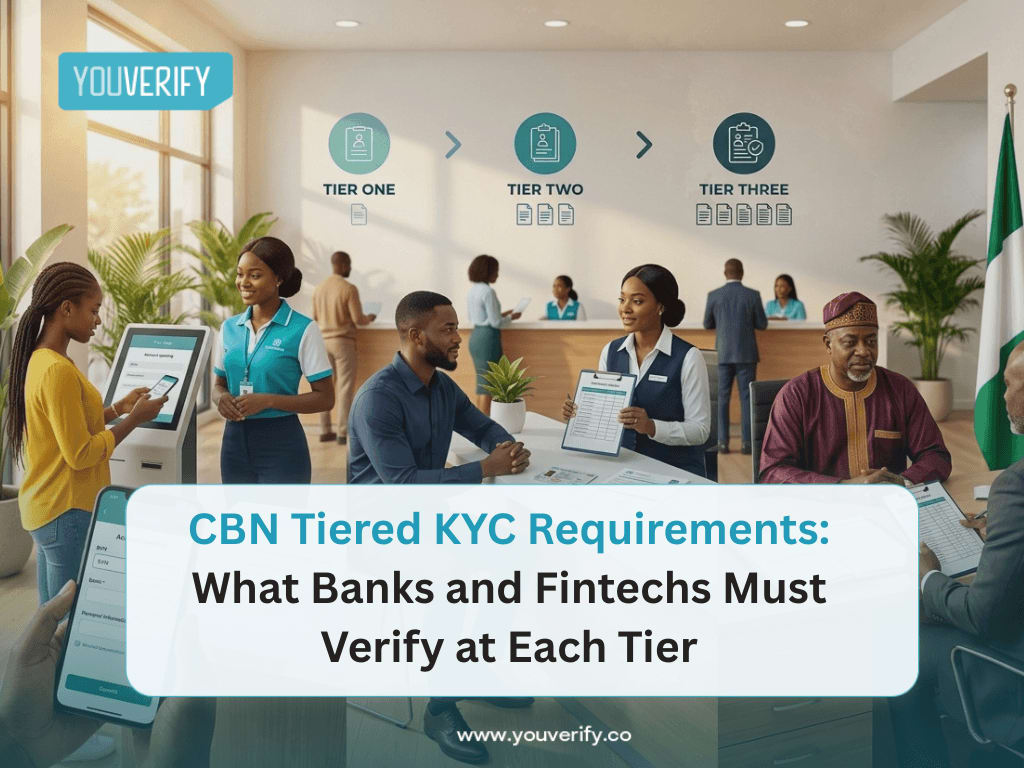
Tiered KYC is a risk-based approach where different levels of customer information and verification are required based on the type and limits of an account or financial service. Lower-tier accounts may have simpler requirements and transaction limits, while higher tiers require more customer information and verification.
The KYC process typically involves collecting customer information, verifying identity, conducting customer due diligence, assessing risk, identifying beneficial owners where applicable, and monitoring the customer relationship on an ongoing basis.