
Anti-Money Laundering (AML)
Top 10 Scammer & Fraudster Countries in the World 2026
ByTemitope Lawal
•5mins Read
The top 10 scammer countries in the world in 2026, ranked by criminality score in the Global Organized Crime Index 2025, are Myanmar (8.08), Colombia (7.82), Mexico (7.68), Ecuador (7.48), Paraguay (7.48), DR Congo (7.47), South Africa (7.43), Nigeria (7.32), Lebanon (7.30) and Türkiye (7.20). Financial crime is now the most prevalent criminal market on earth, scoring 6.21 out of 10 and growing faster than any of the other 14 markets the Index tracks.
No government or international body counts scammers by country, so every "top 10 scammer country in the world" list you will find is an interpretation of indirect evidence. This guide uses named, published indices rather than guesswork. It explains what each country is actually measured on, where the countries most people expect to see really rank, and answers the question underneath the question: which country has the most scammers, and how would anyone actually know?
Fraud, in the broadest sense, is a deliberate deception for personal gain. It involves a dishonest act or trick that is intended to deceive or mislead others for financial or personal advantage.
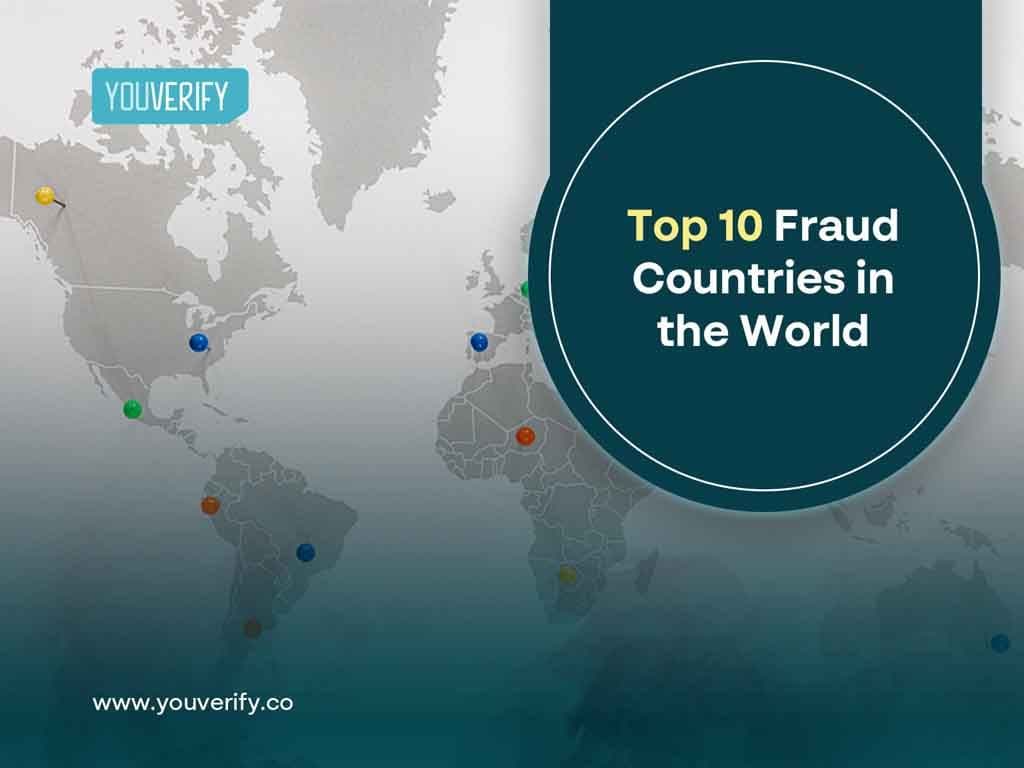
Fraud can take many forms, but it essentially involves a false representation of facts or a concealment of truth to induce someone to act in a way that they would not otherwise. The Global Organized Crime Index has presented graphically the countries with the highest financial crime rate in the world.
In this article, we shall be checking out the top 10 fraud countries in the world. However, before we dive further in, we need to understand that there are various facets of fraud and they include:
Related: How to Check High-Risk Countries
The table below ranks the top 10 scammer countries in the world using criminality scores from the Global Organized Crime Index 2025, published by the Global Initiative Against Transnational Organized Crime (GI-TOC). Scores run from 0 to 10. The global average is 5.08.
| Rank | Country | Criminality 2025 | Criminal markets | Criminal actors | Resilience | Change since 2023 |
|---|---|---|---|---|---|---|
| 1 | Myanmar | 8.08 | 7.67 | 8.50 | 1.46 | -0.07 |
| 2 | Colombia | 7.82 | 7.43 | 8.20 | 5.46 | +0.07 |
| 3 | Mexico | 7.68 | 8.27 | 7.10 | 4.50 | +0.11 |
| 4 | Ecuador | 7.48 | 7.07 | 7.90 | 4.46 | +0.41 |
| 4 | Paraguay | 7.48 | 6.67 | 8.30 | 3.29 | -0.04 |
| 6 | DR Congo | 7.47 | 6.33 | 8.60 | 2.21 | +0.12 |
| 7 | South Africa | 7.43 | 7.17 | 7.70 | 5.67 | +0.25 |
| 8 | Nigeria | 7.32 | 7.33 | 7.30 | 5.46 | +0.04 |
| 9 | Lebanon | 7.30 | 6.60 | 8.00 | 3.08 | +0.20 |
| 10 | Türkiye | 7.20 | 6.90 | 7.50 | 3.96 | +0.17 |
Ecuador and Paraguay are tied on 7.48, so the Index lists both at rank 4.
One caveat before you read this as a pure scam ranking: criminality scores cover all organised crime, including drug and human trafficking, not fraud alone. They are the most credible country-level comparison that exists, but no index publishes a "scammers per country" figure. The sections below break down what each score actually reflects.
Which country has the most scammers? The top 10 fraud countries in the world are highlighted below, but it is imperative to understand that while specific rankings can fluctuate based on various factors and data sources, these countries consistently appear in discussions of high fraud prevalence. They include:
Myanmar has the highest criminality score of any country on earth and is the most credible answer to "which country is the biggest scammer country." It is the documented centre of South East Asia's industrial scam compound operations, where large fenced facilities in border regions run romance scams, cryptocurrency investment fraud and pig-butchering schemes at industrial scale, frequently using trafficked workers.
Its resilience score of 1.46 is the critical number. That is the lowest of any country in the top 20 and reflects a near-total absence of state capacity to disrupt these operations.
Colombia scores 8.20 on criminal actors, meaning entrenched, well-structured criminal organisations. Its criminality is driven primarily by the cocaine trade rather than fraud. Its resilience score of 5.46 is above the global average of 4.78, reflecting functioning enforcement institutions operating against very well-established networks.
Mexico records the most pervasive criminal markets of any country in the world at 8.27. Cartel activity dominates, but the same networks engage in extortion, financial crime and identity theft. Notably its criminal actor score (7.10) is lower than several countries below it in the ranking, meaning Mexico's problem is the sheer scale of illicit markets rather than the structural power of any single group.
Ecuador recorded the sharpest rise of any country in the top ten, up 0.41 since 2023. It has shifted rapidly from transit country to a significant criminal hub, largely on the back of cocaine trafficking through its ports.
Paraguay scores 8.30 on criminal actors, one of the highest in the world, against a comparatively modest criminal markets score of 6.67. This gap is the signature of powerful criminal organisations operating in a country whose illicit markets are smaller than their influence.
DR Congo has the highest criminal actor score of any country on earth at 8.60. Its criminality is driven by conflict economies and non-renewable resource crimes rather than online fraud. Its resilience score of 2.21 is among the lowest globally. Read this ranking carefully: it reflects armed criminal control, not a scam industry.
South Africa ranks 7th globally and is the highest-ranked country in Southern Africa. It records high rates of identity theft, insurance fraud and corporate fraud. Its resilience score of 5.67 is the highest of any country in the global top ten, reflecting comparatively developed financial regulation and enforcement institutions operating against a severe crime problem.
Nigeria ranks 8th globally, with a criminal markets score of 7.33. It is the country most frequently named in international coverage of romance scams and business email compromise (BEC), and the Economic and Financial Crimes Commission (EFCC) actively prosecutes these cases.
Two numbers deserve attention. Nigeria's resilience score of 5.46 is well above the global average of 4.78, reflecting active enforcement institutions rather than absent ones. And its criminal actor score of 7.30 is the lowest in the global top ten, indicating that Nigerian fraud tends to be committed by loose networks and individuals rather than the structured criminal organisations that dominate the countries above it.
Lebanon scores 8.00 on criminal actors against 6.60 on criminal markets. Prolonged economic and banking system collapse has created conditions for financial crime, with a resilience score of 3.08.
Türkiye ranks 10th globally and 2nd of 14 countries in Western Asia, scoring well above the global average of 5.08. It functions as a significant transit and financial hub for transnational criminal networks.
READ ALSO: Top Fraud Threats by Industry in 2025
Myanmar has the highest criminality score in the world at 8.08 out of 10 and hosts South East Asia's documented scam compound industry, making it the most defensible answer to which country has the most scammers.
But the honest answer is that nobody counts scammers. There is no global register, and any source quoting a precise figure is guessing. What the data does support:
The Global Organized Crime Index 2025 scored it 6.21 out of 10, up from 5.98 in 2023. That was the largest increase of any of the 15 markets it tracks. It is the only criminal market ranked in the top five on every continent, and it takes the top spot in both Africa and Europe. 78 countries recorded worsening financial crime since 2023.
The Index attributes the surge to fraud being perceived as a low-risk, low-cost crime. It also found that resilience efforts have only a marginal statistical effect on financial crime, with a correlation of just -0.240. The reason is structural: financial crime involves intangible assets such as data and payment rails, requires no violence, and is therefore easy to commit but very difficult to detect, investigate and police.
Fraud is under-reported everywhere, so indices partly measure reporting culture. A country with strong reporting can look worse than a country with none. Online fraud is also transnational by design: a scammer may operate from one country, target victims in a second, and launder proceeds through a third. Any country ranking measures enforcement capacity and reporting quality alongside actual crime.
For any business, the practical conclusion is that nationality is a weak fraud signal. Fraud risk is far better assessed at the level of the individual transaction, device and identity than at the level of the passport.
"Fraudsters country" and "scammer country" get searched interchangeably, but they surface different pictures depending on what is being measured. The Global Organized Crime Index publishes two component scores underneath its headline criminality figure, and they produce genuinely different rankings.
As ranked by criminal actors, the top 10 fraudsters countries in the world and their score are DR Congo (8.6), Myanmar (8.5), Paraguay (8.3), Colombia (8.2), Honduras (8.1), Central African Republic (8.1), Lebanon (8.0) Ecuador (7.9), Iraq (7.9) and South Africa (7.0).
As ranked by criminal markets, the top 10 fraudsters countries in the world and their market score are: Mexico (8.27), Myanmar (7.67), Colombia (7.43), Iran (7.37), Nigeria (7.33), Kenya (7.27), Brazil (7.23), South Africa (7.17), Ecuador (7.07), and United Arab Emirates (7.00).
The gap between these two lists is the whole point. Mexico has the world's most pervasive criminal markets but comparatively less powerful criminal actors. DR Congo is the exact reverse. A country can host heavy fraud volume without powerful domestic fraud organisations, and it can host powerful organisations without heavy volume. Any single "top 10 fraudsters country in the world" list flattens that distinction, which is why so many of the lists online disagree with each other.
If you only want the top 5 scammer countries in the world for 2026, the Global Organized Crime Index 2025 criminality scores give you:
Ecuador and Paraguay tie at rank 4. Ecuador recorded the sharpest increase of any country in the top five, rising 0.41 since 2023.
Notice that none of these five are the countries most people name when asked to guess. That gap between public perception and measured data is one of the most consistent findings in fraud research, and it is worth holding onto before trusting any list that simply confirms what you already assumed.
Almost every "top 20 scamming countries in the world" list online is unsourced. The Global Organized Crime Index ranks all 193 UN member states, so a genuine top 20 exists.
The top 20 scamming countries are: Myanmar, Colombia, Mexico, Ecuador, Paraguay, DR Congo, South Africa, Nigeria, Lebanon, Türkiye, Kenya, Iraq, Honduras, Brazil, Central African Republic, Afghanistan, Cambodia, Syria, and Venezuela.
Cambodia at 17th is worth flagging specifically. Alongside Myanmar, it hosts a substantial share of South East Asia's scam compound infrastructure, and it is the country in this top 20 most directly associated with online fraud rather than trafficking or conflict economies.
Financial crime is the single most prevalent criminal market in Africa, taking the top spot on the continent in the Global Organized Crime Index 2025.
Ranked by overall criminality, the highest-scoring African countries in the 2025 Index are: DR Congo, South Africa, Nigeria, Kenya, Libya, Central Africa Repubulic.
This is a different question from which countries produce scammers, and the data behind it is considerably stronger.
The Global State of Scams 2025 Report, published by the Global Anti-Scam Alliance (GASA) with Feedzai, surveyed 46,000 adults across 42 markets. It found that 57 percent of adults worldwide encountered a scam in the previous 12 months and 23 percent lost money. Estimated losses across the 42 markets surveyed reached 442 billion US dollars. 13 percent of respondents encounter a scam at least once a day.
Scam encounters were most frequent in South America, Africa and Oceania, where up to one in four adults lost money in the past year. By region, 73 percent of adults in Oceania and 72 percent in South America reported experiencing a scam, with 68 percent in Africa and 66 percent in North America.
The most common tactics were shopping scams, affecting 54 percent of victims, followed by investment scams and unexpected money scams at 48 percent each. Two thirds of scams concluded within a day of first contact, leaving victims almost no time to reconsider.
The harm is not only financial. 69 percent of victims reported significant stress, 17 percent reported a loss of confidence, and 14 percent said the experience created tension within their family.
There is also a confidence gap worth noting: 73 percent of respondents believe they can identify a scam, while 23 percent lost money to one.
Set this against the perpetrator rankings above and the mismatch is stark. The regions reporting the highest victimisation are not the regions most often blamed for producing scammers. Scams flow across borders, which is precisely why country-level blame is a poor defence strategy.
Fraud and corruption are routinely treated as the same thing in country rankings. They are not, and conflating them produces bad risk decisions.
Fraud is deception for gain. A person or organisation misrepresents facts to induce someone to act against their own interests. The victim is usually a private party: a consumer, a bank, an insurer, a business.
Corruption is the abuse of entrusted power for private gain. The victim is usually the public: bribery, embezzlement of state funds, rigged procurement.
They correlate, because weak institutions enable both, but they diverge often enough to matter. A country can have low public sector corruption and high consumer fraud, particularly where a large digital economy meets sophisticated criminals. It can also have severe corruption and comparatively little consumer-facing scam activity.
The practical consequence: using the Corruption Perceptions Index to assess fraud risk, as a great many published fraud rankings do, will misprice risk in both directions. Use fraud measures for fraud and corruption measures for corruption.
At the opposite end of the Global Organized Crime Index 2025, the countries with the lowest criminality scores are Tuvalu (1.53), Nauru (1.72), Sao Tome and Principe (1.80), Liechtenstein (2.10) and the Marshall Islands (2.28). Most are very small states, which illustrates a limitation of the index as much as a virtue of those countries.
Among larger economies, the pattern is clearer. The Nordic countries score consistently low: Finland at 3.25, Iceland at 3.03, Norway at 3.83, Denmark at 4.10 and Sweden at 4.73, all far below the global average of 5.08. Singapore scores 3.72 and Switzerland 4.65.
The Secretariat Economic Crime Index 2025 supports this from a different direction, ranking Finland, Denmark, Iceland, Luxembourg and Estonia among the 19 lowest-risk countries worldwide, citing transparency, robust anti-financial-crime frameworks and strong enforcement.
What these countries share is not an absence of criminals but a presence of institutions. Finland pairs its 3.25 criminality score with a resilience score of 8.42, one of the highest in the world. Resilience is the variable governments can actually move.
The global fraud landscape is complex and dynamic, with certain countries exhibiting higher prevalence rates than others. While data limitations and variations in reporting standards make definitive rankings challenging, key findings from this analysis indicate that countries experiencing rapid economic growth, political instability, or weak regulatory frameworks often face heightened risks of fraud.
The implications of widespread fraud are far-reaching, affecting businesses, individuals, and entire economies. For businesses, fraud can lead to financial losses, damage to reputation, and operational disruptions. Individuals may suffer identity theft, financial hardship, and emotional distress. At the macro level, fraud can undermine trust in financial institutions, hinder economic development, and destabilize societies.
Combating fraud in these top 10 fraud countries in the world requires a multi-faceted approach involving governments, businesses, and individuals.
No Government would want to have anyone in the international community refer to their country as one of the top 10 fraudsters countries in the world. In view of this, they can play a pivotal role by strengthening regulatory frameworks, investing in law enforcement capabilities, and promoting international cooperation.
Businesses, on the other hand, can implement robust fraud prevention measures, including advanced technologies, employee training, and risk assessment.
Individuals are not left out of the risk of combating fraud in these top 10 fraud countries. They can protect themselves by practicing safe online habits, being vigilant against scams, and reporting suspicious activities.
To effectively address the global fraud challenge, international collaboration is essential. Governments, businesses, and international organizations should work together to develop standardized reporting mechanisms, share best practices, and coordinate efforts to combat transnational fraud. Additionally, investing in research and development of innovative fraud detection and prevention technologies is crucial.
Now that we have seen the top 10 fraud countries in the world, we can understand that parts of Africa and Asia are prevalent in the act.
As much as this menace endures, these countries can work out the issue by adopting a comprehensive and collaborative approach, the world can significantly reduce the prevalence of fraud and mitigate its negative consequences.
In case you are a business organization that seems to do business with these top 10 fraud countries and need guidance and compliance with their local regulatory policies; you need not go anywhere, but Youverify. Use our global AI-powered fraud check solution for identifying suspicious customer transactions and fraudulent criminal activities. Perform automatic fraud checks on the go to reduce risks associated with identity theft, financial crimes and account fraud.
Youverify provides AI-powered fraud detection, identity verification and business verification built for African and global markets, helping compliance teams identify suspicious transactions and fraudulent activity in real time while meeting local KYC and AML obligations. With more than 2,000 clients worldwide, including Standard Chartered and MTN, we help businesses reduce exposure to identity theft, financial crime and account fraud without turning away legitimate customers. Book a FREE demo with us today.
Recommend Reads:
Ultimate Guide to Fraud Protection in the United States
Story Time: His iPhone Was Locked and Encrypted. The Thief Just Took the SIM