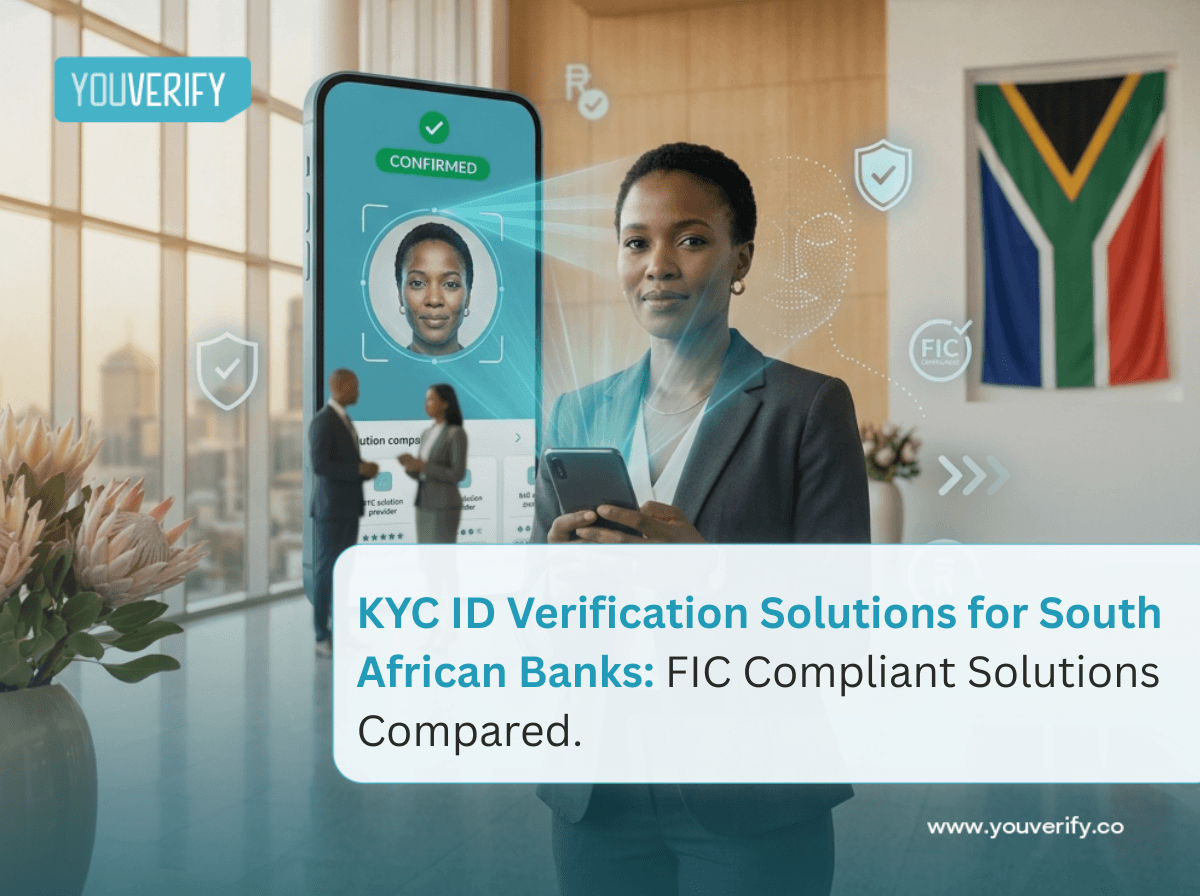
KYC ID Verification Solutions for South Africa Banks: FIC Compliant Solutions Compared
ByTemitope Lawal
•5mins Read
Key Takeaways
ID verification software for South African banks automates FICA-required identity checks by validating documents against independent sources like DHA and confirming the applicant's presence through biometric liveness.
South Africa exited the FATF grey list on 24 October 2025, with the next Mutual Evaluation expected to run through October 2027, raising the bar for defensible onboarding records.
FICA Regulation 4(1) permits electronic verification against an independent source, and the FIC has formally recognised HANIS online verification under PCC33.
The strongest vendors combine direct DHA integration, biometric liveness, PEP and sanctions screening, and CIPC beneficial ownership checks in a single workflow.
Photo-match-only verification and fragmented vendor stacks are the two most common weaknesses banks should screen out during procurement.
Identity fraud in South African banking rose 162% year-on-year in 2024, making vendor selection a fraud control decision as much as a compliance one.
ID verification software for South African banks is technology that confirms a customer's identity against government and biometric data sources before an account is opened, in line with the Financial Intelligence Centre Act (FICA). The best solutions are the ones that are FIC compliant. That is, they integrate directly with the Department of Home Affairs (DHA), run biometric liveness checks, screen against sanctions and PEP lists, and generate audit-ready records that satisfy Financial Action Task Force (FATF) expectations.
South Africa exited the FATF grey list on 24 October 2025 after clearing all 22 action items in its national action plan. The next Mutual Evaluation is expected to run from the first half of 2026 through October 2027, and banks are under pressure to show that digital onboarding controls are durable, not a one-time fix.
Hence, choosing the right ID verification vendor is an important decision every banks in South Africa needs to make. We have put up this guide on how what to look out for in an ID verification solution for South African Banks.
What Is ID Verification Software for South African Banks?
ID verification software is a compliance and fraud-prevention tool that automates the identity checks banks must perform under FICA before establishing a business relationship. Instead of a teller manually inspecting a Smart ID Card or Green Barcoded ID Book, the software captures the document, authenticates it, checks the extracted data against an independent source such as the DHA's Home Affairs National Identification System (HANIS), and confirms the applicant is physically present through a biometric liveness check.
Under FICA, accountable institutions, which include commercial banks, insurers, and estate agents, must verify identity against an independent source and retain verification records for at least five years. Failure to comply can attract penalties of up to R100 million or imprisonment of up to 15 years, which is why South African banks treat vendor selection as a regulatory decision as much as a technology one.
Best ID Verification Software for South African Banks in 2026
From a KYC/AML compliance expert, we made an analysis on which Identity verification comanies available for banks in South Africa can be regarded as AI-poered identity verification solution for South Africa banks
Below is a side-by-side comparison of vendors active in the South African banking and fintech market, evaluated against the criteria above.
Vendor
DHA / HANIS Integration
Biometric Liveness
AML/PEP Screening
Beneficial Ownership (CIPC)
Best For
Youverify
Direct, pre-built
Yes
Yes, global and local lists
Yes
Banks needing a single compliance and fraud platform across onboarding and monitoring
Smile ID
Direct, government database
Yes
Limited, add-on
No
Fintechs and startups scaling across multiple African markets
uqudo
Direct
Yes
Yes
No
Digital payment providers prioritising conversion and low friction
ThisIsMe
Yes
Limited
Yes
Yes
Institutions wanting a long-established local partner with case management
Multinational banks needing a single vendor across many countries
1. Youverify
Youverify offers AI-powered KYC & AML solutions specific for the south african banks. It offers pre-built DHA and CIPC integrations through a single API, which removes the need to manage separate vendor relationships for identity, biometrics, and beneficial ownership checks.
Youverify helps to verify the identities of indivduals and entities. The platform covers the five requirements banks are increasingly treating as non-negotiable for FICA-compliant digital KYC: DHA identity lookup, biometric liveness detection, PEP and sanctions screening, CIPC beneficial ownership checks, and five-year audit-ready record retention.
2. Smile ID
Smile ID has strong document and selfie-matching coverage across African markets and verifies South African ID numbers directly from government databases. It is a solid fit for fintechs prioritising fast onboarding across several countries, though AML and PEP screening typically require a separate add-on rather than a unified workflow.
3. uqudo
uqudo processes South African ID cards, passports, and driving licences with tampering detection and government database checks. Its positioning leans toward digital payments and conversion-sensitive onboarding flows, which suits fintechs more than banks needing deep beneficial ownership tooling.
4. ThisIsMe
ThisIsMe is one of the longer-established local players, with case management and enhanced due diligence features built specifically around South African compliance workflows. It is a dependable option for institutions that value an established local track record, though liveness detection capability trails some newer entrants.
5. VerifyNow
VerifyNow offers pay-as-you-go pricing and sub-10-second Home Affairs checks, which appeals to smaller businesses and lower-volume use cases. Its biometric assurance relies on photo matching rather than active liveness detection, which is a meaningful gap for banks facing synthetic identity fraud.
6. Jumio
Jumio brings global scale and processes identity checks across more than 200 countries and territories, which suits multinational banks standardising on one vendor worldwide. It does not integrate directly with DHA or HANIS, so South African identity data typically passes through document-level checks rather than a live government database match.
Why FICA, DHA and FATF KYC Compliance Matter for South African Banks
KYC Compliance requirements in South Africa sit on three layers, and a credible ID verification vendor needs to satisfy all three at once.
South Africa compliance FICA sets the legal obligation. Regulation 4(1) of the FIC Act Regulations allows electronic verification against an independent source as an alternative to physical document checks, provided the process is documented and auditable.
DHA and HANIS provide the independent source most banks rely on. Since the SABRIC-DHA cooperation agreement, banks have had access to HANIS for real-time fingerprint and biometric verification against the National Population Register. The Financial Intelligence Centre formally recognised HANIS online verification as an acceptable method for identity checks under Public Compliance Communication 33, which strengthens the case for vendors with direct DHA integration rather than third-party data reselling.
FATF sets the international benchmark South Africa is now judged against following its grey list exit. With the next Mutual Evaluation running through October 2027, banks need onboarding systems that produce a defensible audit trail, not just a pass or fail result, since examiners will test the process, not only the outcome.
Before comparing vendors, South African banks should benchmark software against a fixed set of criteria rather than marketing claims:
Direct DHA or HANIS integration, not a cached or third-party copy of population register data.
Biometric liveness detection that resists deepfakes, photo spoofing, and presentation attacks.
PEP, sanctions, and adverse media screening built into the same workflow as identity verification.
CIPC beneficial ownership checks for business accounts, alongside natural person verification.
Five-year audit-ready record retention with a documented verification trail for each check.
API-first integration that fits into existing core banking and onboarding systems without long implementation cycles.
Vendors that only verify a document's authenticity, without checking it against DHA data or adding biometric liveness, fall short of what FICA examiners expect from a modern digital KYC (Know Your Customer) process.
Common Challenges When Choosing KYC ID Verification Solutions
Fragmented vendor stacks. Many banks run separate tools for document checks, biometric liveness, and AML screening, which increases integration cost and creates gaps in the audit trail examiners will test.
DHA verification cost. Home Affairs has proposed raising its online verification tariff from 15 cents to R10 per lookup, which changes the unit economics of high-volume onboarding and makes vendor pricing structure a real consideration, not a footnote.
Weak liveness detection. Photo-match-only verification is vulnerable to presentation attacks and does not meet the bar banks now need against synthetic identity fraud.
Underestimating FATF scrutiny. South Africa's grey list exit was a milestone, not a finish line. Banks that treat onboarding compliance as a one-time project rather than an ongoing control risk falling short at the next Mutual Evaluation.
How Youverify Helps South African Banks Meet FICA, DHA and FATF KYC Requirements
A compliance-first digital KYC platform needs to do more than check a document. It needs to connect to the right independent sources, prove that a real person completed the check, screen for financial crime risk in the same step, and keep a record that survives a FATF Mutual Evaluation.
Youverify's KYC platform delivers direct DHA identity lookup, biometric liveness detection, PEP and sanctions screening, CIPC beneficial ownership verification, and five-year audit-ready record retention through a single API integration built for the South African market. Identity fraud in South Africa's banking sector rose 162% year-on-year in 2024, which makes this combination a fraud control priority as much as a compliance requirement. Pre-built DHA and CIPC integrations mean banks are not managing separate vendor relationships for each check.