
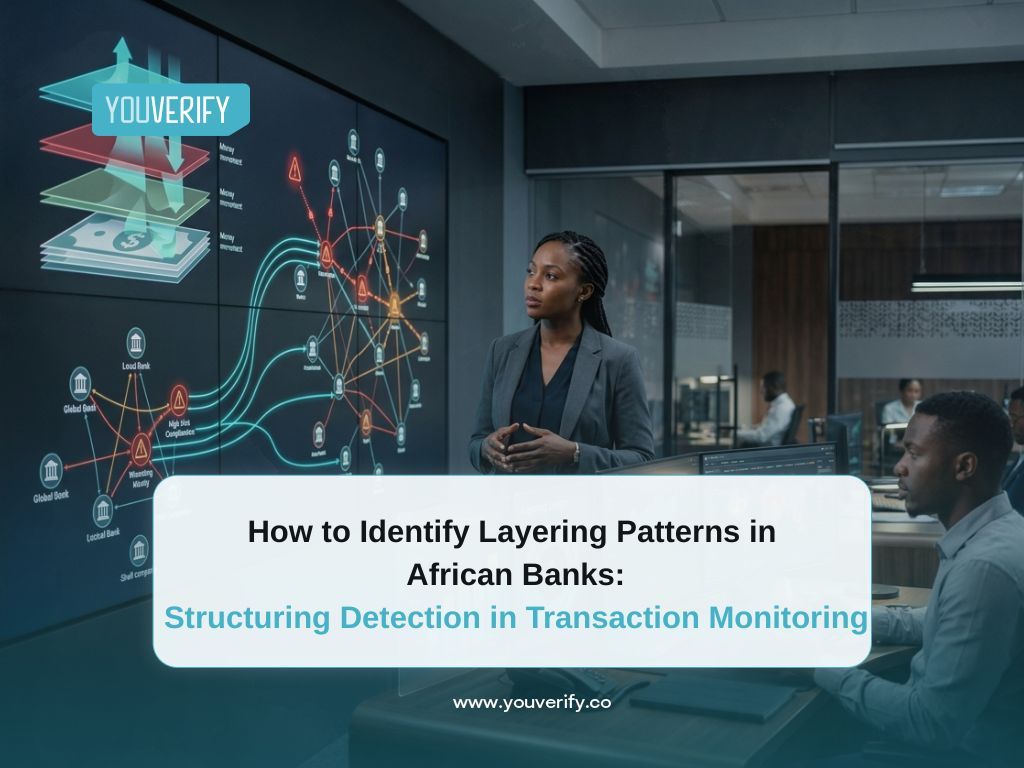


Structuring remains one of the most common money laundering techniques detected by African financial institutions today. In Nigeria, Kenya, Ghana, and South Africa, regulators increasingly expect banks to strengthen transaction monitoring, improve AML/CFT framework controls, and deploy advanced AML transaction monitoring tools capable of detecting layering activity in real time.
Structuring, also called “smurfing,” happens when large amounts of money are deliberately broken into smaller transactions below regulatory reporting thresholds to avoid detection. These transactions may appear harmless individually, but together they form suspicious patterns linked to money laundering and financial crime.
As regulators tighten enforcement across Africa, banks now rely heavily on automated transaction monitoring systems, AI-driven analytics, and relationship mapping to identify suspicious structuring behaviour early.
What Is Structuring in Money Laundering?
Structuring is the deliberate splitting of large financial transactions into smaller amounts to avoid triggering regulatory reporting thresholds.
Under Nigeria’s Money Laundering (Prevention and Prohibition) Act 2022, structuring is illegal even when the underlying funds appear legitimate. Similar provisions exist under South Africa’s FIC Act, Kenya’s POCAMLA framework, and AML regulations across UEMOA countries.
In Nigeria, banks must report:
- Cash transactions above ₦5 million for individuals
- Cash transactions above ₦10 million for corporate accounts
Fraudsters attempt to avoid these reporting requirements by spreading transactions across multiple deposits, accounts, locations, or payment channels.
Related read:
What Is Layering in Money Laundering?
The Role of Structuring in the Money Laundering Process
Money laundering typically involves three stages:
Stage | Description |
| Placement | Criminal funds enter the financial system |
| Layering | Funds are moved repeatedly to hide origin |
| Integration | Laundered funds re-enter the legitimate economy |
Structuring is mainly used during placement and layering. Once funds enter the financial system through multiple small deposits, they are transferred across accounts, converted into digital assets, or moved internationally to obscure the money trail.
This is why modern AML transaction monitoring focuses heavily on identifying transaction chains rather than isolated payments.
Related read:
What Are the 3 Stages of Money Laundering?
AML Regulations in Banking and How to Stay Compliant
Common Structuring Methods in African Banking
Several structuring typologies are frequently detected across African banking systems.
Classic Smurfing
Multiple individuals deposit amounts just below reporting thresholds into the same or related accounts over a short period.
Chequered Deposits
Deposits follow repeated patterns, such as ₦4.8 million every few days, designed to stay consistently below CTR thresholds.
Split Wire Transfers
Large transfers are broken into smaller wire payments sent to the same beneficiary account.
Mobile Money Structuring
Funds are structured through mobile wallets before being transferred into traditional banking systems. This is increasingly common in markets with high mobile money adoption such as Kenya and Ghana.
ATM Structuring
Multiple ATM withdrawals are conducted across different locations within a short period to avoid withdrawal thresholds and scrutiny.
These patterns are now core focus areas for modern transaction monitoring systems.
How to Identify and Detect Layering Patterns in African Banks
Detecting layering requires banks to look beyond individual transactions and analyse broader customer behaviour patterns.
Modern AML transaction monitoring tools identify layering through transaction aggregation, behavioural analytics, and network analysis.
Aggregation Windows
Banks aggregate transactions over 24-hour, 7-day, or 30-day periods to identify patterns where cumulative values exceed reporting thresholds even if individual transactions do not.
Relationship Mapping
Advanced systems connect accounts through shared phone numbers, addresses, IP addresses, devices, or beneficiaries to identify coordinated structuring activity.
Velocity Monitoring
Sudden spikes in deposit frequency or transaction volume may indicate layering attempts.
Cross-Channel Monitoring
Effective transaction monitoring must combine data across cash deposits, mobile money, ATM activity, wire transfers, and crypto-related transactions.
Threshold Clustering
AI-driven systems detect unusual concentrations of transaction values just below reporting limits, a classic sign of AML structuring.
CBN and FATF Requirements for Structuring Detection
The Central Bank of Nigeria (CBN) requires banks to report large cash transactions through Currency Transaction Reports (CTRs). However, suspicious structuring patterns must still be reported through Suspicious Transaction Reports (STRs) even when transactions remain below reporting thresholds.
FATF Recommendation 20 also requires financial institutions to identify and report suspicious activity linked to structuring and layering.
This means a compliant transaction monitoring system must detect suspicious patterns, not just threshold breaches.
Related read:
AML Regulations in Banking
How AML Transaction Monitoring Tools Detect Structuring
Modern AML transaction monitoring tools use multiple detection methods simultaneously.
Rule-Based Monitoring
Static rules identify classic structuring signatures such as repeated deposits below reporting thresholds.
Machine Learning Models
AI models detect more complex patterns where fraudsters vary transaction timing or amounts to avoid simple rules.
Peer Group Analysis
Customer behaviour is compared against similar customer groups to identify unusual activity.
Graph Analytics
Network analysis helps banks uncover coordinated activity across multiple linked accounts. These technologies significantly improve AML transaction monitoring and reduce false positives.
What Compliance Teams Should Review During Structuring Investigations
When a structuring alert is generated, compliance teams should assess whether the activity aligns with the customer’s expected behaviour.
Investigators typically review:
- Transaction patterns and timing
- Source of funds
- Customer occupation and business profile
- Related accounts or counterparties
- Previous STR filings or internal alerts
Where suspicion remains, the bank may file an STR with the relevant Financial Intelligence Unit (FIU).
Common Evasion Techniques and Detection Responses
Evasion Technique | Detection Response |
| Varying transaction amounts | Statistical clustering analysis |
| Using multiple accounts | Graph and relationship analytics |
| Spreading activity across banks | Cross-bank intelligence sharing |
| Mixing legitimate and suspicious transactions | Behavioural baseline analysis |
| Using different payment channels | Cross-channel monitoring |
As structuring techniques evolve, banks increasingly rely on AI-powered AML transaction monitoring tools to identify hidden patterns.
How Youverify Helps African Banks Detect Structuring and Layering
Youverify provides an AI-powered compliance and transaction monitoring system built for African financial institutions.
The platform helps banks strengthen AML transaction monitoring, identify layering activity, and improve compliance with local and global AML regulations.
Youverify’s AML transaction monitoring tools are designed specifically for African banking environments, supporting mobile money, digital banking, cash transactions, and cross-border payment monitoring.