


Key Takeaways
1. Uganda National ID verification is legally required for KYC and AML compliance under Ugandan law.
2. Businesses can use manual checks, NIRA APIs, or third-party verification tools to authenticate IDs securely.
3. Integrating robust verification solutions ensures faster onboarding, reduces fraud, and keeps data compliant with local regulations.
What is the Uganda National ID Overview
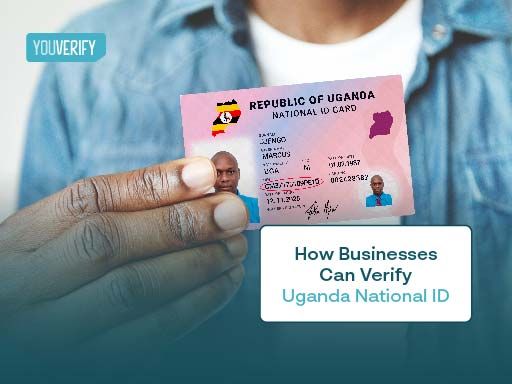
The Uganda National ID, issued by the National Identification and Registration Authority (NIRA), is the primary proof of identity for residents. Modern IDs feature advanced security elements, including holograms, microprinting, ghost images, tactile features, barcodes, and biometric data. These features align with ISO 7810 and ICAO 9303 standards to prevent forgery.
Since 2025, Uganda has rolled out enhanced IDs with nine additional security measures, modeled after currency-level protection, making national ID verification in Uganda more reliable. Businesses handling sensitive transactions, especially in fintech and banking, rely on these IDs for accurate identity verification.
READ ALSO: How to Perform Business Verification in Uganda
What are the Regulatory Requirements for National ID Verification?
Under Uganda’s Anti-Money Laundering Act 2013 and Registration of Persons Act 2015, businesses in Uganda must perform KYC checks using the Uganda National Identification Number. The Bank of Uganda (BoU) mandates verification for transactions exceeding UGX 1 million (~$260).
Currently, over 74 financial and non-financial institutions access the NIRA database via authorized APIs for KYC purposes, promoting secure and inclusive financial services.
The Verification Methods for Uganda National ID
Businesses can choose between manual and digital verification methods, depending on scale and risk tolerance.
Method | Pros | Cons | Best For |
| Manual Inspection | Low cost, no tech required | Slow, forgery risk | Small businesses |
| NIRA Direct API | Real-time, official data | Licensing required | Banks, fintech |
Manual Inspection
Simple manual checks involve scanning holograms and security marks and verifying physical ID features. While inexpensive, this method has a higher fraud risk and is slower for high-volume operations.
NIRA Direct API
Direct access to the NIRA database allows real-time verification of the Uganda National ID, ensuring authenticity and accuracy. This method is ideal for banks and fintech platforms with regulatory obligations.
The Integration Steps for ID Verification
To implement Uganda National ID verification, businesses should:
1. Obtain authorization from BoU/NIRA for API access.
2. Integrate SDKs or REST APIs for e-consent and PKI verification.
3. Collect ID images and selfies for OCR extraction and tamper detection.
4. Cross-check information with the NIRA registry in real time.
5. Perform biometric matching with liveness detection.
6. Ensure all processes comply with ROPA 2015 and the Electronic Signatures Act.
The Best Practices of How Businesses Can Verify Uganda National ID
Here is how businesses can check or verify Uganda's national ID:
1. Automation: AI-powered ID checks reduce verification time to milliseconds.
2. Biometrics: Combining liveness checks with ID validation prevents identity fraud.
3. Compliance: Ensure all data stays within Uganda to meet Data Protection and Privacy Act 2019 requirements.
Frequently Asked Questions
Q1. How to check Uganda’s national identity?
Use NIRA APIs of the Uganda National Identification Number.
Q2. What are the requirements for a National ID in Uganda?
Applicants must provide proof of residence, personal information, and biometric data according to NIRA guidelines.
Q3: What is KYC verification?
KYC (Know Your Customer) verification confirms a customer’s identity to prevent fraud, money laundering, and unauthorized financial activity.
Conclusion
For businesses in Uganda, verifying the Uganda National ID is not just a regulatory requirement; it is a critical step in mitigating fraud and safeguarding financial transactions. By leveraging secure APIs, biometric checks, and NIRA-authorized tools, organizations can streamline onboarding while maintaining full compliance.
At Youverify, we empower businesses to detect, investigate, and mitigate fraud while ensuring regulatory compliance. By unifying compliance teams, fraud analysts, and IT departments on a single platform, Youverify streamlines investigations and enhances decision-making without the need for standalone cybersecurity or MFA systems. To get started, book a demo today.