Best KYC Software in 2027: How Banks and Fintechs in Africa Should Choose
ByTemitope Lawal
•5mins Read
Key Takeaways
KYC software automates identity checks, document verification, screening and risk scoring when customers sign up and throughout the relationship.
African regulators, including the Central Bank of Nigeria (CBN), expect customer due diligence (CDD) to be documented, risk-based and continuous.
Most KYC solutions fall into four types: global document platforms, Africa-native verification platforms, AML screening specialists and unified compliance platforms.
Score every provider on local data coverage, audit trails, data protection, AI explainability and total cost of ownership, not just accuracy claims.
The strongest choice keeps identity, screening and monitoring on one customer record, so every decision can be explained to an examiner.
The best KYC software is not the one with the longest feature list. It's the one whose decisions still hold up when an examiner reviews your files. For banks, fintechs, payment companies and gaming operators in Africa, that standard keeps rising.
Regulators now look past whether you ran a check. They ask how the decision was made, what evidence supports it and who signed off. This guide explains what KYC software does, what African regulators expect from it and how to score providers before you sign a contract.
What Is KYC Software?
KYC software is technology that verifies a customer's identity and assesses their financial crime risk. It automates Know Your Customer (KYC) checks such as ID validation, biometric matching, sanctions screening and risk scoring. Regulated businesses use it to onboard customers quickly while meeting anti-money laundering (AML) obligations.
Good KYC software doesn't stop at onboarding. It keeps customer profiles current through periodic reviews and event-driven updates. That approach is known as perpetual KYC. If you're new to the concept, start with our guide to what KYC means.
Core Features Every KYC Verification Software Needs
KYC verification software should cover the full identity journey, not just the selfie step. The first requirement is government database verification. In Nigeria, that means checks against identifiers like the National Identification Number (NIN) and Bank Verification Number (BVN). Elsewhere it means national ID registries and tax records.
Document verification comes next. The software should read passports, driver's licences and national ID cards, then detect tampering. Biometric matching with liveness detection confirms the person holding the document is real and present.
Screening is the third layer. The system should check customers against sanctions lists, politically exposed person (PEP) lists and adverse media. Results should feed a risk score that sets the level of due diligence each customer receives.
Finally, the software must keep a complete audit trail. Every check, result, override and approval should be timestamped and attributable to a person or rule. Without that record, a correct decision is still hard to defend.
What Regulators Expect from KYC Compliance Software in Africa
KYC compliance software is only as good as the rules it helps you meet. Across Africa, those rules trace back to Financial Action Task Force (FATF) Recommendation 10 on customer due diligence. Each country then adds its own requirements.
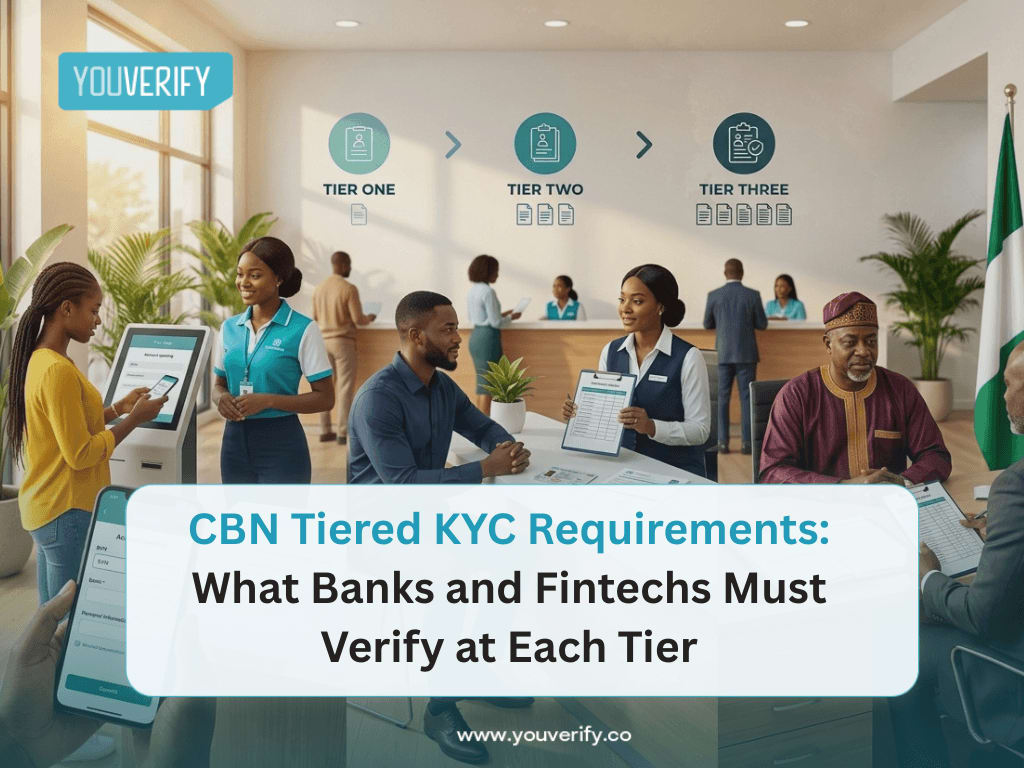
In Nigeria, the CBN Customer Due Diligence Regulations, 2023 apply to every financial institution the CBN supervises. They require internal procedures for verifying both new and existing customers. They also work alongside the CBN tiered KYC framework and the Nigeria Data Protection Act (NDPA) 2023.
Kenya applies the Proceeds of Crime and Anti-Money Laundering Act (POCAMLA). South Africa applies the Financial Intelligence Centre Act (FICA). Ghana applies the Anti-Money Laundering Act, 2020 (Act 1044). A provider serving several markets must map its checks to each regime.
Enforcement shows what's at stake. In April 2024, the CBN told four large fintechs to pause new customer onboarding while their KYC processes were reviewed. Onboarding resumed only after weeks of engagement with regulators.
Data protection now carries similar weight. In August 2024, the Nigeria Data Protection Commission (NDPC) fined a Nigerian bank ₦555.8 million. The NDPC said the bank processed data without informed consent and used non-compliant third-party processors. The bank disputed the findings. For buyers, the lesson is clear: your KYC vendor is one of those third-party processors.
The FATF picture is shifting too. Nigeria and South Africa left the FATF grey list in October 2025. After the October 2026 plenary, Kenya, Angola, Cameroon and South Sudan remained under increased monitoring. Leaving the list moves scrutiny from the country to the individual institution, so controls must stay strong.
Four Types of KYC Solutions on the Market
KYC solutions differ more in design than in marketing. Most fall into one of four types. Knowing the type tells you what a vendor will do well and where you'll need extra tools.
Global document-and-biometric platforms. These focus on reading identity documents and matching faces across many countries. They suit businesses onboarding customers worldwide. However, they may have limited direct access to African government databases.
Africa-native verification platforms. These connect directly to local registries for national IDs, tax numbers and business records. They are strong for eKYC in markets like Nigeria, Ghana and Kenya. Some stop at the verification check and leave screening and monitoring to other systems.
AML screening and monitoring specialists. These focus on sanctions, PEP and adverse media screening, plus transaction monitoring rules. They are often bought alongside a separate identity tool. That split means two vendors, two data models and two audit trails.
Unified compliance platforms. A unified KYC platform runs identity verification, Know Your Business (KYB), screening and monitoring on one customer record. It suits regulated institutions that must explain decisions end to end. The trade-off is a larger implementation than a single-point tool.
How to Evaluate KYC Providers: A 9-Point Scorecard
Feature lists from KYC vendors tend to look alike. The questions below separate the providers that will survive an examination from those that only pass a demo.
Criterion
Question to ask the provider
Red flag
Local data coverage
Which government databases do you query directly, in which countries?
"We cover 190+ countries" without naming African sources
Regulatory mapping
How do your checks map to CBN CDD, FICA, POCAMLA or Act 1044?
No country-specific configuration
Audit trail
Can an examiner see every check, override and approver for one customer?
Logs that only show pass or fail
Data protection
Where is data stored, and how do you meet the NDPA?
No data processing agreement offered
AI explainability
Can your system show the evidence behind each risk score?
"Our model is proprietary" with no reason codes
Human control
Where does automation stop and an officer decide?
Auto-approval with no configurable limits
Ongoing monitoring
Do you support periodic and event-driven KYC refresh?
Onboarding-only checks
Integration
Do you offer a documented API and sandbox?
Integration only through professional services
Total cost of ownership
What do checks, monitoring, storage and support cost at our volume?
Low per-check price with costly add-ons
Score each provider from 1 to 5 on every criterion. Weight local data coverage, audit trail and data protection highest if you are a bank or licensed payment company. For integration detail, see our KYC API integration guide.
Choosing KYC Software by Business Type
The right KYC software depends on who your customers are and who supervises you.
KYC Software for Banks
KYC software for banks must handle high volumes, complex corporate customers and tough examinations. Banks need strong KYB and beneficial ownership checks, not just individual verification. Every risk decision should be traceable to policy, evidence and an accountable officer.
Banks should also check how a provider handles legacy customers. Remediating old files is often harder than onboarding new ones. A periodic KYC refresh capability is essential.
KYC Software for Fintechs and Payment Companies
Fintechs and payment companies compete on onboarding speed, but regulators now watch them closely. They need fast mobile verification that still meets tiered KYC limits. When customers move up a tier, the software should trigger the extra checks automatically.
Strong customer onboarding balances conversion with control. Fintechs should also ask how the provider detects synthetic identities and account farming. Our guide to digital customer onboarding software covers this in more depth.
KYC Software for Gaming and Betting Operators
Gaming and betting operators must verify age and identity before players deposit or withdraw. They also face AML obligations around large or unusual transactions. Their KYC software should combine fast identity checks with monitoring tuned to betting behaviour.
Where KYC Software Is Heading: AI You Can Audit
Artificial intelligence (AI) is now standard in KYC tools. It reads documents, matches faces and prioritises alerts faster than manual teams can. The real question is no longer whether a vendor uses AI. It is what happens when the AI is wrong.
Regulators expect institutions to explain automated decisions. That means reason codes for risk scores, clear evidence for every alert and human sign-off on high-risk outcomes. For a deeper view, read our guide to AI in compliance monitoring.
Two other shifts matter. KYC is moving from one-time onboarding to continuous monitoring across the customer lifecycle. It's also spreading beyond banking. Juniper Research projects global KYC and KYB systems spend will rise from $35.5 billion in 2026 to $53.0 billion by 2030. Sectors such as crypto, eCommerce and gaming are driving much of that growth.
Red Flags When Buying KYC Software
Some warning signs appear early in a sales process. Be cautious if a vendor can't name the local databases it uses. A pass rate quoted without the matching false-acceptance rate should also concern you.
Watch for pricing that hides monitoring, storage or re-verification costs. Be wary of tools that make it hard to export your data or audit logs. Most importantly, avoid any system that can approve high-risk customers without a human decision you can trace.
How Youverify Approaches KYC Software
Youverify was built for regulated institutions whose compliance decisions must survive an examination. It runs KYC, KYB, AML screening and transaction monitoring on one governed customer record. That means one source of truth for every check and decision.
Vyra, Youverify's AI agent, handles risk scoring, monitoring and reporting while showing the evidence behind each outcome. It stops where your policy says it stops. A human compliance officer always makes the final call.
That design reflects a simple principle: one record, one agent, one human who decides. It also reflects deep coverage of African identity sources and regulations. To see how Youverify compares with global KYC platforms, read our KYC platform comparison. For a broader view of verification tools, see our guide to identity verification software and our list of fraud detection software.
The best KYC software depends on your markets, customers and regulator. Banks and fintechs in Africa should prioritise direct local database checks, a full audit trail, NDPA-compliant data handling and explainable AI. A platform that keeps verification, screening and monitoring on one record is easier to defend in an examination.
KYC software is used to verify customer identities, screen them against sanctions and PEP lists, and assign risk scores. Banks, fintechs, payment companies and gaming operators use KYC tools to onboard customers quickly while meeting anti-money laundering rules. It also keeps customer records current over time.
No. AI automates much of KYC, including document reading, face matching and alert prioritisation. Regulators still hold institutions accountable for each decision, so human officers must approve high-risk outcomes. The future of KYC is AI that shows its evidence, with a human who decides.
The best identity verification software matches your customer base. For African markets, choose a provider that verifies directly against national ID registries and combines document checks with biometric liveness detection. It should also connect identity results to AML screening, rather than stopping at the check.
There's no universal top 10, because banks have different risks and regulators. Strong AML software for banks combines KYC and KYB verification, sanctions and PEP screening, transaction monitoring and case management. Evaluate it on audit trails, explainable risk scoring and regulatory reporting for your jurisdiction.
KYC software is usually priced per verification, by monthly subscription or by volume tier. Total cost also includes ongoing monitoring, re-verification, data storage and support. Compare providers on the cost of your expected annual volume, not on the headline price per check.