In a 2025 global survey of 600 financial institutions, 70% said they lost clients in the past year because onboarding was too slow. Yet cutting corners on KYC onboarding carries its own risk. In April 2024, the Central Bank of Nigeria (CBN) paused new customer onboarding at four large fintechs while their KYC processes were reviewed. The goal is an onboarding journey that is fast for genuine customers and hard for fraudsters.
This guide explains the KYC onboarding process step by step, the rules African banks and fintechs must follow and the practices that keep onboarding both compliant and quick.
What Is Customer Onboarding?
Customer onboarding is the process of bringing a new customer into your business, from sign-up to their first transaction. In regulated sectors like banking, fintech and gaming, it includes KYC onboarding checks that verify identity and assess risk before an account goes live.
An efficient customer onboarding process helps new customers see value quickly and reduces early drop-off. For industries under regulatory oversight, such as banking or fintech, onboarding also involves customer onboarding KYC checks to verify customer identities and mitigate risk.
Why Customer Onboarding Matters for Compliance
A well-designed onboarding process builds trust, improves retention and lays the foundation for long-term relationships. It also sets the quality of your customer data. Errors accepted at onboarding follow the customer into every later screening, monitoring and reporting decision.
What Is KYC Compliance?
KYC (Know Your Customer) compliance is the legal process of verifying a customer's identity to prevent fraud, money laundering and terrorist financing. Businesses in finance, insurance, crypto and other regulated industries must meet KYC compliance requirements before providing services. Achieving this requires understanding the KYC requirements in each country where you operate.
The first element is customer identification and verification. You collect identity details and confirm them against documents and official records. In Nigeria, that often means checking a National Identification Number (NIN) or Bank Verification Number (BVN).
The second is customer due diligence (CDD). You assess each customer's risk and apply enhanced due diligence (EDD) where the risk is higher.
The third is ongoing monitoring. You review transactions and customer profiles over time to spot suspicious activity.
Interesting read: What are KYC Best Practices for AML Compliance
The KYC Onboarding Process: 7 Steps
The KYC onboarding process turns regulatory rules into a sequence of checks. Most KYC steps follow the same order: collect data, verify identity against official records, verify documents, confirm the applicant with liveness detection, screen against sanctions and PEP lists, score risk and decide, then monitor.
Each step should be logged, so you can show an examiner exactly what happened.
The first step is data collection. The customer provides their name, date of birth, address and contact details, and consents to data processing.
The second step is identity verification. You confirm those details against official records, such as the NIN or BVN in Nigeria. This is the strongest single check against fake identities.
The third step is document verification. You check the ID document's security features and look for signs of tampering.
The fourth step is biometric verification. A selfie with liveness detection confirms the applicant is a real person who matches the document.
The fifth step is screening. You check the customer against sanctions lists, politically exposed person (PEP) lists and adverse media.
The sixth step is risk scoring and decision. Low-risk customers are approved, while higher-risk customers go through EDD or manual review.
The seventh step is ongoing monitoring. You re-screen customers and review their activity, so the KYC process continues after the account opens.
KYC Onboarding Requirements in Nigeria and Across Africa
KYC onboarding rules across Africa trace back to Financial Action Task Force (FATF) Recommendation 10 on customer due diligence. Each country then adds its own requirements.
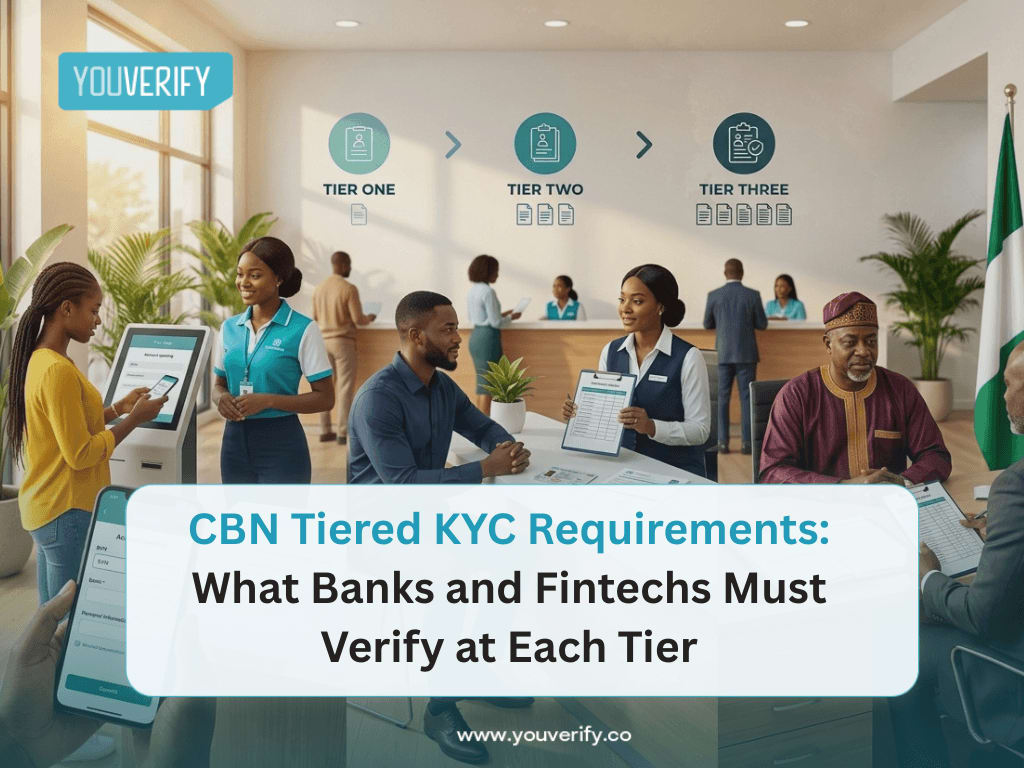
In Nigeria, the CBN Customer Due Diligence Regulations, 2023 apply to every financial institution the CBN supervises. They require documented procedures for verifying both new and existing customers. The CBN tiered KYC framework and the Nigeria Data Protection Act (NDPA) 2023 apply alongside them.
Kenya applies the Proceeds of Crime and Anti-Money Laundering Act (POCAMLA). South Africa applies the Financial Intelligence Centre Act (FICA). Ghana applies the Anti-Money Laundering Act, 2020 (Act 1044). If you operate in several markets, configure onboarding checks per country rather than using one global flow.
Enforcement shows these rules are applied. The CBN's April 2024 pause on new onboarding at four fintechs followed concerns about their KYC processes. For a deeper look at customer due diligence in banking, see our full guide.
KYC Onboarding for Corporate Customers
Corporate customers need Know Your Business (KYB) checks as well as KYC. You must verify the company itself, its directors and its ultimate beneficial owners (UBOs).
Start by confirming the business against its official registry, such as the Corporate Affairs Commission (CAC) in Nigeria. Then identify the people who own or control it. The CBN's guidance on beneficial ownership sets out a three-step cascade approach for identifying and verifying beneficial owners.
Each director and UBO should then be screened like an individual customer. Ownership structures that hide control behind layers of companies should trigger EDD.
KYC Onboarding Best Practices: How to Stay Compliant
Achieving KYC compliance during the customer onboarding process doesn't have to be tedious. Below are customer onboarding best practices that balance compliance, efficiency and user satisfaction.
1. Understand Regulatory Requirements
Different countries and industries have their own KYC rules. Start by mapping the regulations that apply to each market you serve. In Nigeria, that includes the CBN Customer Due Diligence Regulations, 2023, the CBN tiered KYC framework and the NDPA 2023. Turn each rule into a specific onboarding check, so nothing depends on memory.
2. Use Automated KYC Tools
Automated customer onboarding software can instantly verify customer identities using AI-powered document checks, facial recognition and database screening. This reduces manual errors and speeds up every step of the KYC verification process. Choosing the right tool matters, so see our guide to KYC software.
3. Adopt a Risk-Based Approach
Implement varying levels of KYC onboarding based on risk profiles. High-risk customers should go through enhanced due diligence (EDD), while low-risk users can follow simplified onboarding. In Nigeria, the CBN's tiered KYC requirements apply this idea directly. Lower tiers allow simpler checks with tighter account limits.
4. Offer Seamless Digital Customer Onboarding
Today's users expect speed and convenience. Use biometric verification with liveness detection, pre-filled forms and mobile-first flows. Our guide to digital onboarding solutions covers what to look for.
5. Train Your Customer Onboarding Specialists
Even with automation, skilled human oversight matters. A customer onboarding specialist ensures your systems remain compliant, customers are well guided and exceptions are handled smoothly.
6. Monitor and Update Continuously
KYC compliance is not a one-time event. Continuous customer onboarding KYC monitoring ensures that customer profiles remain accurate and that potential risks are flagged early. Schedule a periodic KYC refresh based on each customer's risk level.
Common KYC Onboarding Challenges
The biggest challenge is balancing speed with control. Every extra step can cost you applicants, but every skipped check can let fraud in.
Fraud at the front door is the second challenge. Synthetic identities, deepfake selfies and mule accounts are all designed to pass basic checks. Registry verification, liveness detection and duplicate detection are the main defences.
Data quality is the third. Mismatched names, missing addresses and outdated records slow verification and create false rejections. Pre-filling data from official sources reduces these errors.
The last challenge is fragmented tools. When identity, screening and monitoring sit in separate systems, audit trails break. Keeping every check on one customer record makes decisions easier to explain.
How to Improve the Customer Onboarding Process
These five practices can lift completion rates and lower the cost of KYC compliance.
Simplify form fields and steps to reduce drop-offs.
Integrate KYC compliance software for real-time identity checks.
Use analytics to find where applicants drop off, and ask new customers for feedback. Fix friction without removing checks your regulator requires.
Personalise the journey with helpful messages, FAQs or video tutorials.
Automate document collection and verification.
Automate KYC Onboarding with Youverify
Youverify helps banks, fintechs and gaming operators run KYC onboarding they can defend. KYC, KYB, risk scoring and EDD run as one workflow, on one customer record with one audit trail.
Youverify verifies customers against 150+ official identity sources and 145+ business registries. Liveness detection guards against deepfakes and injection attacks. Screening continues after approval. Vyra, Youverify's AI agent, routes exceptions and drafts case summaries, while named officers make the final decisions. Explore Youverify's customer onboarding solution.
To get started, book a demo today.