Document Verification: How It Works and Why It Matters
ByVictoria okere
•5mins Read
Key Takeaways
1. Document verification confirms a document is authentic, unaltered, and genuinely belongs to the person presenting it, forming the first checkpoint in any KYC or KYB process.
2. Regulators, including the Central Bank of Nigeria and the Financial Action Task Force, require financial institutions to verify customer documents before onboarding, not after.
3. Automated document verification reduces onboarding time from hours to seconds while lowering the compliance risk that comes with manual review.
Document verification is the process of confirming that an identity or business document is genuine, current, and belongs to the person submitting it. For compliance officers, this single step determines whether an institution onboards a legitimate customer or a fraudster wearing someone else's paperwork.
As digital onboarding volumes rise across Nigerian and African financial services, document verification has moved from a background compliance task to a frontline defense against financial crime. A weak process does not just create fraud exposure; it creates direct regulatory liability under frameworks enforced by the Central Bank of Nigeria, which oversees AML/CFT supervision for regulated financial institutions. This guide walks through how document verification works, the methods available today, and how to build a process that satisfies both regulators and customers.
Snippet answer: Document verification is the process of authenticating an identity or business document to confirm it is genuine, unaltered, and belongs to the person presenting it, typically as the first step in KYC or KYB onboarding.
How Document Verification Works
1. Document Capture and Data Extraction
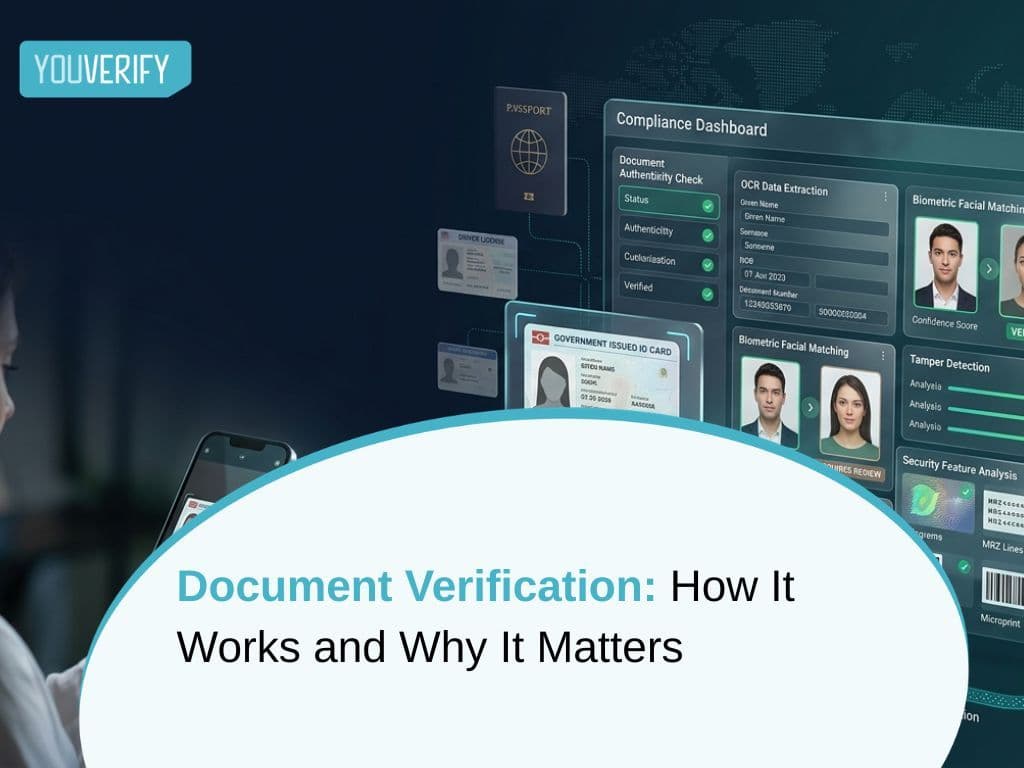
The process begins when a customer uploads or photographs an ID. Optical character recognition then extracts the name, document number, and expiry date, while the machine-readable zone is cross-checked against the printed text to catch tampering.
2. Authenticity Analysis
The system examines security features such as holograms and microprinting, alongside digital manipulation signals like inconsistent fonts or pixel patterns. Providers such as Youverify's ID document verification solution combine this analysis with checks tuned specifically to African identity formats, which global-only tools often miss.
3. Database and Biometric Checks
Where available, extracted data is matched against official registries. A liveness or selfie check then confirms the person submitting the document is its rightful owner, closing the gap that document analysis alone cannot cover. This full sequence forms the backbone of a modern KYC verification process.
Types of Document Verification
Method
How it works
Typical speed
Best suited for
Manual verification
A trained officer visually inspects the document and compares it against records
Minutes to days
Low-volume onboarding, high-risk edge cases, jurisdictions with limited digital coverage
Automated/AI-based verification
Software analyzes the document image and data using machine learning models trained on fraud patterns
Seconds
High-volume digital onboarding for banks, fintechs, and neobanks
Database verification
Extracted data is matched against an official government or credit registry
Seconds to minutes, where available
Confirming a document was genuinely issued, not just that it looks real
Biometric-linked verification
A selfie or liveness check is matched against the photo on the document
Seconds
Preventing identity theft where a real document is paired with the wrong person
Most serious compliance programs in Nigeria and across Africa now combine at least two of these methods. Automated verification alone catches forged documents but not stolen ones; adding a biometric liveness check closes that gap by confirming the person in front of the camera is the same person in the ID photo.
Why Document Verification Matters for African Financial Institutions
Document verification is not a nice-to-have feature for banks, fintechs, and payment providers operating in Africa; it is a direct regulatory requirement. In Nigeria, the CBN's KYC requirements under its AML/CFT regulations obligate financial institutions to verify customer identity documents before account opening, and the NFIU expects institutions to be able to demonstrate that verification took place as part of their Suspicious Activity Report (SAR) obligations. Failure to do so exposes institutions to regulatory sanctions and, increasingly, reputational damage when weak onboarding controls are linked to fraud cases that make the news.
Across the region, the same principle holds under different names. South Africa's FSCA expects verification aligned with the Financial Intelligence Centre Act (FICA). Ghana's Bank of Ghana (BoG) and Kenya's regulators apply similar standards drawn from FATF's broader recommendations on customer due diligence. A Lagos-based fintech onboarding a customer through a mobile app, a Nairobi-based lender assessing a first-time borrower, and a Accra-based payment platform verifying a merchant are all, in practice, being asked to meet the same underlying standard: confirm the document is real, confirm it belongs to the applicant, and be able to prove both if a regulator asks.
Consider a practical scenario. A digital lender in Lagos receives 4,000 loan applications in a single week during a promotional period. Manual review at even five minutes per application would require over 300 hours of compliance staff time, creating a backlog that either delays legitimate customers for days or pressures reviewers to cut corners. An automated document verification layer that clears the straightforward 90 percent of applications in seconds, while routing the remaining 10 percent to human reviewers, lets the lender meet both its regulatory obligations and its growth targets without one undermining the other.
How to Verify a Document Is Genuine: A Practical Checklist
For businesses building or evaluating their own process, a genuine document generally shows a consistent set of characteristics worth checking deliberately rather than assuming.
First, check that the security features match the claimed document type and issuing country. Holograms, microprint, and UV-reactive elements vary by country and by the year a document was issued, so a mismatch between the document's stated origin and its security features is an immediate red flag.
Second, confirm the MRZ or barcode data matches the visible printed information. Fraudsters who alter a printed name or date of birth frequently forget, or are unable, to update the encoded data underneath it.
Third, verify the document has not expired and that its format matches current issuance standards. Older format IDs are not automatically fraudulent, but a claimed "new" document using an outdated template is worth a second look.
Fourth, where database access exists, confirm the document number was genuinely issued and has not been reported lost, stolen, or cancelled.
Fifth, pair the document check with a liveness or biometric check wherever the use case allows it. A perfectly genuine document presented by someone who is not its rightful owner is still a fraud event, and document analysis alone cannot catch that.
Real-World Compliance Scenario
A Lagos-based digital lender receiving several thousand loan applications in a single promotional week cannot manually review every document without creating a backlog or cutting corners under pressure. An automated verification layer clears straightforward applications instantly and routes only genuine edge cases to human reviewers, satisfying both onboarding speed targets and the suspicious transaction reporting obligations reporting entities owe to the Nigerian Financial Intelligence Unit.
Document verification sits at the intersection of fraud prevention and regulatory survival. Institutions that treat it as a compliance checkbox risk both onboarding fraud and regulatory exposure, while those that build a layered, automated process protect their customers and their license to operate. Getting document verification right is no longer optional for any bank or fintech operating in Africa's fast-growing digital economy.
Ready to strengthen your onboarding process? Book a free demo to see how Youverify's document verification solution helps compliance teams cut fraud and onboarding time simultaneously.
About the Author
Victoria Okere is a compliance writer at Youverify specializing in AML/CFT regulations across Nigeria, South Africa, and Kenya, covering CBN, FICA, POCAMLA, and FATF frameworks.