Introduction
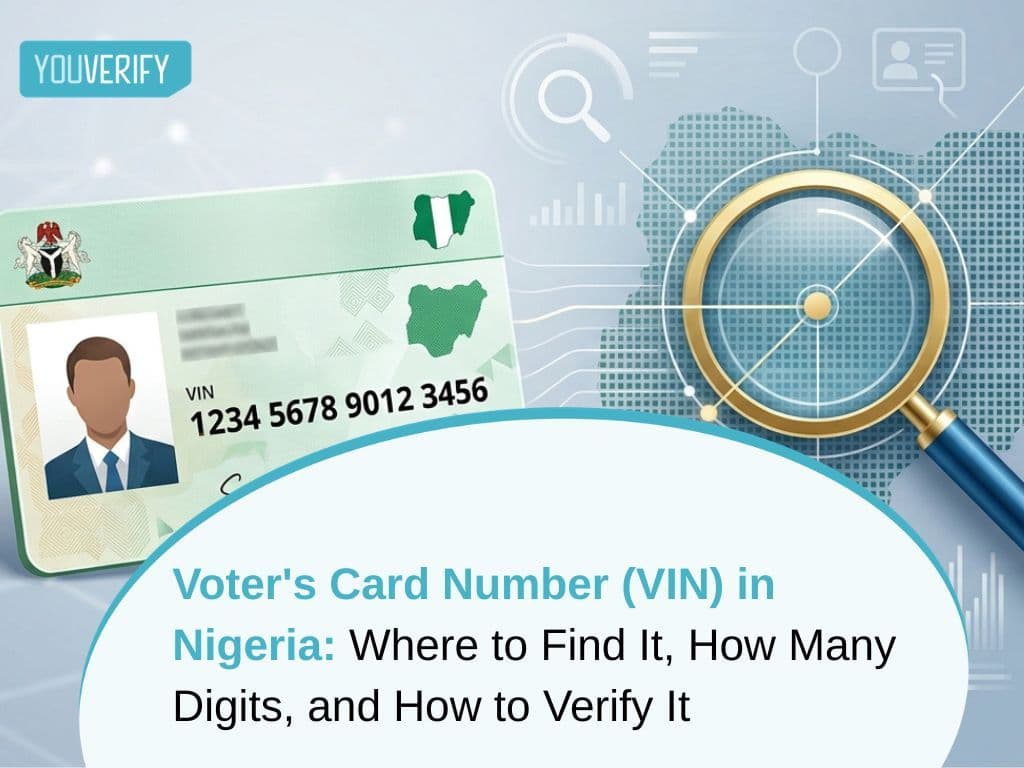
A Voter Identification Number (VIN) is the unique alphanumeric code printed on a Nigerian Permanent Voter Card (PVC). Look for the label VIN on the front of the card, and the code beside it is your VIN. You can verify it on INEC's voter verification portal with your state, local government, last name and VIN.
INEC's revised timetable, announced in February 2026, fixes the presidential and National Assembly elections for 16 January 2027. Governorship and state assembly elections follow on 6 February 2027. INEC's election calendar lists both dates as scheduled. Most guides tell a voter where the number sits and stop. This one also covers the confusing partial-VIN rules and what a VIN cannot do. It also explains why businesses should not treat a voter's card number as proof of identity.
What Is a Voter's Card Number (VIN)?
INEC issues a PVC to each registered voter. The card carries the voter's details and a Voter Identification Number, which INEC uses to locate the voter on the national register. Nigerians search for it as the voter's card ID number, the VIN number or the PVC number. In everyday use, the terms point to the same identifier.
Three numbers are easy to confuse. The VIN identifies you on the register. The polling unit code is a separate 8- or 9-digit code that identifies your voting location. Your National Identification Number (NIN) is issued by the National Identity Management Commission (NIMC). It has nothing to do with voter registration.
Before you collect a PVC, INEC gives you a Temporary Voter's Card (TVC) slip. The TVC also carries a VIN.
Where to Find Your VIN on a Nigerian Voter's Card
Look at the front of your PVC for the label VIN. The alphanumeric code printed beside that label is your VIN, which many people call the voter's card ID number. Its position can vary by card design. Do not confuse it with the polling unit code, which is a separate number.
If you have not collected your PVC, check your TVC slip. It also carries a VIN.
How Many Digits or Characters Is a Voter's Card VIN?
The VIN contains letters and numbers, so "characters" is more accurate than "digits". No fixed length is confirmed in INEC's guidance that we reviewed. Count the characters on your own card and enter them exactly as printed, including any letters.
Much of the confusion comes from partial VINs. INEC's current verification portal accepts either the full VIN or its last 10 digits. Earlier INEC guidance for SMS status checks asked for the last five or six digits. Those shorter formats come from earlier guidance, so use the full VIN wherever you can.
How to Verify Your Voter's Card Number Online
INEC's voter verification service offers two routes. You can search by name and date of birth, or by VIN. Both routes ask for your state and local government of registration, followed by a security check.
To verify by VIN, follow four steps. First, open the INEC voter verification page on the Continuous Voter Registration (CVR) portal. Second, choose the VIN option. Third, select your state and local government of registration and type your last name. Fourth, enter your full VIN, or the last 10 digits, and complete the security check.
If you have lost your card, use the name and date of birth route instead. If nothing matches, check that the spelling and the local government match your registration. INEC's notice on the portal recommends Google Chrome or Safari, because other browsers may be rejected.
INEC's portal states that the CVR exercise ended on 26 July 2026. New registration is therefore closed, but the verification page was still live when we reviewed it in September 2026. A successful search indicates that INEC found a matching voter record based on the details you entered. It does not by itself prove that the card is genuine, that the presenter owns it, or that every voting requirement has been met.
Can You Vote With Only Your VIN?
No. A VIN helps INEC locate a voter record, but it is not a voting credential by itself. Section 47(1) of the Electoral Act 2026 requires a person intending to vote to present a PVC for accreditation. Under section 47(2), the presiding officer uses the Bimodal Voter Accreditation System (BVAS), or another device INEC prescribes. It is used to verify, confirm or authenticate the voter's particulars. A partial VIN cannot replace the PVC.
Nigerian fact-checkers rejected a claim before the 2023 elections that the last five digits of a VIN could stand in for the card. The Electoral Act 2026 keeps the PVC requirement.
What to Do If You Lost Your PVC or Cannot Find Your VIN
Start with your TVC slip, if you still have it, because it carries the VIN. If you have neither, verify by name and date of birth to confirm you are registered. Then follow INEC's replacement process for lost or damaged cards.
If your PVC is lost, destroyed, defaced or damaged, section 18(1) of the Electoral Act 2026 applies. The owner must apply in person at least 90 days before polling day. The section also allows a downloadable copy to be printed. INEC's chairman has said downloadable replacements are meant for voters who already collected a card, as Vanguard reported in July 2026. Confirm the current procedure, eligibility conditions and deadline with INEC before relying on a downloadable replacement.
Keep Your VIN Private
Your VIN is not a password, but treat it with care. Together with your name and local government, it is enough to run a check on INEC's verification portal. Avoid posting photographs of your card online. A VIN, especially with a name, state or local government, should be handled as personal data. Enter it only on an official or properly authorised service. Be wary of third-party "VIN checker" sites that ask for extra information. If your identity has been misused, our guide to reporting identity theft in Nigeria explains the next steps.
Why a Voter's Card Number Is Not Enough for Identity Verification
Banks, fintechs, gaming operators and payment companies sometimes see a voter's card offered as ID. The PVC is a government-issued document, so it can support a customer file. The VIN printed on it is only a record locator.
INEC's verification form takes text fields such as state, local government, last name and VIN. It does not compare a face or fingerprint with the person holding the card. A card can be photographed, borrowed or altered. A matching VIN therefore shows that a record exists, not that the applicant owns it.
For that reason, regulated businesses in Nigeria usually anchor onboarding on identifiers that link to biometric records. The NIN and the Bank Verification Number (BVN) are the common examples. Our comparison of BVN and NIN shows how each is verified. Our overview of digital identity verification in Nigeria covers the wider picture. The full customer-identification duties are set out in our guide to the KYC requirements for banks in Nigeria.
A business that still accepts a voter's card should treat it as supporting evidence. Match its details against a verified identifier and keep the audit trail.
To see identity verification inside a live onboarding flow, speak with a Youverify compliance and identity verification expert.
Bottom Line
The VIN is the code printed beside the label VIN on the front of your PVC. INEC's portal accepts the full number or the last 10 digits. Verify it only on INEC's official portal, keep the card private, and remember that a VIN cannot replace the PVC at accreditation. For businesses, a voter's card number is a weak identity signal on its own and belongs beside stronger, biometric-linked checks.