What Is KYC? The Complete Know Your Customer Verification Guide for 2027
ByVictoria okere
•5mins Read
Key Takeaways
1. KYC (Know Your Customer) is the process banks, fintechs, and regulated businesses use to verify the identity of their customers, assess their risk of financial crime, and monitor their activity throughout the business relationship.
2. KYC is not a single check done at onboarding. It is a life cycle process of identity verification, risk scoring, PEP and sanctions screening, and ongoing monitoring that continues for as long as the business relationship exists.
3. For banks and fintechs in Africa, KYC must integrate with country-specific identity infrastructure, BVN and NIN in Nigeria; Ghana Card via the NIA; and HANIS in South Africa and align with each country's AML framework. Generic global KYC platforms routinely miss these integrations. Youverify's KYC Verification Platform is built for African financial institutions with native identity integrations.
What Is KYC?
KYC stands for Know Your Customer. It is the regulatory process by which banks, fintechs, and other regulated businesses verify that their customers are who they claim to be, understand the nature of their business relationship, and assess their exposure to money laundering, fraud, and terrorist financing risk. KYC is required by AML legislation across virtually every regulated market in the world and applies at onboarding and continuously throughout the customer lifecycle.
KYC is the front line of the global financial system's defence against money laundering, fraud, and terrorist financing. When you open a bank account, onboard onto a fintech platform, or invest through a regulated broker, you go through a KYC process. Behind the scenes, the institution is verifying your identity, checking your name against watchlists, and assigning a risk score that determines how closely your account activity will be monitored going forward.
The term originates from FATF Recommendation 10, which requires financial institutions to identify and verify their customers using reliable, independent sources. It has since been incorporated into national AML legislation worldwide, from the US Bank Secrecy Act to Nigeria's MLPPA 2022 to the EU's AMLD6. In 2027, the standards have never been higher, and the consequences of non-compliance have never been more serious.
KYC Meaning: Full Form, Definition, and What It Covers
KYC full form: Know Your Customer. KYC refers to the complete set of procedures a regulated institution must follow to identify its customers, verify that identity against reliable sources, understand what the customer does and why they need the financial service, and monitor them over time for signs of financial crime.
It is important to understand what KYC covers versus what it does not. KYC is focused on the customer, who they are, what their risk profile is, and whether they should be given access to financial services at all and under what conditions. AML (Anti-Money Laundering) is the broader framework of which KYC is one component. Transaction monitoring, suspicious activity reporting, and compliance program management are all AML functions that sit alongside KYC but go beyond it.
Continuous, event-driven review of the customer's risk profile throughout the relationship lifecycle
Advanced compliance frameworks increasingly expected by regulators globally
Why KYC Matters: The Regulatory and Financial Stakes
The financial stakes of inadequate KYC are not theoretical. In 2012, HSBC paid about US$1.9 billion in U.S. penalties and forfeitures after major AML and sanctions-control failures. In 2023, Binance agreed to pay more than US$4.3 billion to U.S. authorities over AML, sanctions, and compliance failures, including inadequate customer vetting and transaction monitoring. These are not outliers. They illustrate a consistent regulatory posture: inadequate KYC is treated as enabling financial crime, and the penalties reflect that.
For banks and fintechs in Africa, the stakes are equally significant. The Central Bank of Nigeria has issued enforcement notices and imposed fines on licensed banks for KYC failures documented in supervisory examinations. South Africa's exit from the FATF grey list in February 2025 came after years of remediation that directly implicated KYC and CDD standards. The message from regulators globally is consistent: KYC is not a compliance formality. It is the primary mechanism through which financial institutions prevent their platforms from being exploited.
KYC is not a single action. It is a structured process with five distinct stages that together produce a compliance-grade picture of who the customer is and how they should be served. Understanding each stage is essential for compliance officers designing or auditing a KYC program.
Stage 1: Customer Identification Collecting the Data
The first stage of KYC is collecting the information needed to identify the customer. Under FATF Recommendation 10, institutions must obtain at minimum the customer's full legal name, date of birth, nationality, and a permanent address. For digital onboarding, this typically means the customer submitting a government-issued identity document and providing their personal details through a digital form or portal.
At this stage, the institution is collecting information, not yet verifying it. The quality of the data collected here determines how reliable the subsequent verification will be. Garbage data produces unreliable verification outcomes.
Stage 2: Identity Verification Confirming the Data Is True
Identity verification is the process of confirming that the data provided by the customer matches reliable, independent sources. It answers the question, "Is this person really who they say they are?" There are three primary methods: document-based verification (checking physical or digital ID documents); database verification (cross-referencing against government identity registries); and biometric verification (matching the person's face against their document photo using liveness detection).
Document-based verification involves checking that the identity document is genuine, unaltered, and matches the customer's self-declared details. Advanced KYC systems use OCR (Optical Character Recognition) to extract data automatically, then apply AI-powered fraud detection to check for signs of tampering, cloning, or fabrication by checking security features, font consistency, UV markings, and metadata integrity.
Database verification, also called non-document verification or eKYC, is the process of verifying identity by querying authoritative government databases directly, without requiring the customer to upload a document. In Nigeria, this means verifying the customer's BVN (Bank Verification Number) through NIBSS and their NIN (National Identity Number) through NIMC. In Ghana, it means querying the NIA Ghana Card database. In South Africa, it means cross-referencing the Department of Home Affairs HANIS system. Database verification is faster than document verification and harder to spoof; it is the gold standard for African markets with mature digital identity infrastructure.
Biometric verification adds the third layer: confirming that the person presenting the document or providing the database-matched identity is physically present and is the same person whose face appears on the ID. This requires liveness detection, a technology that distinguishes a live person from a photo, video replay, or AI-generated deepfake. The industry benchmark for liveness detection reliability is iBeta Level 2 Presentation Attack Detection (PAD) certification. In 2027, deepfake-enabled identity fraud is a primary threat vector. Any KYC system that does not meet this standard is structurally exposed.
Stage 3: Customer Due Diligence (CDD) Assessing Risk
After verifying identity, the institution must assess the customer's financial crime risk. Customer Due Diligence (CDD) involves understanding the nature and purpose of the business relationship, the expected pattern of transactions, the customer's source of funds, and their overall risk profile. CDD is not a box-ticking exercise; it is the mechanism by which the institution calibrates how closely it needs to monitor this customer.
The three tiers of due diligence that every compliance program must support:
1. Standard CDD: Applied to the majority of retail customers who present no obvious risk indicators. Includes identity verification, address verification, and basic source-of-funds understanding.
2. Enhanced Due Diligence (EDD): Required for Politically Exposed Persons (PEPs), customers from FATF high-risk or monitored jurisdictions, complex corporate structures, non-face-to-face onboarding, and transactions that are unusually large or have no apparent lawful purpose. EDD requires additional documentation, senior management approval in some cases, and more intensive ongoing monitoring.
3. Simplified Due Diligence (SDD): Permitted with regulatory approval for demonstrably low-risk products and customer categories, such as basic accounts for financially excluded individuals subject to strict transaction limits. SDD does not mean no verification; it means a reduced intensity of verification commensurate with the risk.
Stage 4: PEP and Sanctions Screening
Every customer, individual or corporate, must be screened against watchlists at onboarding. Minimum screening coverage includes the OFAC Specially Designated Nationals (SDN) list, the UN Security Council consolidated sanctions list, the EU consolidated sanctions list, and domestic PEP registers relevant to the customer's jurisdiction.
A Politically Exposed Person (PEP) is an individual who holds or has held a prominent public function, such as a head of state, senior government official, senior military officer, member of parliament, or senior judicial official, and their close associates and family members. PEPs are not automatically prohibited from accessing financial services, but their access to public resources and potential for abuse of position means they require EDD. The FATF Guidance on PEPs is explicit that PEP status requires enhanced scrutiny regardless of the customer's stated profile.
Stage 5: Ongoing Monitoring and Perpetual KYC
The final and most frequently underestimated stage of KYC is ongoing monitoring. KYC checks at onboarding tell you who the customer was on the day they joined. Ongoing monitoring tells you whether anything has changed since then: a new sanctions designation, a change in PEP status, transaction behavior that no longer matches the customer's stated profile, or a regulatory event linked to the customer or their associates.
The most advanced compliance programs have moved from periodic review (annual or at relationship milestones) to perpetual KYC (pKYC), a continuous, event-driven model in which changes to the customer's risk profile automatically trigger a review workflow. A new OFAC designation issued on a Tuesday triggers an alert for any customer whose name matches within hours, not at the next scheduled batch review. This is the standard regulators in the UK, the EU, and increasingly across Africa are moving toward.
Types of KYC Verification: Document, Non-Document, Video, and Biometric
KYC verification is not one method. Different institutions, jurisdictions, and customer risk profiles call for different verification approaches. Compliance officers and product teams should understand the full menu of options and when each is appropriate.
KYC Type
How It Works
Best For
Limitation
Document-Based KYC
The customer uploads ID document; OCR extracts data; AI checks authenticity; face match is made against document photo
Broad applicability across markets and customer types
Higher fraud risk than database methods; deepfake attacks on document photos
Non-Document KYC (eKYC / Database KYC)
Identity verified by querying government databases BVN/NIN (Nigeria), NIA (Ghana), HANIS (South Africa) in real time
African markets with mature digital identity infrastructure; fastest onboarding experience
Only available where government database APIs are accessible
Biometric KYC
Face matching and liveness detection confirms person is physically present and matches ID photo
Live video call with compliance officer who verifies documents and identity in real time
Mandatory in some jurisdictions (Germany, Estonia); EDD cases; high-risk customers
Slower, more expensive; requires trained staff; impractical at high onboarding volumes
Reusable KYC
Customer verified once across an ecosystem of institutions; verified status ported to new onboarding relationships
Reducing friction for returning customers across platforms in the same ecosystem
Requires trust agreements between institutions; regulatory acceptance varies by market
What Is KYC in Banking? How Banks Apply KYC Requirements
In banking, KYC is the mandatory compliance process by which a bank verifies a customer's identity, assesses their financial crime risk, and monitors their account activity. Every bank regulated by a central bank or financial services authority is required to maintain a KYC program that meets the standards set by national AML legislation and, where applicable, FATF Recommendations. Failure to maintain adequate KYC exposes the bank to regulatory fines, license action, and criminal prosecution of responsible officers.
For retail banks, KYC applies from the moment a customer opens an account. The bank must verify the customer's identity through government-issued ID, confirm their address, understand the purpose of the account, and assign a risk tier. For corporate customers, the bank must additionally perform KYB (Know Your Business) checks, mapping the ownership structure to identify ultimate beneficial owners, verifying directors, and assessing the business's activity and risk profile.
Banks also face a category of KYC risk that goes beyond their direct customer relationships: correspondent banking. When a bank operates a nostro/vostro relationship with a foreign correspondent bank, it inherits the KYC risk of that correspondent's entire customer portfolio. Correspondent banking KYC failures have generated some of the largest fines in banking regulatory history.
KYC in Africa: Country-by-Country Regulatory Requirements
This section covers what KYC actually requires in the markets that matter for African financial institutions.
1. KYC in Nigeria
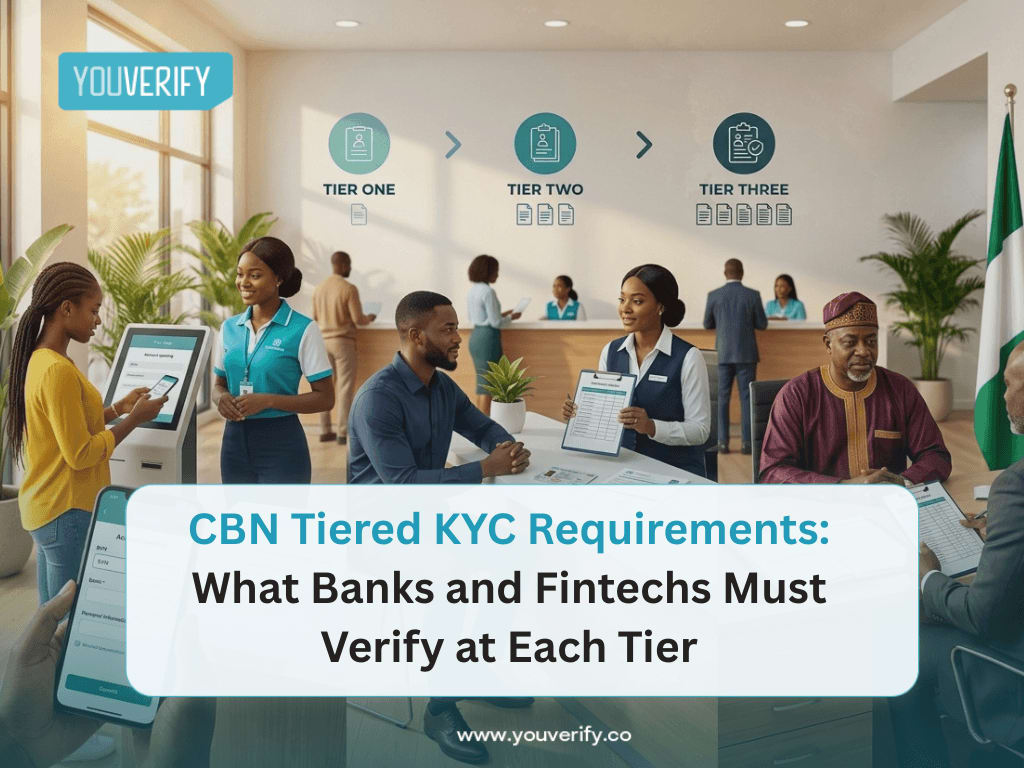
KYC in Nigeria is governed by the Central Bank of Nigeria's AML/CFT/CPF Compliance Framework (2023) and the Money Laundering (Prevention and Prohibition) Act, 2022. The CBN operates a tiered KYC framework for retail accounts, with three levels of account access determined by the depth of identity verification completed:
1. Tier 1 (Low-value accounts): Requires only a telephone number and basic demographic data. Transaction limits apply. Designed to bring the financially excluded into the formal system.
2. Tier 2 (Mid-value accounts): BVN (Bank Verification Number) verification is required, a biometric-linked identifier managed by NIBSS that connects a customer's identity across all Nigerian banks. Also requires basic personal data and a residential address.
3. Tier 3 (Full-access accounts): Requires BVN, NIN (National Identity Number), government-issued photo ID, and a utility bill or bank statement as proof of address. This tier has no transaction limits and is required for any customer handling significant transaction volumes.
Non-document verification via BVN and NIN is the most efficient KYC method for Nigerian institutions. The National Identity Management Commission (NIMC) provides API access to the NIN database for regulated institutions. Banks and fintechs that integrate this directly can verify Nigerian customers in seconds, without requiring document uploads that slow onboarding and introduce fraud risk at the document layer.
2. KYC in South Africa
In South Africa, KYC is governed by the Financial Intelligence Centre Act (FICA), the Financial Intelligence Centre Amendment Act, 2017, and regulatory guidance from the Financial Sector Conduct Authority (FSCA). The primary identity verification document for South African nationals is the RSA Smart ID Card or the green ID book, both verifiable against the Department of Home Affairs' HANIS database.
South Africa's FATF grey listing in 2023 and exit in February 2025 produced a significant upgrade in KYC standards across the South African financial sector. Accountable institutions are now subject to more intensive supervisory examination, with particular scrutiny on EDD for PEPs, beneficial ownership verification, and the adequacy of ongoing monitoring systems.
3. KYC in Ghana
KYC in Ghana is governed by the Anti-Money Laundering Act, 2020 (Act 1044), and the Bank of Ghana's AML/CFT/CPF Guidelines (updated January 2026). The Ghana Card, issued by the National Identification Authority (NIA), is the primary identity verification document. The BoG's 2026 guideline update specifically requires banks to integrate with the NIA biometric database for digital onboarding, replacing document-only verification for standard risk customers.
4. KYC in Kenya
KYC in Kenya is governed by the Proceeds of Crime and Anti-Money Laundering Act (POCAMLA) and the Central Bank of Kenya's Prudential Guidelines. The primary identity document is the Kenyan National Identity Card (Huduma Namba), verifiable through the National Registration Bureau. Kenya's advanced mobile money infrastructure built around M-Pesa and the broader mobile financial services ecosystem has driven strong demand for mobile-first, non-document KYC verification at scale.
KYC and Fraud Detection in 2027: Deepfakes, Synthetic Identities, and AI Attacks
The fraud landscape in 2027 is categorically different from 2020. AI-generated deepfakes, synthetic identities constructed from real data fragments, and document fabrication tools available on underground markets have made identity fraud faster, cheaper, and harder to detect than at any previous point. FATF's 2024 report on digital identity and emerging technologies specifically flags AI-enabled identity fraud as one of the primary evolving threats to the KYC verification process.
Three specific fraud vectors that KYC systems must now actively defend against:
1. Deepfake liveness attacks: AI-generated video or image substitution that tricks a poorly implemented liveness check into accepting a synthetic face as a genuine, live person. The defence is liveness detection certified to iBeta Level 2 PAD standards, which tests the system against a broad range of known attack types, including 3D masks, video replays, and generative AI outputs.
2. Synthetic identity fraud: The construction of a new, plausible identity by combining real identity data fragments (a genuine NIN, a real date of birth, a valid address) with fabricated elements. Synthetic identities are designed to pass standard KYC checks because they contain real data. The defence is non-document database verification that requires a match against the government registry. A synthetic identity that uses a real NIN but a different face will fail an NIA biometric cross-check.
3. Document fabrication: AI tools can now generate photorealistic fake passports and national ID cards that standard OCR systems accept as genuine. The defence is multi-layer document authentication that goes beyond OCR to check physical security features, metadata signatures, and machine-readable zone (MRZ) integrity.
Youverify's identity verification platform deploys liveness detection, AI-powered document authentication, and NIA/BVN/NIN database cross-referencing as standard features, addressing all three attack vectors in a single verification workflow.
KYC Requirements by Sector: Banks, Fintechs, Crypto, and iGaming
KYC is not applied identically across all regulated industries. The specific verification requirements, risk thresholds, and regulatory frameworks differ materially by sector. Understanding these differences is essential for compliance officers designing programs in complex, multi-product financial institutions.
Sector
Regulatory Authority (Africa)
Key KYC Requirements
Highest Risk Factors
Commercial Banks
CBN (Nigeria), BoG (Ghana), SARB/FSCA (South Africa), CBK (Kenya)
Full CDD + EDD for PEPs; BVN/NIN/NIA integration; correspondent banking KYC; corporate KYB
PEP accounts; shell company onboarding; cross-border wire activity
Fintechs / Payment Platforms
CBN (Nigeria), FCA/FSCA, CBK
Tiered KYC aligned to transaction limits; non-doc verification preferred; rapid onboarding at scale
High onboarding volumes masking fraud; merchant account abuse; card testing
Crypto / Virtual Assets
SEC Nigeria, FSCA (South Africa)
FATF Recommendation 15 (VASPs); UBO verification for corporate customers; Travel Rule compliance for transfers
A Real-World KYC Failure: What Inadequate Verification Actually Costs
In 2023, a mid-tier Nigerian fintech with approximately 800,000 active users was cited in a CBN compliance examination for systematic KYC deficiencies. The institution had onboarded customers using phone number and selfie verification only with no NIN or BVN cross-reference, no liveness detection meeting regulatory standards, and no PEP screening integrated into the onboarding flow.
The examination identified 1,400 accounts with transaction patterns consistent with structuring, 37 accounts linked to individuals appearing on the EFCC's domestic PEP register, and 12 accounts whose BVN cross-reference (conducted retrospectively during the examination) produced no match, meaning these customers had been onboarded using fabricated identity data. The fintech received a formal regulatory directive requiring immediate remediation of its KYC program, suspension of new account onboarding pending a CBN-approved remediation plan, and financial penalties.
The cost of remediation technology replacement, manual back-book verification of 800,000 accounts, legal fees, and the commercial impact of suspended onboarding dwarfed what a properly implemented KYC solution would have cost from day one. Youverify's KYC Verification Platform provides BVN and NIN integration, liveness detection, and automated PEP screening as baseline features, precisely the capabilities this institution lacked.
KYC vs AML: Understanding the Relationship
KYC is a component of AML, not a synonym for it. KYC answers the question, "Who is this customer?" AML answers the question: Are this customer or their transactions presenting financial crime risk? KYC comes first; you cannot monitor transactions meaningfully until you know who is making them. But KYC alone is insufficient. An effective AML program requires KYC at onboarding, ongoing transaction monitoring, suspicious activity reporting, and a risk management framework that governs all of it.
The practical relationship: every AML program begins with KYC. The customer identification and risk scoring that KYC produces informs the transaction monitoring rules applied to that customer's account. A Tier 1 low-risk retail customer receives automated monitoring calibrated to consumer-level transaction patterns. A PEP customer identified through KYC's EDD process receives enhanced monitoring with lower alert thresholds and more frequent manual review. The quality of KYC directly determines the quality of everything downstream in the AML program.
How to Build a KYC Compliance Programme: A Framework for Banks and Fintechs
For compliance officers building or auditing a KYC program, the following framework covers the essential elements that regulators will examine. This is not a checklist; it is a structural guide. Each element requires documented policies, operational procedures, and technology capable of executing them consistently.
1. Written KYC/AML Policy: A documented program covering all aspects of KYC customer identification, verification standards by risk tier, EDD triggers and procedures, PEP and sanctions screening scope, ongoing monitoring parameters, and escalation procedures. The policy must be approved at the board level and reviewed at minimum annually.
2. Customer Risk Assessment: A risk rating methodology that assigns every customer a risk tier (Low, Medium, High) based on identity verification outcomes, geographic risk, product type, and transaction profile. The risk tier determines the intensity of due diligence applied and the monitoring parameters configured for that customer's account.
3. Identity Verification Infrastructure: Technology capable of verifying identity documents, conducting database cross-checks against relevant national registries, performing biometric liveness detection, and screening against PEP and sanctions lists in a single, integrated workflow with a complete audit trail for every decision.
4. Ongoing Monitoring System: A transaction monitoring system calibrated to the institution's risk profile and customer base, capable of generating alerts for patterns consistent with money laundering, structuring, and the specific typologies relevant to the institution's markets. For African institutions, this means country-specific typologies: galamsey proceeds in Ghana, advance fee fraud in Nigeria, and TBML through Tema Port.
5. STR/SAR Reporting Workflow: A documented process for investigating monitoring alerts, escalating to the MLRO, and filing Suspicious Transaction Reports (STRs) or Suspicious Activity Reports (SARs) with the relevant financial intelligence units NFIU in Nigeria, FIC Ghana, FIC South Africa, and FRC in Kenya within the timeframes required by national legislation.
6. Training Program: Mandatory AML/KYC training for all staff annually, with enhanced training for customer-facing staff, relationship managers, and the MLRO. Training records must be documented and available for regulatory inspection.
7. Three Lines of Defence: Business units as the first line, the compliance function as the second line, and internal audit as the third. The MLRO must have direct reporting access to the Board or a Board subcommittee and must not be structurally subordinated to revenue-generating functions.
What Documents Are Required for KYC?
The specific documents required for KYC vary by jurisdiction, customer type, and risk tier. The table below covers the standard document requirements for individual customers across the four largest African compliance markets.
Document Type
Nigeria
South Africa
Ghana
Kenya
Primary ID
National ID / International Passport / Voter's Card
RSA Smart ID Card / Green ID Book / Passport
Ghana Card (NIA biometric) / Passport
National ID (Huduma Namba) / Passport
Digital Identity
NIN (NIMC database) + BVN (NIBSS database)
HANIS (Dept. of Home Affairs) verification
NIA Ghana Card database verification
IPRS (Integrated Population Registration System)
Proof of Address
Utility bill / Bank statement (max 3 months)
Utility bill / Bank statement (max 3 months)
Utility bill / Bank statement (max 3 months)
Utility bill / Bank statement (max 3 months)
Source of Funds (EDD)
Bank statements (6 months), payslips, business records
Bank statements, SARS tax records, investment statements
Bank statements, audited accounts (business)
KRA returns, bank statements, payslips
PEP Declaration
Self-declaration + cross-reference against EFCC register
KYC (Know Your Customer) is the process banks and financial institutions use to verify customer identities and assess financial crime risk. It is important because it is the primary mechanism through which the financial system prevents money laundering, terrorist financing, fraud, and sanctions evasion. Without KYC, criminal networks could use financial institutions to move and clean illicit funds without detection. FATF Recommendation 10 requires all regulated financial institutions to maintain a KYC program as a baseline AML control.
How long does KYC verification take?
KYC verification time varies significantly by method and institution. Manual document review can take from hours to several days. Automated KYC platforms with non-document database verification, such as BVN/NIN in Nigeria and Ghana Card/NIA in Ghana, can complete verification in under 60 seconds for standard-risk customers. EDD cases that require additional documentation review, source-of-wealth assessment, or senior management approval typically take several business days. For most retail customers on a modern digital KYC platform, the process takes less than 5 minutes.
What happens if KYC is not done?
Failure to conduct adequate KYC exposes a financial institution to regulatory fines, suspension of operating licenses, and criminal prosecution of responsible officers. In Nigeria, under the MLPPA 2022 and CBN Framework, fines can reach ₦10 million per violation for individual staff and significantly more for institutional failures. Banks found to have systemic KYC deficiencies face CBN-mandated remediation programs, enhanced supervision, and reputational damage that affects customer and investor confidence. For customers, failure to complete KYC means denial of financial services. Banks cannot legally serve customers whose identity has not been verified to the required standard.
What is the KYC full form in banking?
The KYC full form in banking is Know Your Customer. The term describes the regulatory obligation for banks to identify and verify their customers before providing financial services and to maintain an ongoing understanding of the customer's profile, risk, and activity throughout the business relationship. The phrase was formalized through the FATF Recommendations and has since been incorporated into AML legislation across virtually every major financial market worldwide.
What is the difference between KYC and KYB?
KYC (Know Your Customer) applies to individual customers, natural persons. KYB (Know Your Business) applies to corporate customers, companies, partnerships, trusts, and other legal entities. KYB is more complex than KYC because it requires mapping the ownership structure of the entity down to the natural persons who ultimately own or control it (the UBOs), then applying individual KYC-equivalent verification to each UBO identified. Youverify's KYB Solution automates both the entity-level checks and the UBO verification layer for African financial institutions.
Conclusion: What KYC Compliance Looks Like in 2027
KYC in 2027 is not the same process it was five years ago. The regulatory bar has risen; the fraud threat has evolved. Deepfakes and synthetic identities have made basic document checks genuinely inadequate, and the expectation from regulators globally has shifted from point-in-time verification to continuous, risk-based monitoring throughout the customer lifecycle. For banks and fintechs operating across African markets, these demands are compounded by the need to integrate with country-specific identity infrastructure and align with the specific frameworks of multiple regulators simultaneously.
The institutions that get KYC right in 2027 will share three characteristics: they will use technology that integrates natively with the identity databases their customers' regulators actually expect; they will apply genuine risk-based logic, not uniform processes applied indiscriminately to all customers; and they will monitor continuously rather than checking once and forgetting. Everything else is a liability waiting to be discovered in the next supervisory examination.
Youverify's fraud prevention system is purpose-built for African financial institutions. It covers BVN and NIN integration in Nigeria, Ghana Card NIA verification in Ghana, and biometric verification across African markets in a single, auditable workflow that delivers a complete compliance record for every onboarding decision. For business customers, the KYB Solution extends the same depth to corporate onboarding with CAC, CIPC, and RGD integration and automated UBO mapping.
Take the next step. Book a free demo of today. to see how banks and fintechs across Africa are automating compliant, fraud-resistant customer verification from BVN/NIN non-document checks to biometric liveness detection and real-time PEP screening in a single, regulator-ready platform.
About the Author
Victoria Okere is a writer at Youverify with expertise in KYC, AML/CFT, and digital identity verification frameworks across Sub-Saharan Africa. She specialises in translating complex regulatory requirements into actionable compliance guidance for banks, fintechs, and financial regulators across West and Southern African markets.
FAQs
Frequently Asked Questions
KYC stands for Know Your Customer. It is the regulatory process by which banks, fintechs, and other regulated businesses verify the identity of their customers, assess their financial crime risk, and monitor their activity over time. KYC is required by AML legislation globally and applies at onboarding and continuously throughout the customer relationship lifecycle.
In banking, the KYC process involves five stages: customer identification (collecting name, date of birth, address, and identity documents); identity verification (confirming the data is true via document checks, biometric matching, or government database cross-reference); customer due diligence (assessing risk and determining the appropriate level of scrutiny); PEP and sanctions screening; and ongoing monitoring to detect changes in the customer's risk profile after onboarding.
KYC (Know Your Customer) is the process of verifying customer identity and assessing risk at onboarding and on an ongoing basis. AML (Anti-Money Laundering) is the broader framework that encompasses KYC, transaction monitoring, suspicious activity reporting, and the overall compliance program. KYC is a component of AML, not a synonym for it. An effective AML program begins with KYC but extends well beyond it.
Standard KYC documents include a government-issued photo ID (passport, national ID card, or driver's license) and proof of address (utility bill or bank statement less than three months old). In markets with mature digital identity infrastructure such as Nigeria (BVN and NIN), Ghana (Ghana Card / NIA), and South Africa (HANIS), non-document database verification can replace physical documents, enabling faster onboarding without sacrificing verification quality.
eKYC (electronic KYC) is the process of verifying a customer's identity digitally without requiring physical documents to be presented in person. Methods include document upload with AI-powered authentication, biometric liveness detection, and direct database verification against government identity registries. eKYC is faster, more scalable, and more fraud-resistant than in-person document checks when implemented with certified liveness detection and authoritative database integration.
Enhanced Due Diligence (EDD) is a deeper level of customer scrutiny applied to high-risk customers, including Politically Exposed Persons (PEPs), customers from FATF high-risk or monitored jurisdictions, and those with complex corporate structures. EDD typically requires additional documentation (source of wealth and source of funds), senior management approval for the business relationship, and more intensive ongoing monitoring than standard CDD.
Perpetual KYC (pKYC) replaces scheduled, periodic KYC reviews with continuous, event-driven monitoring. When a trigger event occurs, a new sanctions designation, an adverse media alert, a change in the customer's beneficial ownership, or a material shift in transaction behavior, the system automatically initiates a review workflow. Perpetual KYC is the direction regulators globally are pushing the industry, and it is increasingly the standard expected in supervisory examinations.