BVN vs NIN: Key Differences, Uses, and How to Verify Both in 2026
ByTemitope Lawal
•5mins Read
Key Takeaways
BVN (Bank Verification Number) is issued by the Central Bank of Nigeria (CBN) through NIBSS and is specific to bank account holders
NIN (National Identification Number) is issued by NIMC under the National Identity Management Act 2007 and covers all Nigerian citizens and legal residents
BVN and NIN are not the same, they serve different purposes and are governed by different legal frameworks
As of December 2025, Nigeria has 67.8 million BVN registrations and approximately 110 million NIN enrolments
The Federal Government has proposed replacing BVN with NIN but this has not happened, both numbers remain active and mandatory
The CBN December 2023 circular mandates that Tier 1 accounts must have either BVN or NIN, while Tier 2 and Tier 3 accounts must have both
For businesses, verifying both numbers at onboarding is now a CBN compliance requirement under the 2026 Baseline Standards.
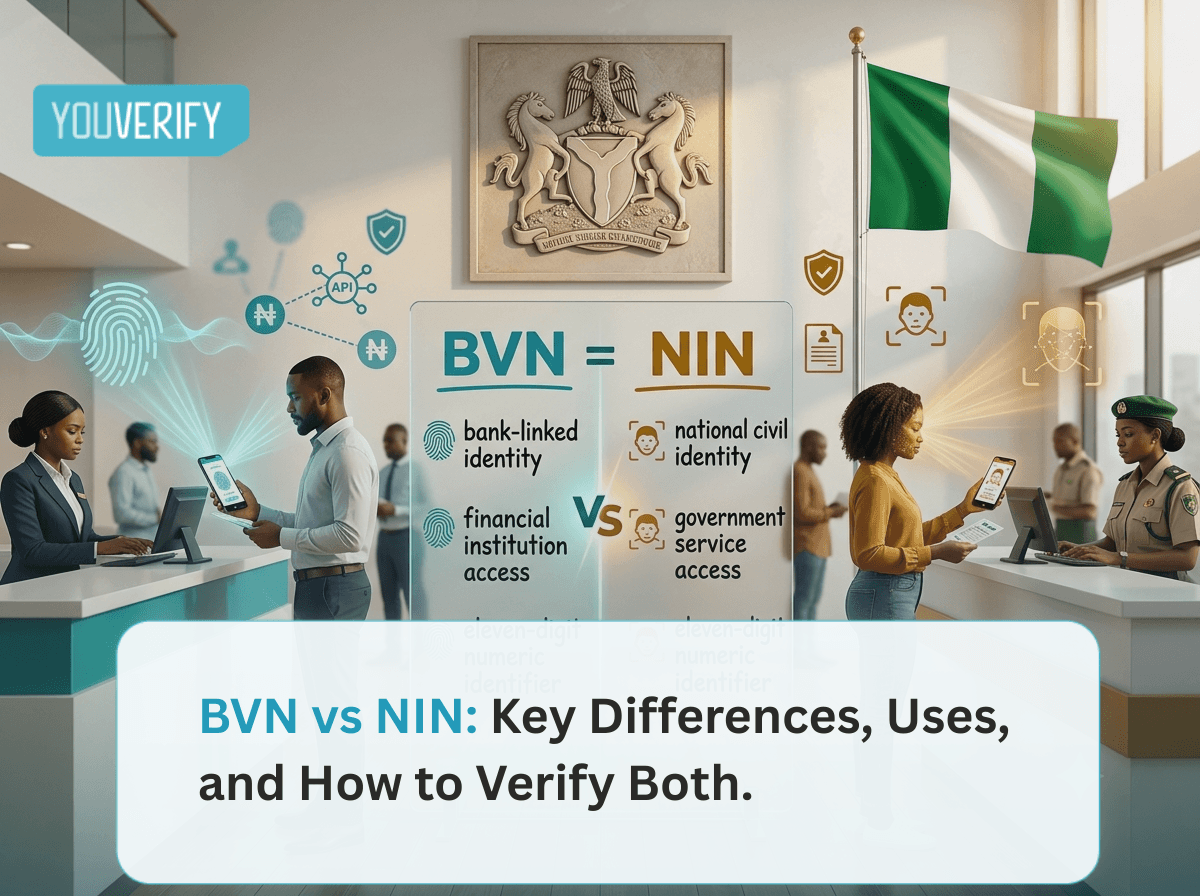
What is the difference between BVN and NIN? Your BVN is your banking identity. Your NIN is your national identity. Both are 11-digit biometric numbers, both are now mandatory for most Nigerians, and both are frequently confused for the same thing, but they come from different authorities, are governed by different laws, and are used for different purposes.
This article explains the difference between BVN and NIN, how to check and retrieve each one, whether BVN is actually being replaced by NIN, and how businesses verify both numbers for KYC and fraud prevention.
What is a BVN?
BVN stands for Bank Verification Number. It is an 11-digit biometric identification number issued to every bank account holder in Nigeria. The CBN introduced BVN in February 2014 in collaboration with the Nigeria Inter-Bank Settlement System (NIBSS) to address escalating fraud, identity theft, and the fragmentation of customer data across multiple banks.
When you enrol for a BVN at any bank branch, your fingerprints and photograph are captured biometrically. That data is stored in the centralised NIBSS database and linked to your 11-digit BVN. The number follows you across every bank account you hold in Nigeria, it does not change when you switch banks, open additional accounts, or change your phone number.
The BVN is the backbone of Nigeria's banking identity infrastructure. By December 2025, the NIBSS BVN database had reached 67.8 million registrations, up from 63.5 million in 2024, reflecting both organic growth and the impact of the CBN's enforcement actions that froze accounts without a BVN or NIN from April 2024.
What BVN is used for:
Linking all your bank accounts under a single verified identity
Enabling banks to check your transaction history and credit risk across institutions
Satisfying KYC requirements for Tier 2 and Tier 3 bank accounts
Preventing fraud and identity theft in financial transactions
Enabling the NIBSS to blacklist individuals involved in financial crimes across the banking system
Identification for purposes outside the financial system
What is a NIN?
NIN stands for National Identification Number. It is an 11-digit number assigned to every Nigerian citizen and legal resident by the National Identity Management Commission (NIMC) under the National Identity Management Act 2007. Unlike the BVN, the NIN is not limited to bank customers, it is meant to be the primary identity anchor for every Nigerian regardless of whether they use banking services.
When you enrol for a NIN at a NIMC enrolment centre, ten fingerprints, a facial photograph, and a digital signature are captured. This biometric data is stored in the National Identity Database and linked to your NIN. The NIN is the legal identity record of a Nigerian citizen.
By 2026, approximately 110 million Nigerians have been enrolled for a NIN, a significantly larger base than the BVN, which covers only those with bank accounts.
What NIN is used for:
Primary national identification for all Nigerians and legal residents
SIM card registration (mandatory since the NCC-NIMC directive requiring NIN-SIM linkage)
Accessing government services, social interventions, and benefits
KYC verification for bank accounts (Tier 1 accounts can use NIN in place of BVN; Tier 2 and 3 require both)
Passport applications and renewal
International travel and legal documentation
What NIN does not cover:
Banking-specific fraud monitoring and blacklisting (that is NIBSS and BVN territory)
Cross-bank transaction history
Real-time financial identity checks at the banking level
BVN vs NIN: The Core Differences
What is the difference between BVN and NIN? The simplest way to understand the difference between BVN and NIN is this: NIN is your national identity, BVN is your banking identity. Here is how they differ across every dimension that matters.
BVN
NIN
Issuing authority
CBN via NIBSS
NIMC
Legal basis
CBN policy directive
National Identity Management Act 2007
Who it covers
Bank account holders only
All Nigerian citizens and legal residents
Number format
11 digits
11 digits
Biometric capture
2 fingerprints + photograph
10 fingerprints + photograph + signature
Primary purpose
Banking identity and fraud prevention
National identification
Can open a bank account
Yes
Yes (Tier 1 only)
Required for SIM registration
No
Yes
Required for passport
No
Yes
Linked to cross-bank records
Yes -- via NIBSS
No
Managed by
NIBSS
NIMC
Is BVN the Same as NIN? Can One Replace the Other?
No. BVN and NIN are not the same. They share the same number format (11 digits), both involve biometric capture, and both are now widely required for financial services, but they are distinct systems managed by different government bodies with different legal foundations.
The confusion is understandable given that since the CBN's December 2023 circular, banks must link accounts to both. But linking is not the same as merging. Your BVN still lives in NIBSS. Your NIN still lives in NIMC. They are cross-referenced, not combined.
Is BVN Being Replaced by NIN?
This is the question most Nigerians are searching for, and the honest answer in 2026 is: the proposal exists, the full replacement has not happened, and both numbers remain active and mandatory.
The Federal Government announced plans to replace BVN with NIN as far back as 2021, when the then-Minister of Communications and Digital Economy Dr Isa Pantami publicly stated that the BVN is a CBN policy directive while the NIN is a law, specifically the National Identity Management Act 2007, and that law is a stronger foundation for national identity than a regulatory policy. The argument was that NIN should be the primary national identity number, with BVN becoming redundant once harmonisation was complete.
That harmonisation has happened in part. Since 2022, CBN has required banks to electronically link customers' BVN to their NIN records, meaning both numbers are now cross-referenced in the NIBSS database. In practice, if you enrol for a BVN today, the NIBSS system attempts to retrieve and link your NIN automatically.
But BVN has not been retired. The NIBSS BVN database actually grew to 67.8 million registrations by December 2025, reflecting 6.8 percent year-on-year growth. In May 2025, the CBN and NIBSS launched the Non-Resident Bank Verification Number (NRBVN) platform, a new initiative enabling Nigerians in the diaspora to get a BVN remotely. You do not launch new infrastructure for a system you are about to retire.
The current reality: both BVN and NIN are mandatory, both remain active, and neither has replaced the other. The CBN's December 2023 circular confirmed this by setting separate requirements, Tier 1 accounts need either BVN or NIN, Tier 2 and Tier 3 accounts need both.
How to Check Your BVN
There are several ways to retrieve your BVN if you have forgotten it or need to confirm it.
1. USSD code (fastest method):
Dial *565*0# on the phone number registered to your bank account. Your BVN will display on the screen. This works on MTN, Airtel, Glo, and 9mobile. A small fee may apply depending on your network.
2. Bank mobile app:
Open your bank's mobile app and navigate to the profile or settings section. Most Nigerian bank apps display your BVN under account information.
3. Internet banking:
Log into your bank's internet banking portal. Your BVN typically appears under account details or profile settings.
4. Visit your bank branch:
Present a valid government-issued ID and request your BVN from a customer service officer. This is the most reliable method if the USSD code is not working.
5. NIBSS portal:
Visit the NIBSS eBVN portal at bvnenrollment.com.ng and follow the verification steps using your registered phone number.
Since the CBN mandated NIN-BVN harmonisation, banks are required to electronically link your NIN to your BVN. In most cases, if both records exist in their respective databases, the linkage happens automatically.
If your account is flagged as unlinked, visit your bank branch with your NIN slip or NIN verification document. The bank will initiate the electronic retrieval and linkage. Alternatively, use your bank's internet banking platform or mobile app, several Nigerian banks have built NIN-BVN linkage as a self-service feature.
If your NIN and BVN biometric records do not match (for example, your name is spelt differently across the two databases), you will need to resolve the discrepancy at either NIMC or your bank before the linkage can be completed.
BVN vs NIN for KYC: What Businesses Need to Know
For banks, fintechs, lenders, and any regulated entity onboarding Nigerian customers, the question is not just what BVN and NIN are, it is how to verify them accurately and in compliance with CBN requirements.
What the CBN Requires
The CBN's December 2023 circular established the following minimums:
1. Tier 1 bank accounts and wallets must have either a BVN or NIN linked and electronically revalidated.
2. Tier 2 and Tier 3 accounts must have both BVN and NIN linked and verified.
From March 2024, accounts without the required linkage were placed on Post No Debit or Credit, meaning no transactions could be processed until the KYC gap was resolved. This enforcement action drove the spike in BVN enrolments seen through 2024 and 2025.
Under the CBN's March 2026 Baseline Standards, all verification must now be automated. Manual BVN or NIN checks, where a compliance officer manually inspects a customer-provided document, no longer meet the regulatory standard. Real-time electronic verification via NIBSS for BVN and NIMC for NIN is required.
Why BVN and NIN Verification Accuracy Matters for Fraud Prevention
BVN vs NIN for KYC is not just a compliance question, it is a fraud question. The two numbers serve different fraud prevention functions and verifying only one leaves a gap.
BVN verification tells you whether the person has a legitimate banking history, whether they appear on the NIBSS fraud watchlist, and whether the biometric data they are presenting matches the enrolled bank customer. It is the banking layer of identity.
NIN verification tells you whether the person is a legitimate Nigerian citizen or legal resident in the NIMC database, and whether their biometric data matches the national identity record. It is the legal identity layer.
A fraudster using a stolen identity might pass one check and fail the other. Running both -- and running them against live government databases in real time, not against self-declared documents -- is what closes the gap.
How Companies Verify BVN and NIN
There are two approaches to BVN and NIN verification for businesses.
1. Direct database access: Regulated financial institutions can apply for direct API access to NIBSS for BVN verification and NIMC for NIN verification. This gives real-time lookups against the authoritative source. The application process for direct NIBSS access requires CBN licensing and regulatory approval and is designed for large institutions with high verification volumes.
2. Via an accredited verification provider:Businesses, particularly fintechs, digital lenders, and smaller financial institutions, typically access BVN and NIN verification through an accredited intermediary that has already integrated with both NIBSS and NIMC. This is the faster, lower-overhead path to compliant verification without building and maintaining a direct regulatory integration.
For businesses evaluating the best NIN verification site or the best app to check BVN details for enterprise use, the key criteria are: whether the provider has a live, maintained direct connection to NIBSS and NIMC (not a third-party relay), what the average response time is, and whether the verification result comes with a full audit trail for CBN examination purposes.
How Youverify Helps with BVN and NIN Verification
Youverify connects directly to NIBSS for real-time BVN verification and NIMC for real-time NIN verification, returning identity match results in seconds as part of a unified customer onboarding workflow.
For a fintech or bank running the CBN three-tier KYC process, this means:
At Tier 1, your customer submits their BVN or NIN. Youverify queries the relevant database, returns a biometric match result, and the onboarding proceeds automatically if the match is confirmed.
At Tier 2 and Tier 3, Youverify queries both NIBSS and NIMC, cross-references the results, runs liveness detection and document verification in the same workflow, and flags any discrepancies between the BVN and NIN records for human review.
The result is a single onboarding flow that covers both databases, meets the CBN's 2026 automation requirement, and builds a complete audit trail of every verification action, without requiring your compliance team to manage separate integrations for BVN and NIN.
Youverify also screens verified customers against AML watchlists, PEP databases, and sanctions lists within the same platform, giving compliance teams the full picture of a customer's identity and risk profile from a single query.