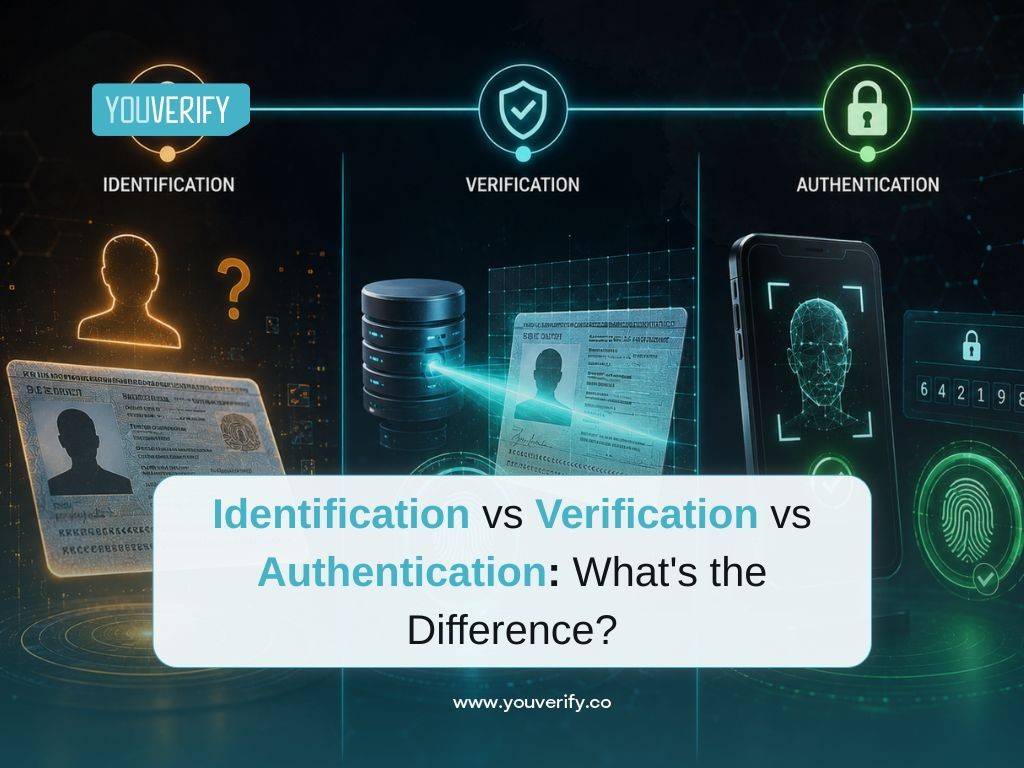
Identification vs Verification vs Authentication: What's the Difference?
ByEmmanuel Agwu (Edited by Favour Praise)
•5mins Read
Key Takeaways
Identification, verification, and authentication each serve a distinct role in the identity verification process, answering "Who are you?", "Can you prove it?", and "Can you access this system?" respectively.
Identity verification combines document verification, biometric verification, and other trusted methods to confirm a user's identity, reduce identity fraud, and support KYC and AML compliance.
Authentication protects verified users by requiring passwords, one-time passwords (OTPs), biometric authentication, or multi-factor authentication (MFA) before granting access to systems or accounts.
Using identification, verification, and authentication together helps businesses strengthen customer onboarding, prevent fraud, protect sensitive information, and deliver secure digital identity management.
Identification, verification, and authentication are terms that are often used interchangeably in cybersecurity, digital identity, and compliance. While they all play a role in establishing and protecting a person's identity, they serve different purposes throughout the identity verification process.
As digital services continue to grow, so does the need for secure identity management. The global identity verification and authentication market was valued at approximately $15.72 billionin 2025 and is projected to reach $28.4 billion by 2029, driven by increasing cybersecurity threats, stricter regulatory requirements, and the rapid adoption of digital financial services.
Understanding the differences between identification, verification, and authentication helps explain how organizations protect users, prevent fraud, and control access to sensitive information.
In this article, you'll learn what identification, verification, and authentication mean, how they differ, how they work together, and why each plays a critical role in modern identity verification.
In short: Identification answers "Who are you?", verification answers "Can you prove it?", and authentication answers "Can you access this system?"
Identification vs Verification vs Authentication at a Glance
Although these terms are closely related, they occur at different stages of the identity verification journey.
Process
Purpose
Question It Answers
Example
Identification
Establishes a person's claimed identity
Who are you?
Entering your name or email address when creating an account
Verification
Confirms the claimed identity is genuine
Can you prove who you are?
Uploading a passport or driver's licence for identity verification
Authentication
Confirms the verified user should be granted access
Are you really the person logging in?
Entering a password, OTP, or using Face ID to access an account
While identification starts the process, verification builds trust in the identity provided, and authentication ensures only authorised users can access systems or services.
What does Identification mean?
Identification is how someone establishes or claims an identity, usually by sharing information that uniquely identifies them.
It's the first step in identity verification. Everything else in the relationship between a user and an organisation builds on it.
That information can be something as simple as a name, email address, phone number, username, or customer ID.
For example, when you create a social media account, you're asked to provide your name, email address, and date of birth. These details are used to identify you and create your profile, but they do not confirm that the information is genuine.
However, identification alone is not enough to grant access to a system or service. Once the user's identity has been established, further steps are required to verify that the user is who they claim to be. That's why identification must be followed by verification, which confirms that the identity being claimed is authentic.
Example: A customer enters their name, email address, and phone number while opening a digital bank account. At this stage, the bank knows who the customer claims to be but it has not yet verified that claim.
Verification is the process of confirming that the identity presented is valid and true. It involves comparing the personal information provided during identification to a reliable source, such as a government-issued ID, passport, or driver's license.
Verification is crucial in situations where the accuracy of the identity is critical, such as opening a bank account or applying for a job.
For example, when opening a bank account, a customer may be asked to upload a government-issued ID and take a selfie. The institution then compares the ID with the person's facial biometrics and validates the document before approving the account.
Unlike identification, verification answers the question:
"Can this person prove they are who they claim to be?"
Modern identity verification solutions often combine several verification methods to improve accuracy and reduce fraud.
Common Identity Verification Methods
The most common identity verification methods include:
1. Document Verification
This involves validating government-issued identity documents, such as passports, national identity cards, driver's licences, or residence permits, to confirm that they are authentic and have not been altered or forged.
2. Biometric Verification
Biometric verification uses unique physical characteristics, such as facial recognition, fingerprints, iris scans, or voice recognition, to match an individual with their identity documents.
3. Knowledge-Based Verification
This method requires users to answer questions that only they should know, such as previous addresses or account-related information. Although still used in some industries, it is becoming less common as biometric verification provides stronger security.
Verification helps organisations reduce identity fraud, comply with KYC and AML regulations, and ensure that only legitimate customers are onboarded.
Authentication is the process of confirming that a verified user is genuinely who they claim to be before granting access to a system, application, or service. Unlike identification, which establishes identity, and verification, which validates it, authentication ensures that the verified person is the one attempting to log in or perform a specific action.
In simple terms, authentication answers the question:
"Can this verified person access this account or system?"
Authentication is used every time a user signs in to an online banking app, accesses a company network, logs into an email account, or approves a digital transaction.
Common Authentication Methods
Authentication relies on one or more authentication factors to confirm a user's identity.
1. Something You Know: This includes information only the user should know, such as: Passwords, PINs, and Security questions
2. Something You Have
This involves a physical device or object the user possesses, such as:
- A mobile phone that receives a one-time password (OTP)
Many organisations now use Multi-Factor Authentication (MFA), which combines two or more authentication factors to provide stronger protection against unauthorised access.
For example, a banking app may require a customer to enter their password (something they know) and approve the login using Face ID or a fingerprint (something they are).
Authentication is the final layer of protection that helps secure accounts, prevent unauthorised access, and reduce the risk of identity fraud.
Identification vs Verification vs Authentication: Key Differences
Although identification, verification, and authentication work together, they each serve a distinct purpose in the identity lifecycle.
The easiest way to understand them is to think of them as three consecutive steps.
Step 1: Identification
The user claims an identity by providing basic information, such as their name, email address, or customer ID.
Question answered: Who are you?
Step 2: Verification
The organisation or business confirms that the claimed identity is genuine by validating identity documents or biometric information against trusted sources.
Question answered: Can you prove who you are?
Step 3: Authentication
The verified user proves they are authorised to access a system by presenting one or more authentication factors.
Question answered: Are you the verified person trying to access this account?
These three processes work together to establish trust, protect sensitive information, and reduce identity fraud.
Identification vs Verification vs Authentication Comparison
How does Identification, Verification, and Authentication Work Together?
Although each process serves a different purpose, they are most effective when used together.
A simple way to understand this is through the customer onboarding process at a bank.
Real-World Example
Imagine a customer opening a bank account online.
Identification
The customer enters their name, email address, phone number, and other personal details to create an account.
↓
Verification
The customer uploads a government-issued ID and completes a facial verification check. The bank validates the identity document, compares the selfie with the ID photo, and confirms the customer's identity.
↓
Authentication
When the customer logs into their online banking account, they enter their password and verify the login using a one-time password (OTP) or biometric authentication.
Each step builds on the previous one. Without identification, there is no identity to verify. Without verification, anyone could impersonate another person. Without authentication, verified users' accounts could still be accessed by unauthorised individuals.
This layered approach is why identification, verification, and authentication are essential components of modern digital identity verification, customer onboarding, and fraud prevention.
Why Identification, Verification, and Authentication Matter in KYC
For regulated industries such as banking, fintech, insurance, and cryptocurrency, identification, verification, and authentication are fundamental to Know Your Customer (KYC) compliance.
During customer onboarding, organisations first identify the customer by collecting personal information. They then verify the customer's identity using trusted documents and biometric verification before authenticating future logins and transactions using passwords, one-time passwords, or biometric authentication.
Using all three processes together helps organisations:
Prevent identity theft and account takeover fraud.
Meet KYC and AML compliance requirements.
Reduce financial crime and onboarding fraud.
Protect sensitive customer information.
Build trust while delivering a secure digital onboarding experience.
Common Misconceptions About Identification, Verification, and Authentication
Because these terms are closely related, they're often used interchangeably. However, misunderstanding them can create security gaps and compliance challenges.
Here are some of the most common misconceptions:
Myth: Identification verifies a person's identity. Fact: Identification only establishes who someone claims to be. It does not prove the claim is genuine.
Myth: Verification and authentication are the same. Fact: Verification confirms an individual's identity, while authentication confirms that the verified individual is authorised to access a system or service.
Myth: Authentication alone prevents identity fraud. Fact: Authentication is only effective after proper identity verification. If a fraudster successfully creates or uses a false identity, authentication alone cannot detect the deception.
Understanding these differences will help you build stronger identity management systems and reduce fraud risks.
Why Businesses Need Identification, Verification, and Authentication
Every organisation that collects customer information or provides digital services relies on identification, verification, and authentication to establish trust and secure user interactions.
In industries such as banking, fintech, insurance, healthcare, telecommunications, and government services, these processes help organisations:
Protect sensitive customer information.
Prevent identity theft and impersonation.
Reduce account takeover and financial fraud.
Meet KYC, AML, and regulatory compliance requirements.
Deliver secure and seamless digital onboarding experiences.
Without all three processes working together, organisations face greater risks of fraud, unauthorised access, and regulatory penalties.
Simplify Identity Verification and Fraud Prevention with Youverify
Youverify helps businesses automate identity verification, customer onboarding, and compliance with AI-powered solutions built for today's digital economy. From document verification and biometric verification to AML screening and fraud detection, our unified platform enables organisations to verify identities with confidence while delivering secure and seamless customer experiences.
Ready to strengthen your KYC and identity verification process? Book a demo and discover how Youverify can help you build faster, safer, and more compliant onboarding workflows.
FAQs
Frequently Asked Questions
Identification is the process of claiming an identity, verification confirms that the identity is genuine, and authentication confirms the verified user can access a system or service.
The correct order is identification, verification, and then authentication. A user first claims an identity, proves it, and finally authenticates to gain access.
No. Identity verification confirms a person's identity using trusted information or documents, while authentication confirms that the verified individual is the one attempting to access an account or system.
Identity verification helps organisations prevent fraud, comply with KYC and AML regulations, protect customer information, and ensure only legitimate users are onboarded.
Yes, but it provides weaker security. For example, logging in with only a username and password authenticates a user but does not verify their real-world identity. For high-risk activities such as opening bank accounts, organisations typically perform identity verification before authentication.
Identification is the process of claiming an identity, such as providing your name or email address. Authentication is the process of proving that you are the verified user before accessing a system, usually by entering a password, OTP, or using biometric authentication.
The most common form of authentication is password-based authentication, where users enter a password or PIN to access an account. However, many organizations now combine passwords with one-time passwords (OTPs) or biometric authentication as part of multi-factor authentication (MFA) for stronger security.